Recruitment bias can undermine fair hiring, innovation, and business success. This guide outlines actionable steps to minimize unconscious bias during hiring, ensuring decisions are based on skills and qualifications rather than subjective factors. Key takeaways include:
- Standardize processes: Use clear, measurable job criteria and consistent evaluation methods.
- Blind screening: Remove names, photos, and other identifiers to focus solely on qualifications.
- Structured interviews: Ask all candidates the same job-relevant questions and use numerical scoring.
- Diverse interview panels: Include members from varied backgrounds to reduce groupthink.
- Skills-based assessments: Test real-world job tasks instead of relying on degrees or experience alone.
- Automate anonymization: Tools like Skillfuel streamline fair evaluations and reduce bias.
- Monitor decisions: Track demographic trends and audit hiring data to identify patterns of bias.
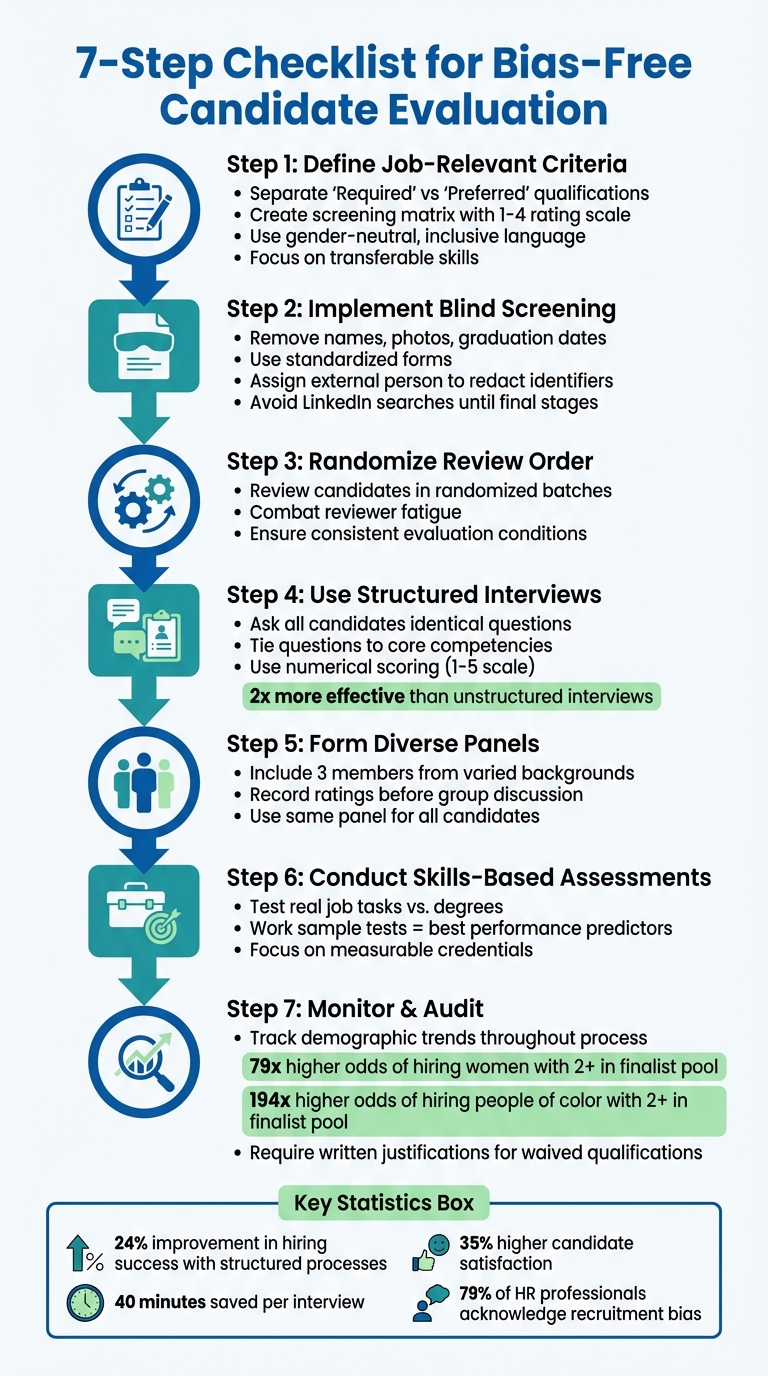
7-Step Checklist for Bias-Free Candidate Evaluation Process
Recruiting Biases and How to Avoid Them
Preparation Steps for Bias-Free Evaluation
Before diving into resume reviews, it’s crucial to lay the groundwork for a fair and consistent hiring process. According to the University of Illinois Chicago, "implicit bias research strongly suggests a need to invest time early in the hiring process for the search committee to reach a shared understanding of the qualifications of the job". Without this shared understanding, evaluators may fall back on subjective judgments, allowing bias to influence decisions before candidates are even considered.
Define Job-Relevant Criteria
Having clear, measurable criteria helps ensure consistency during evaluations. Start by separating "Required" qualifications – non-negotiable skills or experience – from "Preferred" qualifications, which signal potential for higher performance. Each qualification should directly link to specific job duties to justify its inclusion.
Create a screening matrix with a standardized rating scale (e.g., 1 to 4) to evaluate both required and preferred qualifications. For top-priority skills, define what constitutes "strong" performance beyond the minimum requirement before reviewing any applications.
When defining criteria, focus on the role’s actual needs rather than the attributes of the person currently holding the position. Use inclusive, gender-neutral language – write "sales representative" instead of "salesman" – and emphasize present-tense action verbs like "operates" or "performs" to clarify expectations. Additionally, recognize transferable skills from diverse backgrounds to expand your talent pool and allow for greater flexibility in hiring.
Once your criteria are set, take steps to eliminate irrelevant candidate details that might introduce bias.
Implement Blind Screening Practices
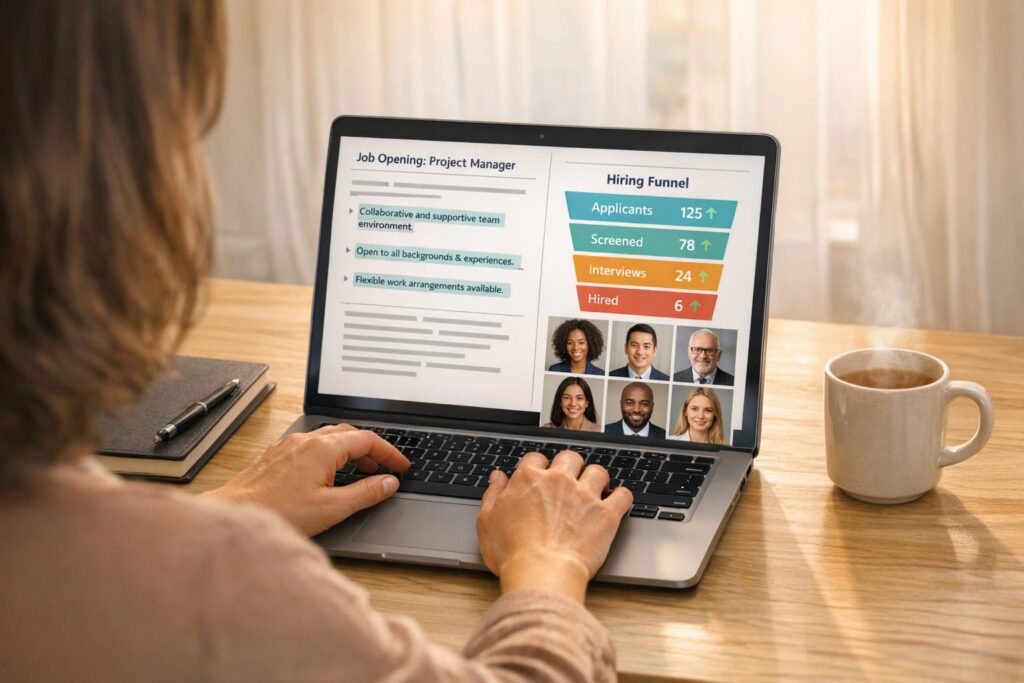
Blind screening ensures evaluators focus only on job-relevant information, minimizing the impact of unconscious bias. For example, names, photos, and graduation dates can trigger biases, even unintentionally. Research supports an "opt-in" framework, where hiring managers actively choose what information to view, as a more effective way to reduce bias compared to providing full resumes upfront. Harvard Business School research also highlights that over 60% of employers reject qualified candidates simply because they lack a college degree, a practice that unfairly introduces socioeconomic and age bias.
To implement blind screening, remove personal identifiers like names, photos, and graduation dates from applications. Use standardized forms to focus solely on job-relevant qualifications. Assign someone outside the hiring team to redact these details before sharing materials with evaluators. Additionally, instruct hiring teams to avoid searching LinkedIn or other social media platforms until candidates reach the final stages of the process.
These steps help create a more objective review process, paving the way for fairer candidate comparisons.
Randomize Candidate Review Order
Even with objective criteria in place, the order in which candidates are reviewed can influence decisions. Reviewer fatigue and unconscious comparisons to the immediately preceding candidate can skew evaluations. Randomizing the order of candidate reviews helps combat these issues.
To maintain consistency, review candidates in randomized batches rather than as they apply. This approach ensures all candidates are evaluated against the same criteria and under similar conditions. By pre-establishing evaluation benchmarks and randomizing the review process, you can reduce variability and focus on assessing candidates fairly.
Screening and Assessment Checklist
Start your screening process by applying consistent, job-specific standards to every candidate. This ensures a fair and objective evaluation process.
Use Consistent, Job-Specific Questions
Catalyst highlights a critical issue in traditional interviews:
"Evidence demonstrates that unstructured interviews – where each candidate is asked questions not consistent across the candidate pool – are riddled with bias".
On the other hand:
"Standardized interviews… ground decisions in equitable, skills-based data".
To create a fairer process, develop a uniform list of questions tied directly to the job’s core competencies. Each question should focus on specific requirements. For instance, instead of asking, "Have you done X before?" try, "How would you approach X?" This phrasing encourages candidates to showcase their problem-solving skills and thought processes.
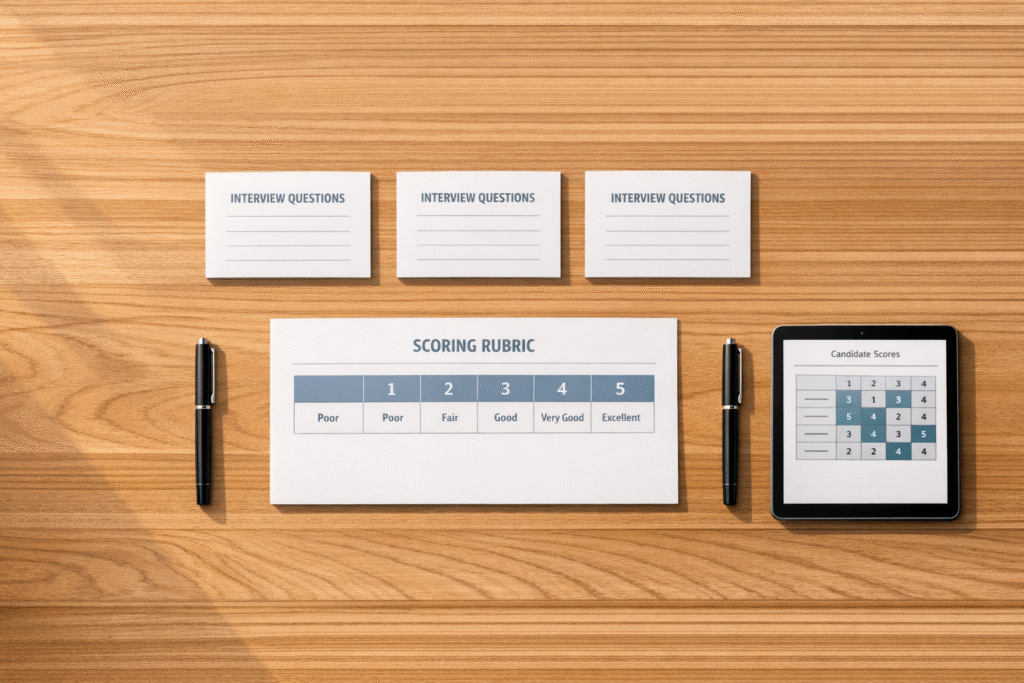
Assign panel members specific questions to ensure all key competencies are covered without overlap. Use a numerical scoring system (e.g., 1 to 5) to evaluate answers immediately, avoiding vague impressions. Let candidates know upfront that everyone will be asked the same questions – this transparency builds trust and sets clear expectations.
The next step is assessing candidates based on their actual skills and qualifications.
Focus on Skills and Qualifications
Evaluate candidates by testing their ability to perform real job tasks rather than relying on proxies like educational degrees. Research shows that work sample tests, which simulate actual job responsibilities, are among the best predictors of future performance. Professor Francesca Gino from Harvard Business School explains:
"A skill test forces employers to critique the quality of a candidate’s work versus unconsciously judging them based on appearance, gender, age, and even personality".
For example, software-based skill tests have proven effective in objectively assessing qualifications. Similarly, VMware’s Chief Legal Officer, Dawn Smith, revamped job descriptions for senior legal roles to emphasize measurable credentials – like years of legal practice and specific government service – over subjective traits. This approach, paired with a diverse candidate pool, resulted in hiring a minority woman for a prominent role. As Smith put it:
"Unconscious biases are so deep inside of us. Unless we identify them and talk about them they are not going to change".
Finally, streamline the process by automating candidate anonymization.
Automate Anonymization with Skillfuel
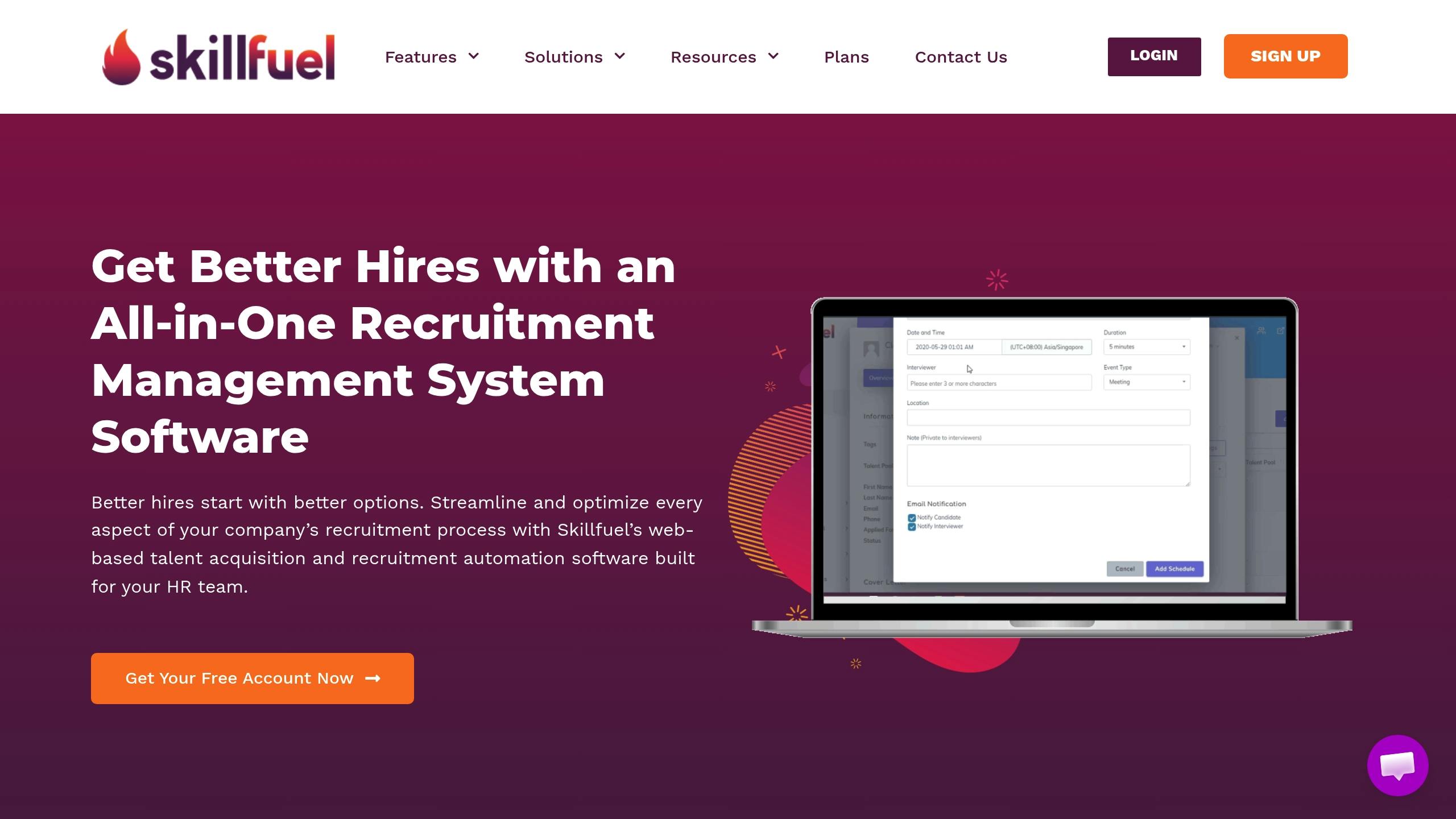
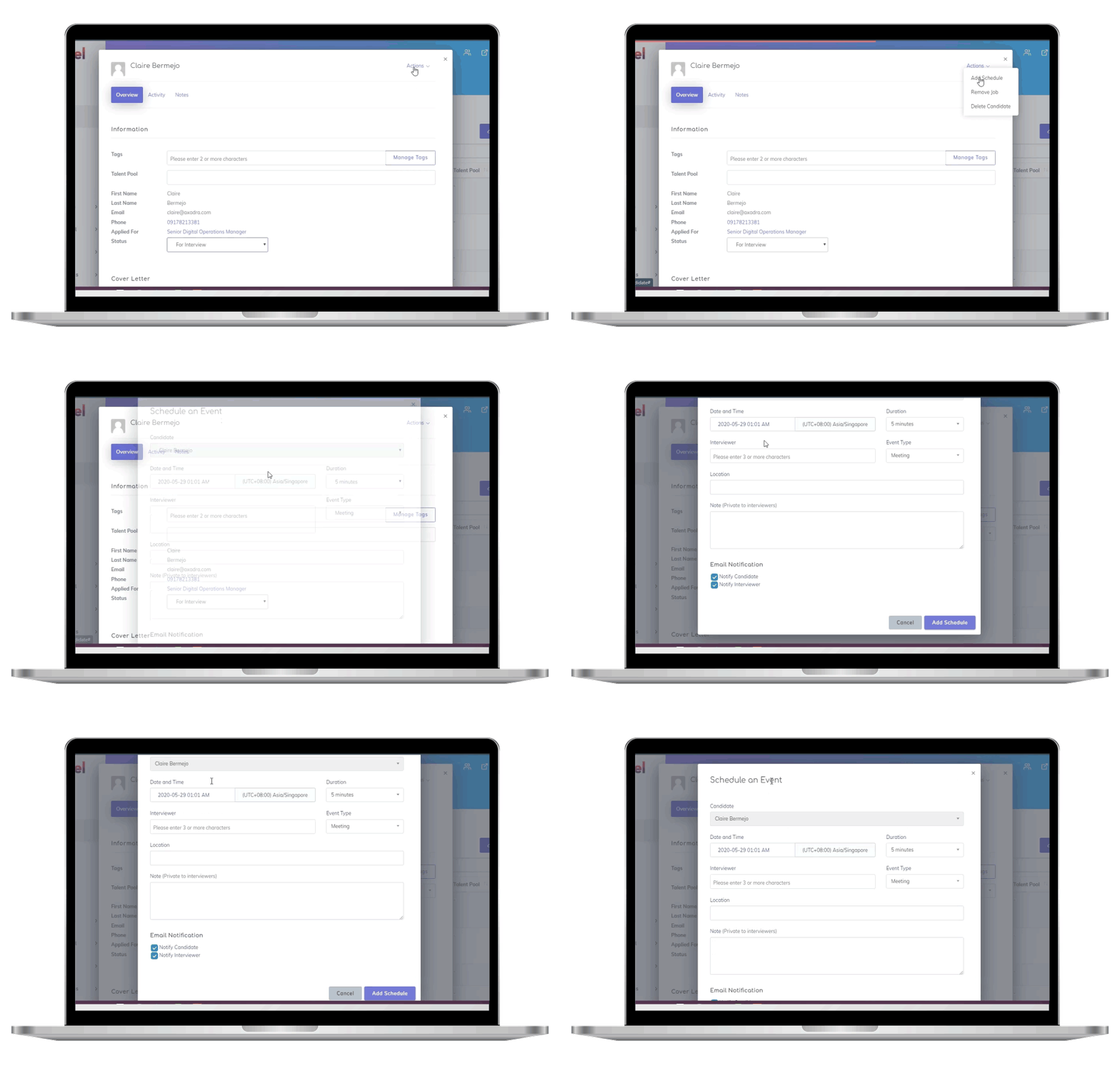
Manual anonymization is time-consuming and prone to error. Skillfuel’s applicant tracking system (ATS) automates this process by concealing names, photos, and dates, ensuring evaluations focus solely on job-relevant criteria.
AI-driven tools can significantly improve outcomes. For instance, AI talent screening can result in 2x better matches, create a 20% fairer process, and save up to 90% of the time spent on screening. MeVitae elaborates:
"Employers and AI use anonymized candidate profiles to minimize algorithmic and cognitive bias".
Moreover:
"We remove the AI black-box by highlighting evidence, in the candidate’s application, to show whether requirements are met and the candidate is a good fit".
Skillfuel’s centralized dashboard simplifies team collaboration by allowing evaluators to review candidates against standardized criteria. The system prioritizes measurable skills and work samples over traditional credentials, while still leaving room for human judgment in later stages. This combination of automation and human input ensures a screening process that is both efficient and equitable.
Interview Process Checklist
After completing standardized and anonymized screenings, it’s essential to maintain objectivity during the interview stage. First impressions can often skew decision-making, so a structured approach is key to minimizing these biases.
Form Diverse Interview Panels
Building on objective pre-screening, structuring interviews thoughtfully can further reduce bias. A diverse panel brings a range of perspectives and helps prevent groupthink. As Mass.gov highlights:
"Having a team that consists of culturally diverse members will increase the richness of the perspective that the panel can provide".
A three-member panel works well – it’s small enough to stay focused but large enough to provide varied viewpoints. Include individuals from different roles, such as a supervisor, a peer, and someone from the Diversity Office. This mix helps counteract affinity bias, where interviewers might unconsciously favor candidates who resemble themselves.
To keep evaluations fair, have each panelist record their numerical ratings immediately after the interview, before discussing impressions with the team. Catalyst notes that premature discussions can allow dominant voices to influence others. Consistency is also important – use the same panel members for all candidates applying to the same position to ensure fairness.
Conduct Structured Interviews
Structured interviews are twice as effective as unstructured ones in predicting job performance. To maximize this effectiveness, ask all candidates the same set of predetermined questions in the same order, ensuring each question ties back to specific job competencies identified during preparation.
Transparency is crucial. Share the agenda, interviewer details, and questions with candidates in advance. This approach is particularly helpful for candidates with disabilities, as it provides them with time to prepare. For virtual interviews, encourage candidates to use neutral backgrounds for consistency.
Assign specific questions to individual panel members to avoid redundancy and ensure all competencies are addressed. One panelist should manage the flow of the interview, handle introductions, and keep everything on schedule. This methodical process builds on the fairness established during the screening phase.
Document Responses Objectively
During interviews, focus on recording factual, criteria-based notes. Use a behavior-based rating scale (e.g., 1–5) to score each response immediately after it’s given.
Dr. Melissa Harrell from Google People Analytics emphasizes:
"Structured interviews are one of the best tools we have to identify the strongest job candidates (i.e., predictive validity). Not only that, they avoid the pitfalls of some of the other common methods".
Standardized rubrics not only improve accuracy but also save time – each interview takes, on average, 40 minutes less. Additionally, rejected candidates who went through structured processes reported being 35% more satisfied with their experience. Tools like Skillfuel’s centralized dashboard make it easy for panel members to document evaluations digitally, ensuring all ratings are finalized before group discussions begin.
sbb-itb-e5b9d13
Decision-Making and Review Checklist
Once you’ve completed structured interviews, it’s time to approach the final hiring decision with the same level of discipline. This stage can be tricky because biases often creep back in when decisions rely on gut instincts or casual discussions instead of solid, documented evidence.
Base Decisions on Objective Data
After wrapping up the interviews, shift your focus from subjective impressions to measurable evaluations. Review each panelist’s scoring rubric, and ensure interviewers finalize their ratings within 24 hours to avoid memory distortions. When the hiring committee meets, start by discussing each candidate’s strengths, then address specific skill gaps in relation to the criteria you outlined earlier.
Organizations that rely on structured evaluation processes report a 24% improvement in hiring success. To make fair decisions, weight competencies appropriately, define clear rating distinctions ahead of time, and back up every conclusion with evidence. As The Management Center puts it:
"Bias is like dental plaque. It’s barely detectable at first, but the longer you ignore it, the worse it gets – sometimes causing permanent damage".
Standardize Reference Checks
Once internal evaluations are complete, validate your assessments externally with standardized reference checks. Ask consistent, job-relevant questions for every candidate, focusing on their performance, skills, and behaviors rather than personal traits. It’s best for hiring managers to conduct these checks over the phone, as verbal conversations often reveal nuances that emails miss.
Use open-ended questions like, "What was it like to work with this candidate?" instead of simple yes/no inquiries. Confirm employment dates and cross-check references through official channels. This step is crucial because 64.2% of employees have lied on their resumes, and 16.7% of job seekers admit to providing fake references. As WorkBright recommends:
"The best rule is to ask questions directly related to job performance – assessing the candidate’s ability to do the job to make the best hiring decision possible is the goal".
Monitor and Audit for Bias
Analyzing diversity metrics throughout your hiring process can uncover patterns that individual decisions might overlook. Track demographic trends from application submissions to resume reviews, interviews, and final offers. Check if average ratings differ across demographic groups to spot whether certain candidates face tougher standards.
Look for trends where representation increases at later stages. For example, having at least two women in the finalist pool increases the odds of hiring a woman by 79 times, while having two people of color boosts the odds of hiring a person of color by 194 times. Additionally, audit referral programs, as they often mirror existing organizational demographics.
Incorporate trained Bias Interrupters to identify and tackle biases. Require written justifications whenever pre-established qualifications are waived for a candidate, and revisit hiring rubrics regularly to ensure they promote fairness. As Bias Interrupters explains:
"Interrupting bias is an iterative process – you may need to make several rounds of changes".
Using Skillfuel Tools for Bias Mitigation
Skillfuel’s recruitment management platform is designed to help you maintain fairness and consistency in your hiring process. By offering tools that support objective decision-making, it reduces the impact of unconscious bias at every stage. These features integrate effortlessly with your existing systems, ensuring a structured and impartial approach.
Automate Workflows with Kanban Boards
Skillfuel’s Kanban-style workflows guide every candidate through the same evaluation process with pre-set criteria. This structure eliminates inconsistent treatment, one of the most common sources of bias. By standardizing the journey from initial screening to final offer, you create a level playing field for all applicants.
Danielle Harders, Director of Global Business Recruiting at Brex, highlights the benefits of this approach:
"Having these structured rubrics has helped interviewers feel a lot more confident in their decision making. We can move from gut feel to concrete data".
Automating workflows not only reduces subjectivity but also shifts the focus to measurable, data-driven outcomes.
Centralized Dashboards for Team Collaboration
Skillfuel’s centralized dashboard brings all candidate information – files, interview notes, and scores – into one place. This shared access ensures that team members have consistent, transparent data for objective decision-making. The platform also includes tools for collaborative discussions, enabling panels to compare candidates side-by-side using clear criteria. Filtered search functions make it easy to evaluate qualifications quickly and fairly.
Given that 79% of HR professionals acknowledge bias in recruitment, this data-driven approach helps teams identify and address discrepancies, such as variations in ratings across demographic groups.
Customizable Career Pages for Diverse Hiring
First impressions matter, and Skillfuel’s customizable career pages are designed to promote inclusive hiring from the start. By using gender-neutral language and avoiding exclusionary terms like "digital native" or "rockstar", you can attract a broader range of candidates. Research shows that roles advertised with inclusive language can be filled up to 14 days faster than those with biased phrasing. Additionally, with 86% of job seekers valuing diversity when evaluating employers, showcasing your DEI (Diversity, Equity, and Inclusion) commitments on these pages signals a genuine effort toward inclusion.
The platform also supports accessibility features like dyslexia-friendly fonts and mobile-first designs, ensuring that candidates with diverse abilities and varying levels of tech access can navigate the application process with ease.
Conclusion
Creating a hiring process free from bias is essential for building fair and effective teams.
Key Takeaways
To achieve this, you need structured practices at every step. Start by defining criteria focused on job relevance and use blind screening to remove details like names or graduation dates that could introduce bias. Conduct structured interviews with standardized questions for all candidates, and evaluate answers using consistent rubrics instead of relying on instinct.
Bringing in diverse interview panels can help minimize individual biases, while skills-based assessments offer better insights into a candidate’s potential than traditional metrics like college degrees. Tools like Skillfuel streamline this process with features such as Kanban workflows and centralized dashboards, helping your team stay consistent and transparent.
Stick to these practices to refine and strengthen your hiring process over time.
Commitment to Continuous Improvement
Addressing bias is an ongoing effort. As Dawn Smith, Chief Legal Officer at VMware, explains:
"Unconscious biases are deeply ingrained. Unless we identify them and talk about them they are not going to change".
Regularly review hiring data to identify areas where bias might creep in. Track candidate demographics and compare ratings across groups to ensure fairness. With the World Economic Forum predicting that up to 50% of job-required skills could shift by 2027, updating your processes regularly is critical. Skillfuel simplifies this by letting you monitor trends and make data-driven adjustments, reinforcing the structured practices mentioned earlier.
It’s worth noting that companies in the top quartile for ethnic and racial diversity in management are 33% more likely to outperform their peers in profitability.
FAQs
What is blind screening, and how does it help reduce bias in hiring?
Blind screening is a hiring method that removes personal details – like names, gender, or other identifying information – from candidate applications. This approach ensures that hiring decisions are based purely on qualifications, skills, and experience, reducing the impact of conscious or unconscious biases.
By concentrating solely on objective factors, blind screening helps create a fairer hiring process. It allows HR teams to focus on finding the most qualified candidates without being influenced by irrelevant external factors.
How do diverse interview panels help reduce bias in hiring?
Including a mix of interviewers from various backgrounds – different ages, gender identities, races, skills, and experiences – is a powerful way to cut down on bias during the hiring process. This diversity helps counter unconscious biases, such as affinity bias or in-group favoritism, which can easily creep into decisions when panels are too homogenous.
When interview panels bring together different perspectives, the result is a more balanced and accurate evaluation of candidates. Beyond fairness, this approach signals the company’s dedication to diversity and inclusion, which can make a strong, positive impression on job seekers. It also reduces the risk of groupthink, encouraging a more comprehensive review of how candidates align with the company’s culture and goals. The outcome? More equitable and thoughtful hiring decisions.
Why are skills-based assessments better for evaluating candidates?
Skills-based assessments stand out because they emphasize a candidate’s actual abilities and hands-on experience instead of traditional markers like degrees or job titles. This shift helps minimize unconscious bias, leading to a more impartial and objective evaluation process.
By focusing on proven skills, employers can pinpoint the best-fit candidates while creating a hiring process that’s more inclusive. This approach not only promotes diversity but also ensures that hiring decisions are grounded in merit.