
Fourteen Forbes Human Resources Council members published onboarding strategies August 4 positioning the first 90 days as the retention decision window, with recommendations spanning 90-day roadmaps, AI-plus-human buddy systems, and pre-boarding protocols that start before day one, according to guidance published on Forbes.
TL;DR: Forbes Human Resources Council members published 14 onboarding strategies August 4, framing the first 90 days as the period when retention is decided and recommending structured roadmaps, continuous feedback, and hybrid AI-human support systems.
The council post consolidates practitioner guidance from HR executives across enterprise and mid-market organizations, each framing onboarding as a multi-month integration process rather than a single-day orientation event. The strategies address four core employee needs during the first quarter: role expectations, workplace navigation, relationship building, and manager connection.
Council Members Frame Week Two as Retention Inflection Point
Ritu Mohanka, an executive at VONQ, stated that “retention is decided in week two, not month six,” positioning early-stage engagement as the primary retention lever. The framework challenges what Mohanka described as logistics-only onboarding that “stops at paperwork.”
Smiti Bhatt Deorah of AdvantageClub.ai emphasized recognition timing, stating that “when a new hire’s early contributions are noticed and connected to their growth path, they settle in faster.” The council post identifies the first 90 days as the period that “shapes everything” for long-term retention outcomes.
Amy Cappellanti-Wolf of Dayforce specified that onboarding “begins before an employee’s first day and continues through the initial months,” establishing pre-boarding and extended integration as standard practice. The guidance frames this timeline as necessary for building what she described as “confidence, connections and a sense of purpose.”
Four-Need Framework and 90-Day Roadmap Structure
Connie White of Altos Labs outlined four core employee needs that onboarding must address: knowing role expectations, understanding coworkers they will work with most closely, navigating organizational norms, and building manager relationships. White stated that “successful onboarding needs to include all of those aspects so a new employee can contribute quickly and well.”
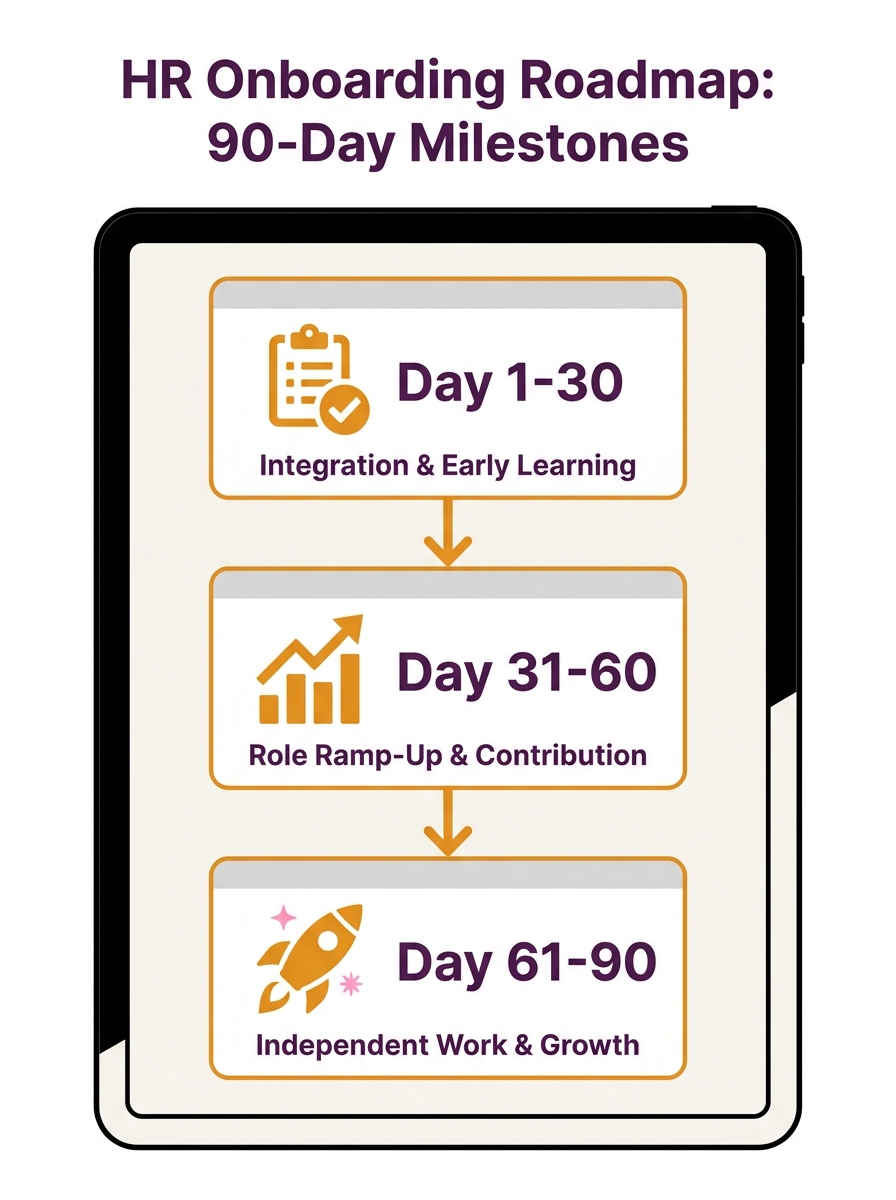
Shashank Bhushan of Amagi Corp recommended giving new hires “a clear 90-day roadmap, early access to mentors and role-specific learning paths,” positioning clarity and support as retention drivers. The roadmap approach aligns with guidance from Sheena Minhas of ST Microelectronics, who specified “clear 30-60-90 goals” as part of belonging-focused onboarding.
Dr. Nara Ringrose of Cyclife UK Limited positioned onboarding as “a strategic process that incorporates regular feedback, clearly defined probationary goals, training and opportunities for open and constructive communication.” The feedback emphasis appears in multiple council member strategies.
This framework extends employee onboarding beyond single-day orientation into a structured 90-day integration cycle, matching guidance from HR software providers who define onboarding as a multi-phase process.
AI-Human Hybrid Support and Personalization Tactics
Dr. Timothy J. Giardino of myWorkforceAgents.ai recommended pairing each new hire with “both a human onboarding buddy and an agentic AI guide,” positioning the combination as continuous knowledge transfer. The AI component provides 24/7 policy support while the human buddy “builds connection, judgment and cultural trust,” according to the guidance.
Sherrie Suski of Tricon emphasized personalization over process, describing onboarding as “not a check-the-box exercise.” Suski recounted a case where Tricon’s director of employee engagement ordered a case of a new hire’s preferred soda brand after learning he couldn’t find it in California. The employee’s response: “I am never leaving this company.”
The personalization approach contrasts with what Minhas described as “day-one friction” caused by tools not being ready or pre-boarding steps skipped. Minhas specified that pre-boarding should include “welcome from the team” and “tools ready and available.”
Extended Learning and Manager Engagement
Nicky Hancock of AMS positioned onboarding as extending “well beyond an employee’s first few weeks,” recommending continuous learning, mentorship, and career development as retention mechanisms. The guidance frames ongoing manager support and regular HR engagement as improving “retention, engagement and career mobility.”
The manager relationship component appears across multiple strategies. Minhas specified “manager one-on-ones from week one” as part of onboarding infrastructure. Cappellanti-Wolf identified “regular manager check-ins” and “visibility into career growth opportunities” as factors that keep employees engaged when they “understand how their role contributes to organizational success.”
The extended timeline and manager-engagement emphasis align with applicant tracking system workflows that track new hire milestones beyond the hiring close date, extending recruitment platform oversight into early retention phases.
Why This Matters Now
The Forbes council framework arrives as organizations confront persistent retention challenges in tight labor markets where replacement costs continue to rise. The shift from orientation-day onboarding to 90-day integration processes reflects practitioner recognition that early-stage employee experience determines long-term tenure outcomes.
The council members’ emphasis on week-two retention decisions and first-90-day roadmaps positions onboarding as a structured process requiring cross-functional coordination between HR, hiring managers, and IT teams preparing tools and access. For HR teams evaluating onboarding workflows, the framework identifies four measurable components—role clarity, relationship building, workplace navigation, and manager connection—that can be tracked through probationary periods.
The hybrid AI-human support model and personalization tactics represent tactical implementations that HR teams can deploy without full platform overhauls. The guidance frames onboarding investment as directly tied to retention ROI, making it a priority line item for talent acquisition leads managing hiring budgets in 2026.