
Recruiting with social media is no longer optional – it’s essential. With 92% of companies using platforms like LinkedIn, Instagram, and TikTok to find talent, social media helps you connect with both active job seekers and passive candidates scrolling through their feeds. It’s also a cost-effective way to showcase your company’s personality and attract top talent. Here’s how to get started:
- Set clear goals: Define what success looks like with measurable KPIs like cost-per-hire, engagement rates, or retention.
- Pick the right platforms: LinkedIn works for professionals, TikTok for Gen Z, and Instagram for early-career candidates.
- Plan your content: Mix job posts with behind-the-scenes stories, employee spotlights, and industry insights.
- Invest in paid ads: Target specific skills, job titles, or locations to reach passive candidates.
- Build a talent community: Engage followers with meaningful content and create spaces for interaction.
- Track and adjust: Use data to refine your strategy and focus on what works.
Social media recruitment is about more than just posting jobs – it’s about building relationships and creating a strong online presence that resonates with potential candidates.
The Most Effective Social Media Recruitment Campaign Strategy
sbb-itb-e5b9d13
Step 1: Set Your Recruitment Goals and Metrics
Before diving into posting jobs on social media, it’s important to have a clear sense of what you want to achieve. A solid social recruiting strategy starts with understanding your challenges and defining measurable goals for success.
Identify Your Recruitment Challenges
Take a close look at your hiring process. Review metrics like cost-per-hire, time-to-fill, and 90-day retention rates to pinpoint gaps in your current approach. For instance, are you struggling to connect with passive candidates who aren’t actively job hunting? Or maybe your recruitment costs are higher than expected – traditional job boards average $4,700 per hire, while social media recruitment typically costs between $1,000 and $2,000.
Think ahead to your hiring needs for the next six months. Which positions are the most urgent? Are there specific skills that have historically been tough to find? Tools on specialized platforms can help verify candidate skills early in the process, streamlining your efforts. Social media can also address common challenges by speeding up hiring timelines (20–30 days compared to 65+ days), improving candidate quality through better alignment with your company’s culture, and boosting your employer brand.
Once you’ve identified the challenges, you’ll be in a better position to set measurable goals for your social recruiting efforts.
Set Measurable KPIs
After identifying your challenges, focus on setting SMART goals – Specific, Measurable, Achievable, Relevant, and Time-bound. Companies using SMART goals are 376% more likely to achieve success. For example, you might aim for something like: "Increase LinkedIn engagement rate from 2% to 5% by the end of Q1".
"Recruitment success in social media isn’t about impressive numbers in isolation – it’s about whether your social presence is actually helping you attract and hire the right talent."
– PeopleScout
Organize your KPIs into three main categories:
- Awareness: Metrics like reach, impressions, and follower growth.
- Engagement: Actions such as clicks to career pages, comments, and shares.
- Impact: Outcomes like applications from social platforms, quality of hires, and cost-per-hire.
To assess applicant quality, compare the interview performance and assessment scores of candidates sourced through social media to those from other channels. Use UTM parameters on your social links to track which platforms and content types generate the most traffic and high-quality applications. Go beyond counting applications – focus on metrics like the percentage of social-sourced candidates who pass initial screenings, their offer acceptance rates, and their 90-day retention. Social hires often outperform traditional methods in retention, averaging 85% versus 65%.
Step 2: Select the Right Social Media Platforms
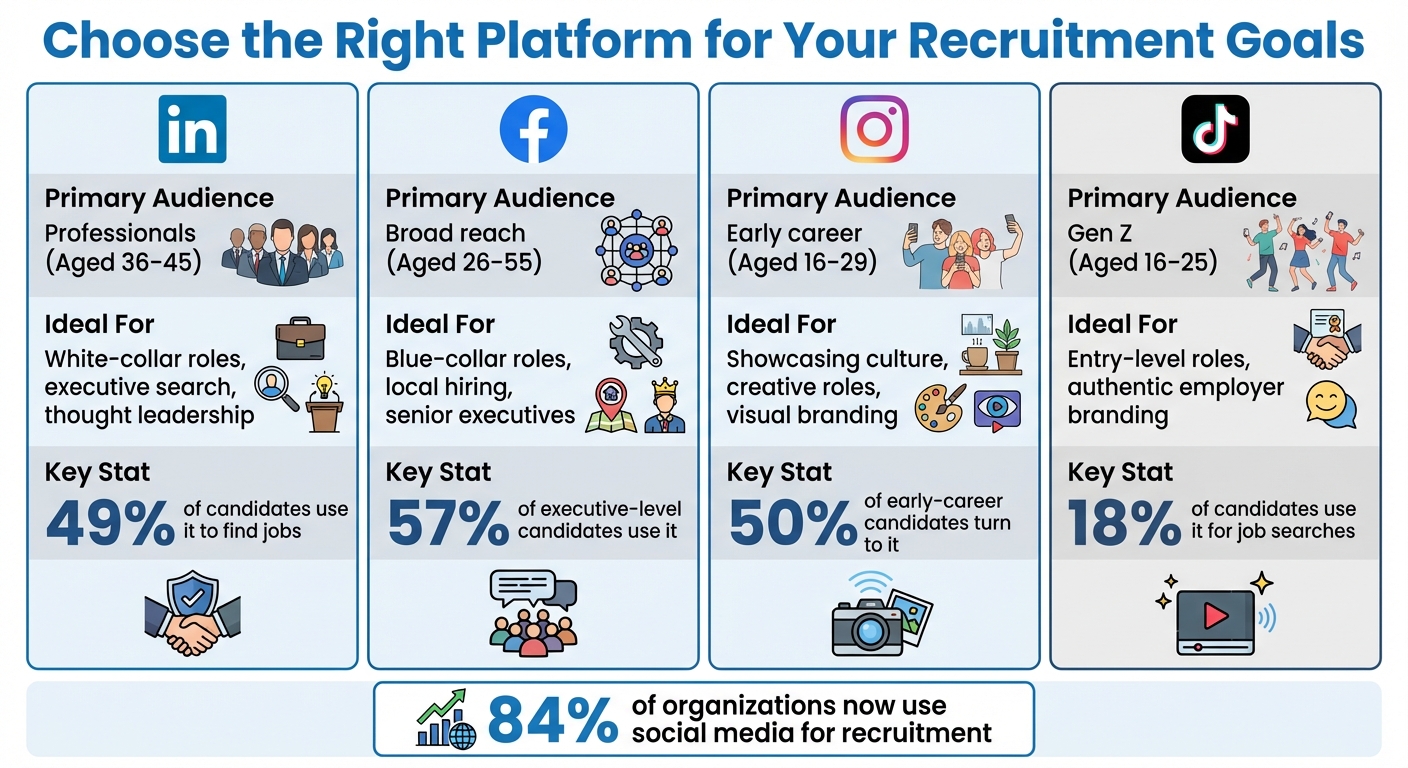
Social Media Platform Comparison for Recruitment: Audience, Use Cases, and Statistics
Social media platforms each bring their own strengths to the recruiting table, making them better suited for certain roles and demographics. With 84% of organizations now leveraging social media for recruitment, the trick lies in aligning the platform’s unique features with your target candidates and the roles you’re hiring for.
Don’t treat all platforms the same – what works on LinkedIn may flop on TikTok or feel out of place on Facebook. As PeopleScout puts it, "What resonates on LinkedIn falls flat on TikTok and feels out of place on Facebook". Each platform has its own audience, culture, and expectations, and your recruitment content should reflect that. By tailoring your approach, you can identify the platforms that align best with your hiring goals and craft strategies specific to each one.
| Platform | Primary Audience | Ideal For | Key Stat |
|---|---|---|---|
| Professionals (Aged 36–45) | White-collar roles, executive search, thought leadership | 49% of candidates use it to find jobs | |
| Broad reach (Aged 26–55) | Blue-collar roles, local hiring, senior executives | 57% of executive-level candidates use it | |
| Early career (Aged 16–29) | Showcasing culture, creative roles, visual branding | 50% of early-career candidates turn to it | |
| TikTok | Gen Z (Aged 16–25) | Entry-level roles, authentic employer branding | 18% of candidates use it for job searches |
To maximize your efforts, create detailed candidate personas. Think about their workplace habits, technical skills, and even hobbies – this will help you zero in on the platforms they frequent most. This prep work ensures your time and resources are focused on the channels where your ideal candidates are actually active.
LinkedIn for Professional Recruiting
LinkedIn is the go-to platform for recruiting experienced professionals and building your company’s credibility in the industry. With 1.2 billion users and nearly half of candidates using it for job searches, LinkedIn is a powerhouse for corporate, technical, and leadership-level hiring.
"Every five posts you have, one should be a job. The rest should be more stuff about why you want to come work there… because there are too many jobs already on social media."
– Chris Russell, Founder of RecTech Media
To stand out, share content that offers value – industry insights, employee success stories, and company milestones. This builds trust and positions your company as a desirable place to work before you even post a job opening.
LinkedIn’s targeting tools are especially helpful for reaching passive candidates. You can filter by job title, skills, and even company size. Posts mentioning AI, for instance, attract 17% more applications. Using unique tracking links for each post also allows you to measure what content resonates most with potential applicants.
Instagram, Facebook, and TikTok for Company Culture
If you want to highlight your company culture, visual platforms like Instagram, Facebook, and TikTok are your best bet. They’re particularly effective for engaging younger audiences and candidates for roles where personality and cultural fit matter as much as skills.
Instagram, with over 2 billion monthly active users, is a favorite for early-career candidates – 50% of them use it during their job search. Use Stories, Reels, and employee takeovers to share authentic, behind-the-scenes content. Polished videos are great, but employee-driven content tends to feel more genuine and relatable.
Facebook, on the other hand, offers a broad reach with 3.07 billion monthly active users. It’s especially useful for local hiring, blue-collar roles, and senior executive recruitment. Community groups and localized targeting can make your job posts even more effective. In fact, 57% of executive-level candidates report using Facebook in their job search.
For Gen Z, TikTok reigns supreme. With 1.59 billion monthly active users, 18% of candidates use it for job searches. Plus, nearly 40% of Gen Z prefer social media over traditional job boards. A standout example is Chipotle’s #ChipotleHire campaign, which invited candidates to submit video resumes. The campaign not only created buzz but also gave hiring managers a glimpse of candidates’ personalities and cultural fit before formal interviews.
Step 3: Plan Your Recruitment Content
Now that your recruitment goals are clear and you’ve chosen your platforms, it’s time to map out content that will grab candidates’ attention. The key is to tailor your content to match the tone and audience of each platform you’re using.
Here’s the thing: job ads alone won’t cut it. To truly connect with potential candidates, you need to mix things up. A good rule of thumb? For every five posts, only one should be a direct job ad. The rest should focus on showcasing your company’s personality – think employee stories, company updates, and snapshots of your workplace culture. This keeps your social media engaging rather than feeling like a constant sales pitch.
Your content strategy should include a variety of posts, such as employee spotlights that highlight career journeys, behind-the-scenes looks at daily work life, industry updates to establish your expertise, and posts about community involvement to reflect your values. Keep in mind that video content tends to perform much better – on Facebook and Instagram, it gets five times the engagement of static images. And since 75% of job seekers check out a company’s social media presence before applying, every post matters. Let’s dive into how to balance your content and empower your team to share their stories.
Create a Balanced Content Mix
Different platforms call for different types of content. For example, Instagram and TikTok are perfect for behind-the-scenes content like team celebrations, office tours, or day-in-the-life videos – especially if you’re targeting younger candidates. Meanwhile, LinkedIn is the go-to spot for sharing professional insights and thought leadership.
Interactive content is another great way to boost engagement. Use LinkedIn polls to ask followers about their favorite job perks, or host live Q&A sessions on Instagram where candidates can ask recruiters anything. Welcoming new hires with a photo and short Q&A is also a fun way to humanize your team and create shareable content.
Don’t forget to create a signature hashtag, like #LifeAtYourCompany. This makes your recruitment content easy to find and helps tie your posts together across different platforms.
Turn Employees into Content Contributors
One of the most effective ways to build trust with candidates is through employee-generated content. It’s simple: people trust people. Posts shared by employees get eight times more engagement and are reshared 24 times more often than those from official company accounts. Plus, candidates are 65% more likely to consider a job if they hear about it from someone they know rather than through a corporate ad.
Start small, with six to ten employees who are comfortable on camera and excited to participate. Give them basic guidelines on things like lighting and camera angles, but let them have creative freedom to keep things authentic. Provide tools like microphones, tripods, and ring lights, and offer editing support if needed.
"Think like a director-producer, not just a marketer. The people that are part of your program aren’t just people who work for your organization – they are talent, creators, influencers."
– Jamia Kenan, Social Media Strategist, Sprout Social
To make it easier for employees to join in, offer pre-written templates or “fill-in-the-blank” social media posts they can quickly personalize. You can also create a resource hub (using tools like Notion) with tips, post ideas, and how-to videos. Hosting "Lunch & Learn" sessions can help employees feel more confident about creating content and understanding platform algorithms.
Here’s an example of what’s possible: In 2025, Sprout Social expanded its Employee Creative Network from a small six-person pilot program to a global initiative involving 100 employees. This effort boosted video production by 47% year-over-year, and employee-generated content made up just 8% of their total content mix but drove an impressive 29.5% of all video impressions – a 680% increase in video impact.
Encourage participation by showing employees how sharing content can enhance their personal brands and career visibility. As Carmen Vicente, Social Media Manager at Gorgias, explains:
"People understand how important career visibility is in today’s age, so once we make that connection, participation seems to flow".
For a more streamlined approach, tools like Skillfuel (https://skillfuel.com) can help you align your social media recruitment efforts with your overall hiring strategy.
Step 4: Use Paid Social Media Advertising
Once you’ve mapped out your content strategy, it’s time to amplify your reach with paid social media advertising. Organic posts are great but limited – they primarily engage your existing followers. To connect with passive candidates – those who aren’t actively searching for jobs but might be intrigued by the right opportunity – you need to invest in paid ads. Here’s why: 73% of potential candidates are passive job seekers who won’t be browsing job boards but can still be reached via social media.
Paid social ads allow for precise targeting. Instead of casting a wide net, you can zero in on candidates based on job titles, skills, locations, and even interests. For example, LinkedIn is excellent for reaching corporate professionals using filters like seniority level and industry. On the other hand, Facebook excels at interest-based targeting, making it a great option for connecting with frontline workers in fields like healthcare, retail, or logistics.
If you’re just getting started, a budget of $100–$500 per month can go a long way. Focus on one or two key roles and use tight geographic targeting, like a 15-mile radius around your office. With a medium budget of $500–$5,000, you can expand to multiple campaigns, allocating about 70% to direct response ads (to drive applications) and 30% to awareness ads (to build your employer brand). Larger budgets allow for more comprehensive strategies, starting with broad awareness and ending with retargeting campaigns.
When advertising on Meta platforms (Facebook and Instagram), make sure to use the "Employment" Special Ad Category to comply with anti-discrimination rules.
Target Your Ideal Candidates
Success hinges on knowing exactly who you’re trying to reach. Think of this as building a candidate persona – essentially a recruitment version of a buyer persona. Include details like demographics, skills, job history, interests, and even personality traits.
Different platforms shine in different ways. LinkedIn uses its professional profile data to target candidates by job title, skills, education, or even niche professional groups. Facebook and Instagram, on the other hand, offer psychographic targeting, focusing on interests, activities, and online behaviors [34, 35]. You can also leverage lookalike audiences by uploading a list of top-performing past hires or high-quality applicants. This helps you scale your reach without sacrificing quality. For highly specialized roles, platforms like Quora allow you to target users based on the specific questions they’ve asked or topics they follow.
Use Retargeting Tools
It often takes more than 10 touches before a candidate takes action, like submitting an application. That’s where retargeting comes in. By installing tools like the Facebook Pixel or LinkedIn Insight Tag on your careers page, you can track site visitors and show them tailored job ads after they leave [34, 36].
"If you’re not retargeting, you’re leaving money on the table. If someone has… visited your website… they’ve essentially raised their hand to say ‘I’m interested’."
– Gavin Bell, Founder, Blue 16 Media
Use custom audiences to retarget candidates based on their behavior. For instance, show ads to those who visited a job category page but didn’t apply or started an application but didn’t finish [42, 43]. Serve them content that addresses potential concerns – like employee testimonials, behind-the-scenes videos, or benefits highlights [36, 43].
Two things to keep in mind: First, set frequency caps to avoid bombarding candidates with the same ad more than 3–5 times – overexposure can waste your budget and annoy potential applicants [34, 37]. Second, exclude candidates who have already applied from your retargeting lists.
For a seamless experience, consider using Lead Generation Ads with pre-filled forms that pull contact information directly from a candidate’s profile. This reduces friction, especially for mobile users who might abandon a lengthy application process. Monitor frequency metrics closely – if someone sees your ad more than five times, it’s time to reassess your spending.
Skillfuel (https://skillfuel.com) can help integrate these paid social strategies into your broader recruitment efforts, ensuring your ad dollars lead to quality hires. These targeted campaigns lay the groundwork for building a strong talent pipeline in the next phase.
Step 5: Build a Talent Community
Paid ads can bring candidates to your doorstep, but a talent community – a network of active and passive professionals – keeps them engaged long after that initial interaction. Unlike a traditional talent pool, which consists of actively screened candidates, a talent community includes those who may not be actively job hunting but still choose to stay connected with your brand.
The secret to maintaining a vibrant talent community lies in offering consistent value beyond job postings. Share content like industry updates, career tips, and behind-the-scenes looks at your workplace. A good rule of thumb is the 80/20 rule: focus 80% of your content on employer branding and insights, and reserve 20% for job postings. For example, L’Oréal runs a dedicated Facebook page that highlights company culture and employee experiences. This strategy strengthens their employer brand, which can lower cost-per-hire by as much as 43%. With this approach, you’re not just building a community – you’re laying the groundwork for long-term candidate relationships.
Create Groups for Candidate Engagement
To make your talent community more interactive, create spaces where candidates can connect and engage. Platforms like LinkedIn and Facebook are perfect for setting up dedicated groups where potential candidates can interact with your team and each other. These groups act as virtual hubs where recruiters can share industry news, moderate discussions, and establish themselves as thought leaders. For instance, Salesforce uses the hashtag #SalesforceOhana on Instagram to showcase employee stories and achievements, promoting its inclusive "family" culture. You can also organize your community into smaller groups based on job titles, interests, or experience levels to deliver more targeted and relevant content.
Engage with Candidates Regularly
A thriving community requires consistent and meaningful interaction. Encourage your recruiters to actively participate by answering questions, commenting on posts, and joining discussions. This two-way communication helps build genuine connections. Hosting live Q&A sessions or "Ask Me Anything" events on platforms like Facebook, Instagram, or LinkedIn once or twice a month is another great way to engage in real-time and share insights about your company culture.
Make sure to respond promptly to private messages to reinforce your brand’s accessibility. Additionally, your current employees can play a big role as brand ambassadors by sharing their day-to-day experiences and interacting with posts from candidates.
To simplify managing your talent community, tools like Skillfuel (https://skillfuel.com) can help. It integrates your social media pages, schedules posts, and automates communication with candidates, making it easier to incorporate social media into your recruitment strategy.
Step 6: Track Results and Adjust Your Approach
Once your campaigns are live, the next step is measuring their effectiveness. Keeping an eye on the right metrics will tell you if your social media efforts are attracting qualified candidates. Pay close attention to conversion metrics like Click-Through Rate (CTR) and Application Conversion Rate. These metrics show how many users click on your job links and how many of those clicks lead to submitted applications. If you see a high CTR but few applications, it might be time to tweak your job description or refine your call-to-action.
Avoid getting caught up in vanity metrics, such as follower counts. As PeopleScout puts it:
"A post with 50,000 impressions sounds successful, but if none of those viewers became applicants, what did that impression count actually achieve?"
Instead, focus on engagement metrics like likes, shares, and comments to understand what content resonates best. Use web analytics to identify which platforms are driving the most qualified traffic to your job board. For more precise tracking, set up Google Analytics goals to log a conversion every time a candidate lands on the "Thank You" page after applying.
Monitor Key Metrics
To measure your success, establish a consistent monthly tracking routine. At the end of each month, gather your data and compare it to previous periods. Use unique tracking links and UTM parameters to pinpoint which platforms are delivering the best candidates. Efficiency metrics like Cost-per-Hire (total recruitment cost divided by the number of hires) and Time-to-Fill can help you assess the return on investment (ROI) of your social campaigns. If candidates are dropping off during the application process, monitor the time-to-apply to identify where they lose interest.
Adjust Based on Data
When you notice trends in your data – like video content generating 5× more engagement – adjust your strategy accordingly. For example, you might want to produce more "day-in-the-life" videos. If one platform consistently brings in higher-quality candidates, consider reallocating your ad budget to focus on that channel. A/B testing job descriptions and CTAs can also help increase the number of completed applications. As PeopleScout explains:
"If social media is driving volume but not quality, you need to reconsider your messaging, targeting or both"
Making these adjustments ensures your strategy evolves based on what works. Tools like Skillfuel (https://skillfuel.com) can simplify this process by providing centralized dashboards. With Skillfuel, you can monitor all your social channels – LinkedIn, Facebook, Instagram, and more – in one place. This makes it easier to identify trends and adapt your strategy quickly without juggling multiple tools.
Conclusion
Integrating social media into your recruitment plan requires a clear strategy and continuous fine-tuning. Start by defining your recruitment goals and focusing on platforms where your ideal candidates are most active. A helpful guideline is the 5:1 rule: for every job ad you post, share four pieces of content that highlight your company culture, employee stories, or industry insights. This balanced approach strengthens your recruitment efforts, from goal setting to content planning and paid outreach.
Your employees can be your greatest asset in recruitment. When they share company content on their personal networks, job seekers are 65% more likely to consider applying than if they see the same content from a corporate account. This underscores the power of employee advocacy in extending your reach and building trust.
Consistency is another key to turning prospects into applicants. Regular posting not only builds trust but also signals stability, which can help grow your follower base organically. However, consistency alone won’t cut it – you need to analyze your data and refine your approach. If one platform consistently delivers better applicants, consider reallocating your budget to maximize results.
Active engagement is non-negotiable in social recruiting. Respond to comments, thank users who share your posts, and participate in relevant conversations. With 79% of job seekers using social media during their job search, your presence can be the deciding factor in filling roles efficiently.
"Social recruiting is not a ‘set it and forget it’ tactic. It requires interaction – reply to comments on your posts, thank people for sharing, and even engage in relevant conversations" – Truffle
Viewing social media as a long-term investment in building relationships with candidates pays off. By combining targeted strategies, consistent engagement, and employee advocacy, you can create a recruitment plan that delivers results while strengthening your connection with potential talent.
FAQs
Which social platform should I prioritize for my roles?
LinkedIn stands out as the go-to platform for hiring professional and specialized talent, thanks to its advanced filtering options, InMail features, and detailed career pages. However, if your goal is broader outreach or showcasing your workplace culture, platforms like Facebook and Instagram are better suited – especially for connecting with younger audiences and passive job seekers. Use LinkedIn for roles requiring a professional focus, while leveraging Facebook or Instagram to enhance visibility and strengthen your employer brand, depending on the audience you want to reach.
What should I post besides job ads to attract candidates?
To attract talent beyond traditional job postings, focus on showcasing your workplace culture. Share photos, videos, and employee stories that give potential candidates a glimpse into daily life at your company. Consider hosting virtual events or webinars to connect with passive candidates who might not actively be searching for a job but are open to opportunities.
Additionally, stay active in industry groups, share company updates, and celebrate employee achievements on your platforms. These efforts not only highlight your company’s values but also help establish a strong employer brand that resonates with potential hires.
How do I measure if social recruiting is actually working?
To gauge how well your social recruiting efforts are working, pay attention to metrics that matter. These include the quality and quantity of candidates you attract, the sources of your hires, and how quickly positions are filled. It’s also important to measure conversion rates – how many social interactions lead to applications and, ultimately, hires. Additionally, evaluate how your efforts influence employer branding and candidate engagement. Leveraging analytics tools can make it easier to monitor these factors and see if your strategy aligns with your hiring objectives.