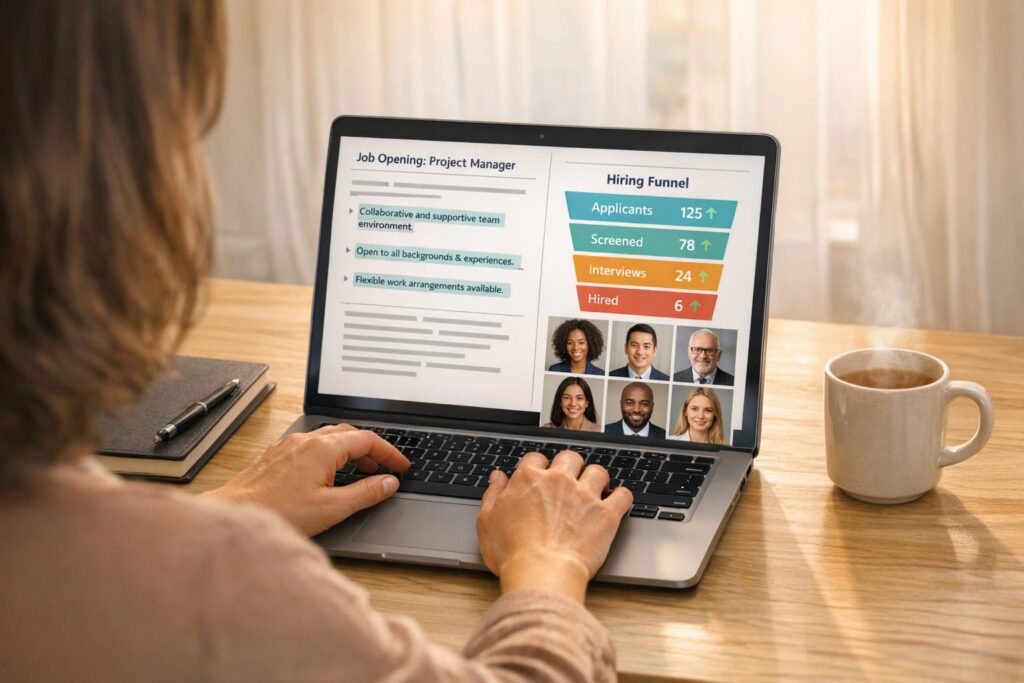

Recruitment funnels help companies filter candidates from application to hire. But inefficiencies can lead to high costs, delays, and missed opportunities. For instance, the average cost per hire in the U.S. is $4,700, and delays can stretch the hiring process to 44 days or more. If not optimized, issues like 30–50% candidate drop-off rates or poor communication can derail hiring efforts.
Key Problems and Solutions:
- Too Many Unqualified Candidates:
- Problem: 42% of resumes don’t meet job requirements.
- Solution: Write clear job descriptions, use automation, and target passive talent through referrals or niche platforms.
- Screening Delays:
- Problem: Screening takes too long, and inconsistent evaluations lead to missed opportunities.
- Solution: Use scorecards, Applicant Tracking Systems (ATS), and blind screening to standardize and speed up the process.
- Interview Scheduling Delays:
- Problem: Slow coordination frustrates candidates, with 42% dropping out due to delays.
- Solution: Use real-time scheduling tools and shared feedback dashboards to streamline coordination.
- Slow Offers and Poor Communication:
- Problem: 62% of candidates lose interest when communication drags.
- Solution: Pre-approve compensation packages, set clear offer deadlines, and keep candidates informed with automated updates.
- Weak Onboarding:
- Problem: Up to 20% of new hires quit within 45 days due to poor onboarding.
- Solution: Create structured onboarding plans, assign mentors, and use centralized dashboards to track progress.
Metrics to Track Funnel Performance:
- Application Completion Rate: Identify where candidates drop off.
- Screen-to-Interview Ratio: Evaluate job description alignment.
- Offer Acceptance Rate: Address issues like compensation or communication.
- Cost Per Hire: Monitor financial efficiency.
Optimizing your recruitment funnel reduces drop-offs, improves candidate experience, and saves time and money. Tools like Skillfuel can help automate processes, track metrics, and streamline hiring.
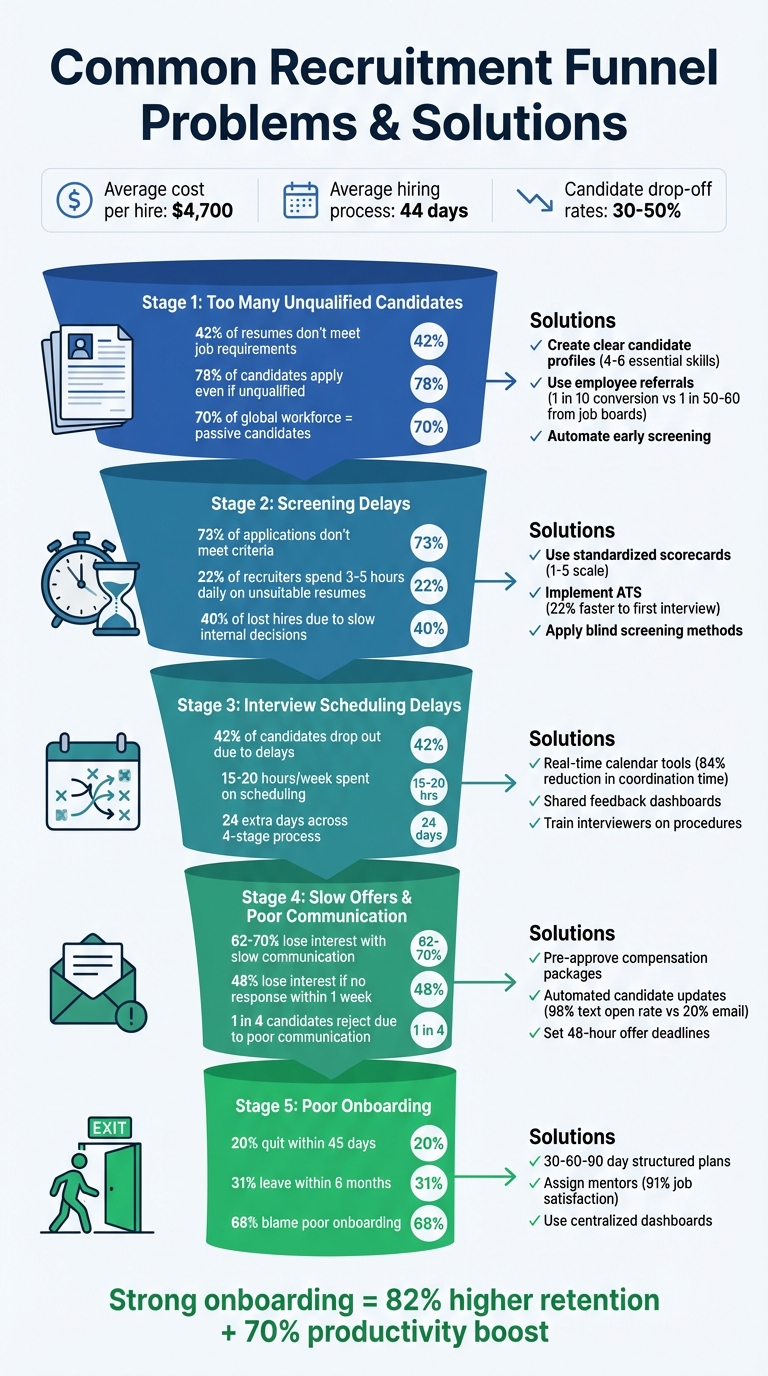
5 Common Recruitment Funnel Problems and Solutions with Key Statistics
How to use a recruitment funnel to save time and money?
sbb-itb-e5b9d13
Problem 1: Too Many Unqualified Candidates
Sorting through a flood of irrelevant resumes can slow down the hiring process dramatically. In fact, 42% of resumes received by HR managers come from candidates who don’t meet the job requirements. Why does this happen? Vague job descriptions and generic job boards make it easy for applicants to mass-submit resumes without carefully reviewing the qualifications.
Here’s another eye-opener: 78% of candidates admit they apply for roles even if they don’t meet all the qualifications. This creates a pile of applications from underqualified individuals. Job titles like "Marketing Specialist" or descriptions packed with corporate jargon often attract candidates from unrelated fields. Plus, keyword matching on job platforms can push your ad to the wrong audience.
The consequences are more than just wasted time. Qualified candidates may get overlooked or lose interest as you sift through irrelevant resumes. And let’s not forget: 70% of the global workforce consists of passive candidates, meaning the best talent isn’t actively applying on job boards. As Ralph van Katwijk from HireLab puts it:
Most hiring problems don’t start in the interview room – they start way earlier, at the top of your funnel.
To address these challenges, focus on defining your ideal candidate, targeting the right audience, and using automation to filter applications early.
Solution: Create Clear Candidate Profiles
Start by defining exactly who you’re looking for. Develop an Ideal Candidate Profile (ICP) that highlights the 4–6 essential skills or qualifications you absolutely need. Separate these from "preferred" qualifications to avoid creating unrealistic expectations that scare off strong candidates.
Write job descriptions that are easy to skim. Use bullet points and clear, straightforward language. Since most candidates spend less than 30 seconds reading a job post, include a brief summary at the top to explain the role’s impact. Avoid buzzwords like "rockstar" or "ninja" – instead, focus on responsibilities and outcomes.
Transparency is also key. Including salary ranges is no longer just a nice-to-have; in many U.S. states, it’s now required by law. Plus, candidates expect it. Use inclusive language and write in the second person (e.g., "you will") to make the description feel personal. Don’t forget to hold intake calls with hiring managers to uncover specific needs or cultural fit details that standard templates might miss.
Solution: Use Employee Referrals and Targeted Sourcing
Employee referrals are a game-changer. They convert to hires at a rate of 1 in 10, compared to just 1 in 50–60 for candidates from job boards. Launching a referral program with clear incentives can bring in higher-quality candidates.
For even better results, adopt targeted sourcing. Proactively reaching out to candidates – rather than waiting for them to apply – leads to a hire rate of 1 in 72, compared to 1 in 152 for inbound applicants. Use platforms like LinkedIn, Facebook, Instagram, and even TikTok to connect with passive talent. For specialized roles, explore niche platforms like GitHub, Stack Overflow, or Reddit.
Tools like Skillfuel’s social media recruitment features can help you post ads directly to where your ideal candidates are. This not only attracts talent but also builds your brand as an employer. When reaching out to passive candidates, make your messages personal. Mention specific projects or skills to boost response rates by up to 26%.
Solution: Automate Early Screening
Automation can save you hours by filtering out unqualified candidates before they even reach your desk. Recruitment software can handle tasks like sorting resumes and managing applications, so your team can focus on top candidates. Use knockout questions – simple yes/no filters – to weed out applicants who don’t meet baseline criteria.
Set up your Applicant Tracking System (ATS) to flag or filter candidates based on must-haves like years of experience, certifications, or location. Keep the application process short – nearly 60% of candidates abandon applications that are too long or complex. Aim for an application process that takes under five minutes.
Don’t forget about your existing candidate database. Past applicants who weren’t a fit for one role might be perfect for another. Use automated systems to re-engage these candidates when new opportunities arise. This approach keeps your recruitment funnel efficient and effective.
Problem 2: Screening Delays and Inconsistent Evaluation
Screening becomes a bottleneck early in the hiring process. A staggering 73% of HR professionals say fewer than half of the applications they receive meet the job criteria. On top of that, 22% of recruiters spend three to five hours daily sifting through unsuitable resumes. Clearly, the sheer volume of applications isn’t the only issue.
The real challenge lies in inconsistent evaluation. Hiring managers and recruiters often use different standards to assess candidates. One might focus on years of experience, another on academic background, or even subjective factors like "cultural fit". This lack of alignment leads to decision fatigue, with recruiters delaying tough calls and leaving candidates in limbo.
These delays are costly. Over 40% of lost hires occur because internal teams take too long debating while competitors act quickly with offers. Without a clear process or ownership – whether by a recruiter, hiring manager, or committee – promising candidates can easily slip through the cracks. However, there’s hope: introducing standardized screening processes and workflows can significantly speed things up. For instance, in February 2026, a mid-sized staffing firm cut its time to the first interview by 50% by introducing a one-page role brief, a five-item scorecard, and automated resume parsing through their ATS. A streamlined, standardized approach can make all the difference.
Solution: Use Standardized Evaluation Scorecards
Gut instincts won’t cut it. A two-part scorecard can improve consistency by combining objective qualifications (like certifications, technical skills, or years of experience) with behavioral criteria (such as problem-solving, teamwork, or communication). Each criterion should use a clear 1–5 scale, with precise definitions for each score. For example, instead of rating "communication" vaguely as a 3, specify: "Communicated clearly and concisely; answered questions with adequate detail".
To ensure everyone evaluates candidates the same way, conduct calibration sessions using sample profiles. Requiring screeners to record evidence for their ratings also creates an audit trail, making it easier to compare candidates fairly. It’s worth the effort – after all, a bad hire can cost up to 30% of an employee’s first-year salary when you factor in recruitment expenses, onboarding, and lost productivity.
Solution: Implement an Applicant Tracking System
Manual screening is time-consuming and prone to errors. An Applicant Tracking System (ATS) can centralize all candidate data, ensuring everyone has access to the same information. Beyond organization, an ATS speeds up the process. For example, Skillfuel’s ATS automates resume parsing and organizes applications, cutting down on manual backlogs. You can even add pre-screening questionnaires to filter for "must-have" qualifications, like certifications or visa status, before human review.
An ATS also enforces standardized templates and scorecards, ensuring consistent evaluations. For example, you can set the system to prompt reviewers to complete scorecards immediately after interviews, capturing impressions while they’re fresh. Automated reminders and clear decision timelines – like reviewing applications within 48 hours and giving feedback within 24 hours – help prevent candidates from being left in the dark. One mid-size tech company saw a 22% reduction in time to the first interview after adopting a standardized ATS workflow.
Solution: Apply Blind Screening Methods
Blind screening eliminates identifying details – such as names, photos, or locations – during the early stages, forcing reviewers to focus solely on qualifications and skills. This approach minimizes bias and ensures fairer evaluations.
Pair blind screening with inclusive job descriptions to create a level playing field. Avoid gendered language or unnecessary requirements that might discourage qualified candidates. The idea is to give every applicant a fair shot based on their abilities.
And while AI is becoming a powerful tool in hiring, with 85% of recruiters saying it improves workflows and 79% expecting it to influence decisions soon, experts caution against relying on it entirely. AI can handle initial triage and ranking, but human input remains critical for final decisions, especially when assessing alignment with team dynamics and values.
Problem 3: Interview Scheduling Delays and Slow Feedback
Coordinating interviews is a logistical headache. Between juggling time zones, packed schedules, and candidates interviewing at multiple companies, the process can quickly spiral into chaos. Many teams still rely on endless email chains asking, "What times work for you?" while using outdated tools that can’t keep up with modern hiring demands.
The consequences of these delays are serious. 42% of candidates drop out due to slow scheduling. As Drew Whitehurst, Director of Marketing, RevOps, and Product Strategy at interviewstream, points out: "The companies winning the talent war aren’t always offering better compensation or flashier perks. They’re simply removing friction in the interview process". This friction not only frustrates candidates but also drains recruiter productivity.
"Your time-to-schedule isn’t just a metric for coordinators, it’s now a critical differentiator in winning top talent." – Adejoke (JK) Adekunle, Product Marketing Manager, Cronofy
And it doesn’t stop there. Feedback delays compound the issue. Recruiters spend 15–20 hours a week on scheduling alone. Once interviews are completed, slow feedback submission often stalls the entire hiring funnel. Across a four-stage interview process, scheduling inefficiencies can add up to 24 days of extra coordination. No-show rates, meanwhile, hover between 10% and 30%.
Solution: Integrate Real-Time Calendar Tools
End the back-and-forth emails. Real-time calendar tools that sync with Google Calendar or Outlook let candidates instantly view availability and book their own slots. Companies using automated scheduling report an 84% reduction in time spent coordinating interviews, with 81% of candidates scheduling themselves within 24 hours. On average, automated scheduling saves 50 minutes per applicant.
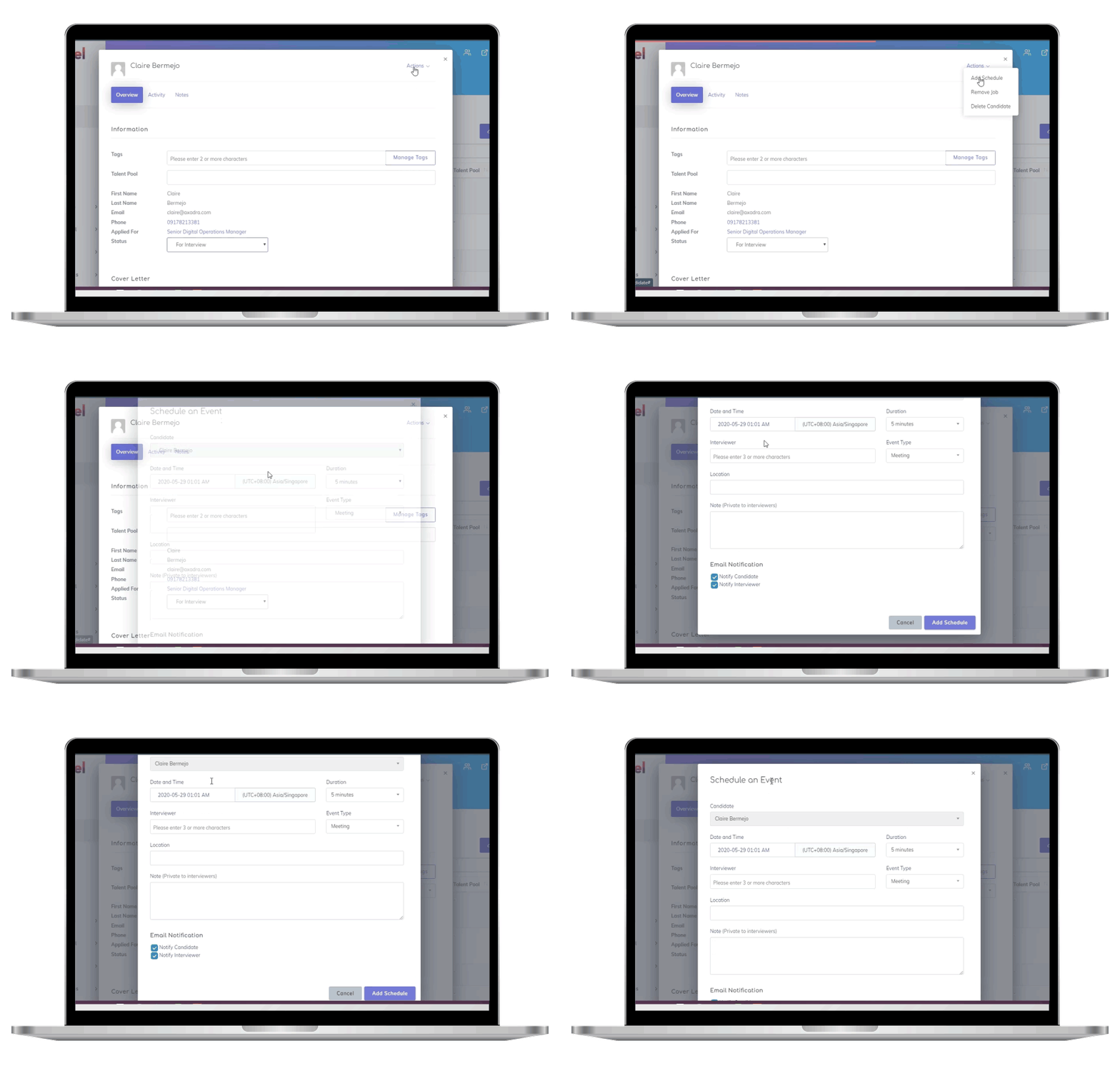
Skillfuel’s scheduling feature takes this a step further. It syncs calendars in real time, allowing candidates to pick times that suit them. Automated invites, confirmations, and reminders are sent to both candidates and interviewers, cutting down on no-shows. Even complex setups like panel or multi-session interviews are handled seamlessly with RSVP management. This creates an "on-demand" experience for candidates while freeing your team from hours of logistical headaches.
Solution: Use Shared Dashboards for Feedback
While automated scheduling speeds things up, centralized feedback systems ensure candidates don’t fall through the cracks. Fragmented email chains and scattered spreadsheets waste recruiters’ time and slow decision-making.
Skillfuel’s shared dashboards bring all feedback into one place. Automated reminders prompt hiring managers to submit evaluations immediately after interviews, capturing impressions while they’re fresh. The system can even schedule debrief meetings right after interviews to ensure feedback is recorded promptly. By eliminating silos and streamlining communication, this approach keeps the process moving without endless follow-ups.
Solution: Train Interviewers on Standard Procedures
Unprepared interviewers can derail the hiring process and leave candidates with a poor impression of your company. When interviewers don’t know what to ask or how to evaluate consistently, feedback becomes unreliable. On top of that, poor calendar management – like failing to update availability – creates constant friction for recruiters.
To address this, train interviewers on standardized procedures. Provide preparation materials like behavioral question guides and evaluation criteria. Encourage interviewers to update their calendar status every 48 hours to avoid last-minute scheduling conflicts. Building interviewer pools that are three times larger than your typical need can also prevent single conflicts from disrupting the process. Some teams even use "lock-in" blocks to protect interviewers’ productivity while ensuring dedicated time for hiring. Combined with scheduling tools, these practices create a smoother, more efficient process for everyone involved.
Problem 4: Slow Offers and Poor Communication
Even after fixing scheduling delays, slow offers and poor communication can still derail hiring efforts. The longer it takes to communicate an offer, the higher the risk of losing top candidates. Studies show that between 62% and 70% of job seekers lose interest when communication drags, with many expecting updates within just one week. If you’re not quick, you might find your ideal candidate has already moved on.
The consequences of poor communication extend beyond losing a single hire. Virgin Media, for example, found that 18% of rejected candidates were also customers. Poor communication during the hiring process led 6% of them to cancel their subscriptions, costing the company approximately $5.4 million in annual revenue. Additionally, one in four candidates has turned down an offer due to poor communication, and 72% have shared negative experiences with others. In today’s fast-paced world, candidates expect updates as quickly as they’d track a package delivery, and companies that respond faster are 250% more likely to secure their top choice. Meanwhile, hiring managers report that recruitment now takes longer than it did two years ago, with 24% of employers admitting to costly mistakes caused by slow processes.
"The offer isn’t just paperwork. It’s a relationship moment." – Huda Elshwadfy, Recruitera
Companies that prioritize clear communication and transparent compensation often see offer acceptance rates nearing 90%, while inefficient processes can drop that number below 60%.
Solution: Pre-Approve Compensation Packages
Waiting on budget approvals can cost you your best candidates. Take, for example, a mid-sized fintech firm that saw a 30% drop-off in senior developer candidates between the first interview and on-site visits in February 2026. They addressed this by pre-approving salary ranges and clearly stating compensation bands in job posts. The result? A 45% increase in on-site attendance and better offer acceptance rates.
To avoid delays, prepare salary ranges, benefits details, and total rewards packages early in the hiring process. Secure stakeholder approval upfront so you can extend a verbal offer as soon as you’ve identified the right candidate. Follow up with formal documentation within 48 hours. This proactive approach keeps you ahead of competitors and ensures candidates remain engaged.
Solution: Keep Candidates Informed
Almost half of all candidates (48%) lose interest if they haven’t heard back within a week of applying. Younger candidates are even less patient – over 50% of those aged 18–25 expect a response within seven days, while older candidates may wait up to two weeks.
"Short, predictable updates are enough to build trust and maintain momentum." – Talentech
Automated communication tools, like those from Skillfuel, can send personalized updates throughout the hiring process. Even if a final decision hasn’t been made, brief check-ins can prevent candidates from feeling forgotten. Text messaging, which boasts a 98% open rate compared to just 20% for email, can also maintain engagement during the crucial period between the final interview and the offer.
Solution: Set Clear Offer Deadlines
Unclear timelines create unnecessary stress and leave room for competitors to swoop in. Establish strict Service Level Agreements (SLAs) for your offer process, aiming to deliver a final decision within two business days (48 hours) of the last interview. Start with a verbal offer, then quickly follow up with formal documents. Use digital signature platforms to streamline the process, allowing candidates to review and sign offers on any device.
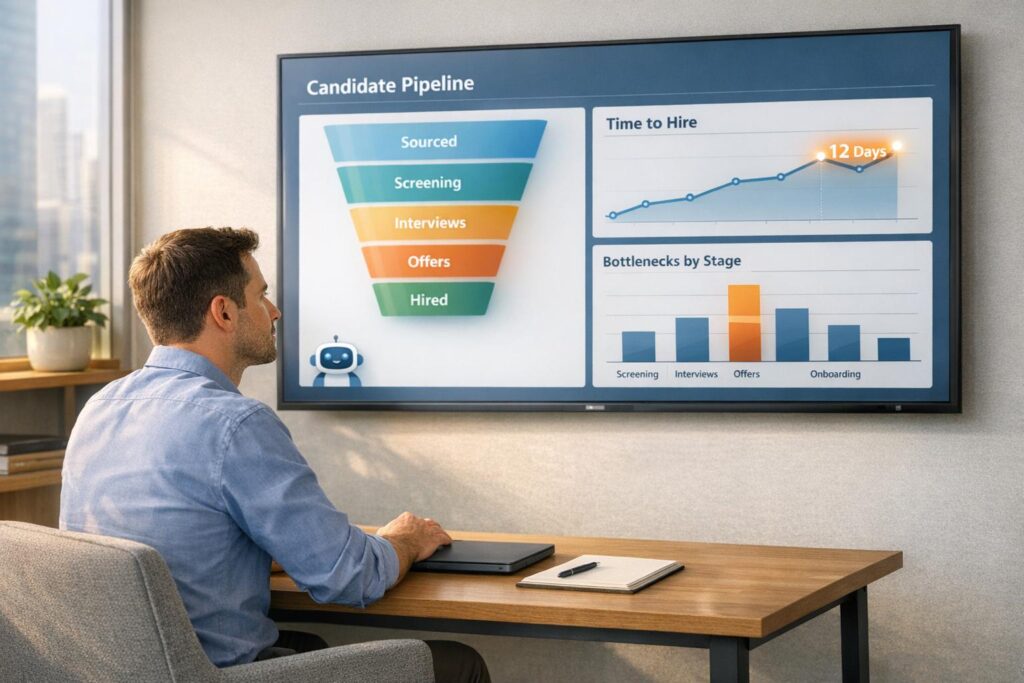
To identify and fix bottlenecks, track metrics like Time-to-Offer (the time from the final interview to the offer being sent) and Time-to-Acceptance. Share clear timelines with candidates during their first interview so they know exactly what to expect. When everyone is on the same page, you reduce uncertainty and increase the likelihood of securing top talent before competitors can act.
Problem 5: Poor Onboarding and Early Turnover
Statistics paint a stark picture: up to 20% of new hires quit within 45 days, and 31% leave within six months, with 68% blaming poor onboarding for their decision. This not only disrupts team productivity but also leads to hefty replacement costs – ranging from 40% of a front-line employee’s annual salary to 200% for leadership roles. Adding to the challenge, only 12% of employees strongly agree that their organization excels at onboarding. Disorganized processes, such as delayed IT setups or incomplete paperwork, leave new hires feeling disconnected. Worse, 80% of employees who feel undertrained during onboarding plan to leave, and 23% of those who quit within six months believe clearer expectations could have convinced them to stay.
"Front-line workers want to feel heard and respected throughout their entire career, not just during the initial – and often too short – onboarding period." – Sean Behr
The good news? A well-structured onboarding process can flip the script. Companies that invest in comprehensive onboarding see 82% higher new hire retention and a 70% boost in productivity. Strong onboarding programs can also cut turnover by up to 69%, and employees who experience meaningful onboarding are 69% more likely to stay for at least three years. Here’s how to reshape onboarding into a strategic advantage.
Solution: Build Structured Onboarding Plans
Set your new hires up for success with 30-, 60-, and 90-day goals that provide clear, actionable steps. For the first 30 days, focus on tools, compliance, and company culture. Move to collaborative tasks in the next 30 days, and by day 90, aim for independent contributions. These structured milestones not only guide new employees but also reduce early turnover by clarifying performance expectations.
Incorporate SMART goals (Specific, Measurable, Achievable, Relevant, and Time-bound) to keep things clear and motivating. For instance, instead of vaguely asking a new hire to "learn the product", set a goal like: "Complete three customer support tickets independently by day 45." This approach eliminates ambiguity and provides clear benchmarks for progress.
Avoid overwhelming new hires with too much information all at once. Instead, spread training out over several weeks using microlearning – bite-sized, manageable lessons. Before their first day, send welcome emails, digital handbooks, and schedules to ease anxiety. This allows Day One to focus on team introductions and immersing new hires in company culture rather than drowning them in paperwork.
Solution: Assign Mentors and Facilitate Team Connections
Social isolation can make new hires disengage quickly. Assigning a buddy or mentor helps them feel supported from day one. In fact, employees with mentors report 91% job satisfaction, and 79% of front-line workers who feel they belong are unlikely to leave their job. A mentor provides continuous support, making new hires feel connected throughout the onboarding process.
Mentors don’t have to be managers. Approachable peers can answer everyday questions – like where to grab lunch or how to request time off – in a way that feels informal and judgment-free. This kind of support encourages open communication and builds confidence.
Additionally, regular one-on-one meetings with managers can make a huge difference. Daily check-ins during the first few days, followed by weekly sessions, provide ongoing feedback and address challenges early. Employees who meet with their managers at least once a week report 43% higher engagement.
Solution: Track Onboarding with Centralized Dashboards
Gaps in coordination between HR and hiring managers can lead to onboarding hiccups – like delayed IT setups or incomplete training. A centralized dashboard can streamline the entire process, ensuring every task is completed on time and reducing the risk of early turnover.
For example, Skillfuel’s web-based recruitment management software offers centralized dashboards that let managers track onboarding tasks and progress in one place. Automating paperwork through self-service portals frees up Day One for meaningful activities like team building and cultural immersion. Whether the hire is remote or in-person, this ensures a consistent and high-quality onboarding experience.
To identify potential issues early, track key metrics such as time to productivity, new hire engagement, and retention rates. Use automated feedback forms and pulse surveys at the end of the first week, month, and quarter to pinpoint friction points and make adjustments as needed.
How to Measure Recruitment Funnel Performance
Tracking key metrics is essential to understanding where candidates drop off in the recruitment process. For example, the average global time-to-fill ranges from 36 to 42 days. Monitoring these numbers helps avoid wasted resources and lays the groundwork for identifying inefficiencies in the funnel.
Start by calculating yield ratios at each stage of the process. This measures how many candidates advance from one step to the next. For instance, if 100 applications result in 8 interviews, the conversion rate is 8%, which aligns with industry averages. Similarly, analyze your offer acceptance rate by dividing the number of accepted offers by the total offers extended. With an industry benchmark of 55.6%, a lower rate could indicate problems with compensation, communication, or the overall candidate experience.
Another key metric is cost per hire. This is calculated by adding internal costs (like recruiter salaries and referral bonuses) to external costs (such as job board fees and agency expenses) and dividing by the total number of hires. In 2019, the average cost per hire was approximately $4,000. If your cost exceeds this significantly, it may signal a need to shift resources toward more efficient recruitment methods. For example, employee referrals often convert better, with 1 hire for every 10 candidates, compared to job boards, which average 1 hire for every 50–60 applicants.
Create a Funnel Stage Analysis Table
To address recruitment challenges effectively, organize metrics and solutions in a simple table. Break down the funnel into stages like Sourcing, Screening, Interviewing, Offer, and Hire, and assign a key metric to each. For instance, during the attraction stage, track the application completion rate (completed applications divided by started applications). During screening, measure the time to shortlist, and for interviews, calculate the interview-to-offer ratio (offers made divided by interviews conducted, multiplied by 100). This approach helps pinpoint bottlenecks and guides targeted improvements.
| Funnel Stage | Key Metric | What It Reveals |
|---|---|---|
| Attraction | Application Completion Rate | If 92% of candidates abandon applications, forms may be too long or not mobile-friendly |
| Screening | Screen-to-Interview Ratio | Low rates may indicate job descriptions don’t align with candidate qualifications |
| Interview | Interview-to-Offer Ratio | An industry average of 36.2% suggests lower rates could stem from inconsistent evaluations or scheduling delays |
| Offer | Offer Acceptance Rate | A benchmark of 55.6% indicates rejections may point to uncompetitive compensation or poor communication |
| Overall | Cost per Hire | Tracks financial efficiency across all stages to optimize your budget |
Using this table, you can identify problem areas and implement fixes more effectively.
Monitor Metrics to Find Problem Areas
After establishing baseline metrics, review them quarterly to catch potential issues early. Look for sharp drop-offs – specific points where candidate numbers decrease unexpectedly. For example, if 40% of candidates abandon applications because they aren’t mobile-friendly, you know where to focus improvements. Similarly, if the time to shortlist is too long, consider automating resume screening. High unfit rates and slow processing times often indicate inefficiencies in filtering candidates.
Beyond speed, assessing quality is equally important. The quality of hire measures the long-term impact by evaluating performance ratings and retention rates after a set period. If new hires leave within six months or underperform, it may be time to revisit your screening criteria. Additionally, source of hire data can reveal which channels – like LinkedIn, job boards, or referrals – produce the most qualified candidates. Use this information to adjust your budget and focus on the most effective channels. Regular audits ensure your recruitment funnel stays aligned with your hiring objectives.
How Skillfuel Improves Recruitment Processes
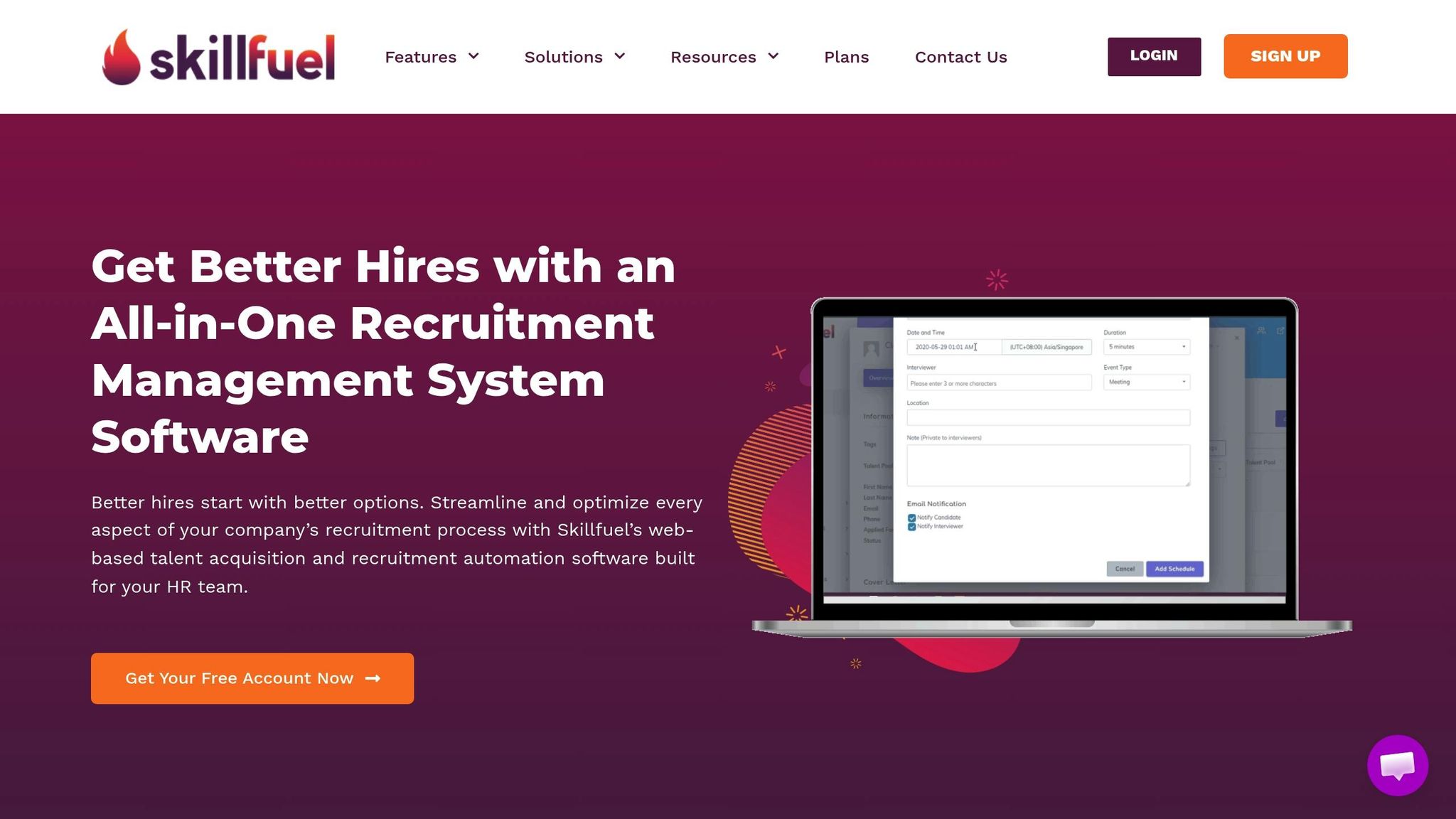
Skillfuel is packed with features designed to make recruitment faster and smoother at every step. It takes the hassle out of hiring by automating repetitive tasks, organizing candidate information in one place, and enabling real-time teamwork. This means fewer communication gaps and delays during screenings. Recruiters can even use drag-and-drop Kanban boards to track candidate progress visually, making it easier to pinpoint and fix any bottlenecks along the way.
Handling a high volume of candidates becomes much simpler with Skillfuel. The platform uses smart filters and automated qualification checks to take care of early-stage screenings, freeing up HR teams to focus on building meaningful connections instead of sifting through piles of applications manually. For interviews, Skillfuel integrates with popular calendar apps, eliminating back-and-forth emails and improving attendance rates. Shared dashboards also help hiring managers give timely feedback, keeping the process moving and ensuring top candidates stay engaged.
Main Features of Skillfuel
Skillfuel tackles recruitment challenges head-on with a range of targeted tools. Its Applicant Tracking System (ATS) keeps all candidate data in one place, using structured scorecards for fair and consistent evaluations – making the screening process more manageable. The interview scheduler syncs calendars and sends automated reminders, cutting down on the average 23.7-day interview process in the U.S.. The platform’s social media recruitment tool enables one-click job postings on LinkedIn and Facebook, while its employee referral tracking system helps manage referral incentives and monitor referred candidates. This feature can speed up hiring by as much as 55% while also improving retention rates.
Skillfuel also includes a job portal builder, which lets companies create branded, mobile-friendly career pages to encourage more candidates to complete their applications. The onboarding dashboards keep new hires on track and make it easy to assign mentors, helping companies cut down on early turnover costs – expenses that can range from 0.5 to 2 times an employee’s salary. To keep candidates engaged, the platform sends out automated updates, ensuring no one feels left in the dark.
Plans for Different Business Sizes
Skillfuel offers plans designed to meet the needs of businesses of all sizes. The Free Plan provides small teams with essential features. The Premium Plan is aimed at growing organizations, offering advanced scheduling, social media tools, and analytics. For large organizations, the Enterprise Plan delivers even more, including advanced dashboards, referral tracking, and dedicated support.
Conclusion
Fixing leaks in your recruitment funnel is key to tackling common hiring headaches. When unqualified candidates flood the pipeline, screening takes too long, interviews get delayed, offers move at a snail’s pace, and onboarding feels like an afterthought, the result is wasted time and resources. These issues can lead to drop-off rates of 30% to 50% in many companies. The fix? Create detailed candidate profiles, automate early-stage screening, standardize evaluations, speed up feedback loops, and plan onboarding from the very beginning.
"When you optimize recruitment funnel performance, hiring shifts from reactive to strategic, enabling you to attract top candidates rather than constantly chasing them." – Bisma Naeem, Author
Platforms like Skillfuel simplify recruitment by centralizing everything – from tracking applicants to scheduling interviews. Real-time calendar syncing eliminates the endless back-and-forth of scheduling, while shared dashboards ensure feedback flows smoothly, keeping candidates engaged and interested.
This streamlined approach doesn’t just save time; it also delivers actionable insights. Metrics like application completion rates, time-to-shortlist, and offer acceptance help identify exactly where candidates drop off. With the right tools and processes, you can reduce friction, create a better candidate experience, and fill positions faster – without compromising on quality.
FAQs
Which recruitment funnel metric should I fix first?
Every recruitment funnel has its weak spots, and focusing on the stage where candidates drop off the most can make a huge difference. For many companies, the biggest challenges come from low candidate engagement and application completion rates, which often sit below 11%.
To address this, consider these strategies:
- Boost your employer branding: Showcase what makes your company a great place to work. Highlight your culture, values, and employee success stories.
- Streamline job applications: Complicated forms can scare candidates away. Simplify the process to make it quick and user-friendly.
- Create engaging ads: Use compelling visuals and clear messaging to grab attention and drive interest.
Another common drop-off point occurs during the interview stage. High candidate drop-off rates here can often be traced back to lengthy processes or avoidable delays. Improving communication, speeding up scheduling, and making interviews more efficient can help keep candidates engaged.
Finally, dig into your recruitment funnel data. Identify where the biggest bottlenecks are, and take targeted actions to fix them. Small tweaks in the right places can lead to big improvements.
How can I reduce candidate drop-off without adding recruiter work?
Simplify your hiring process and keep candidates engaged without overburdening your recruiters. Leverage tools like AI-powered matching and automated communication to create a personalized experience. Streamline application steps and send timely updates to reduce drop-offs. These approaches smooth out the process, eliminate hurdles, and maintain efficiency with minimal recruiter effort.
What’s the simplest way to standardize screening and interviews?
To create a more consistent and fair hiring process, it’s crucial to standardize how screenings and interviews are conducted. Start by clearly defining the role’s requirements and establishing structured evaluation criteria. Using scorecards can help ensure every candidate is assessed on the same scale. Incorporating tools like applicant tracking system (ATS) automation can also minimize bias while simplifying the process. This structured approach not only makes evaluations more uniform but also enhances efficiency during hiring.