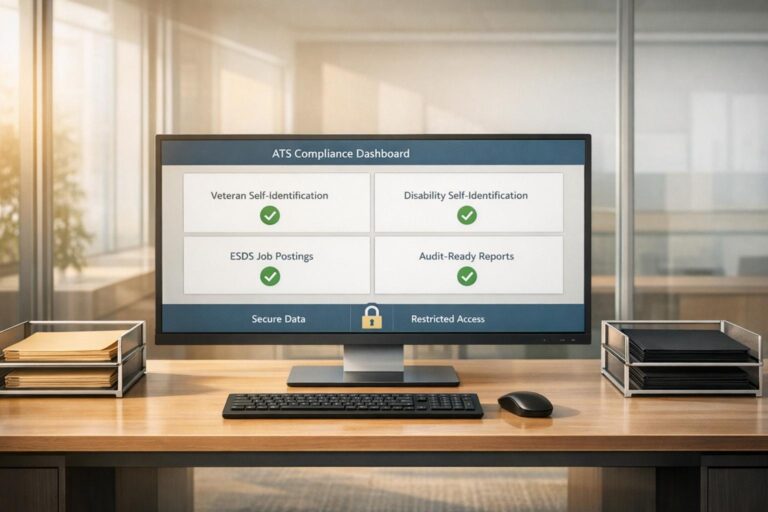
Applicant Tracking Systems (ATS) help federal contractors meet OFCCP compliance requirements by automating critical tasks like data collection, self-identification surveys, and reporting. While compliance ultimately depends on the contractor’s efforts, an ATS simplifies processes, reduces errors, and ensures readiness for audits. Key takeaways:
- OFCCP Compliance Basics: Federal contractors must follow regulations under VEVRAA (veterans) and Section 503 (disabilities), requiring proactive hiring efforts, self-identification, and record-keeping.
- ATS Benefits:
- Automates pre- and post-offer self-identification surveys for veterans and individuals with disabilities.
- Tracks and securely stores demographic data, keeping it separate from hiring decisions.
- Generates audit-ready reports, including applicant flow and hire logs.
- Manages job postings to state ESDS systems as required by VEVRAA.
- Compliance Challenges: Manual processes can lead to errors and inefficiencies, making ATS tools critical for accurate data handling and reporting.
Skillfuel, for instance, automates these tasks, ensuring compliance with minimal administrative burden. By using an ATS effectively, contractors can streamline hiring processes while meeting federal requirements.
Affirmative Action Recruiting and Applicant Tracking – OFCCP Compliance in Recordkeeping
sbb-itb-e5b9d13
OFCCP Requirements for Federal Contractors
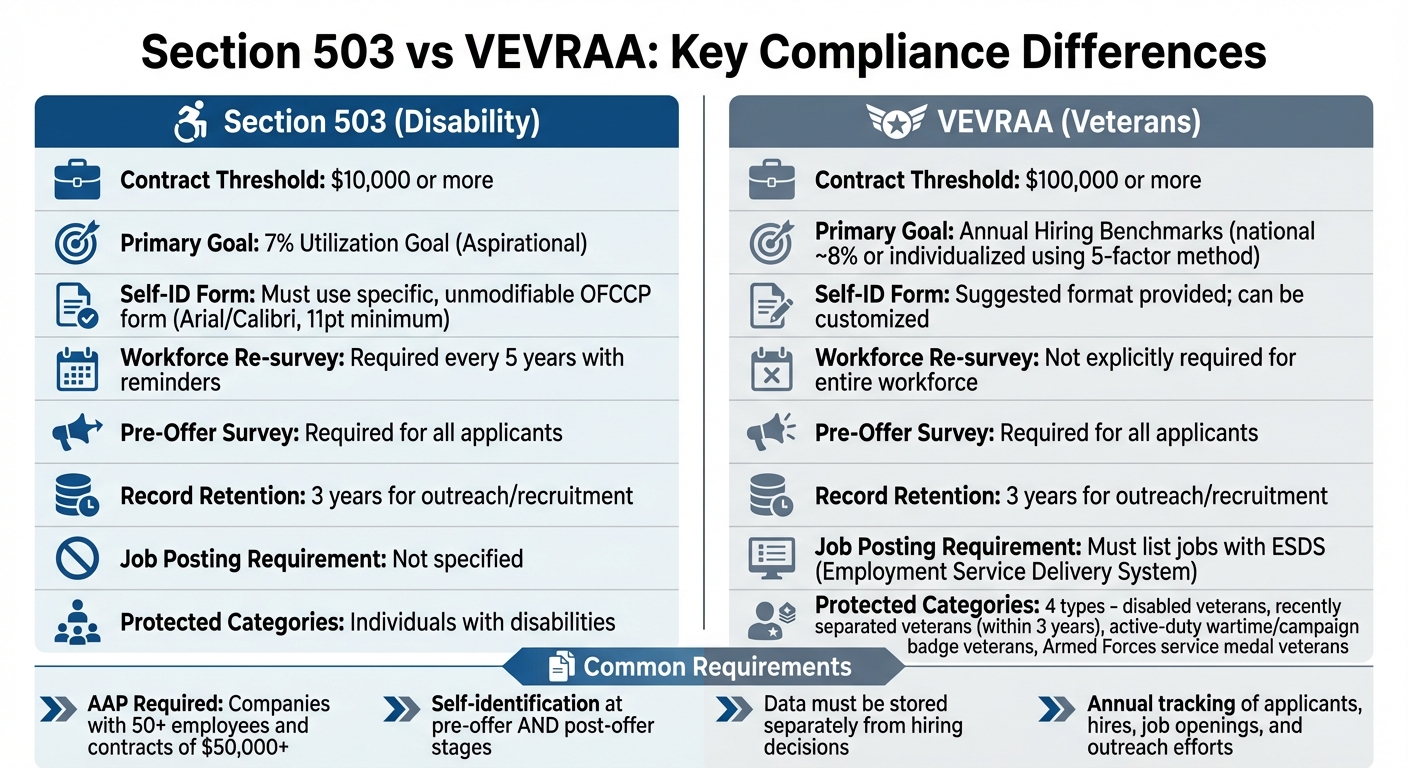
Section 503 vs VEVRAA Compliance Requirements Comparison for Federal Contractors
Federal contractors must adhere to specific regulations under VEVRAA (for veterans) and Section 503 (for individuals with disabilities). These rules go beyond avoiding discrimination – they require active efforts to recruit, hire, and promote individuals in these groups.
Section 503 applies to federal contracts or subcontracts worth $10,000 or more. VEVRAA, on the other hand, comes into play for contracts or subcontracts valued at $100,000 or more. If your company has at least 50 employees and a contract of $50,000 or more, you’re also required to implement a written Affirmative Action Program (AAP).
Both regulations share some common ground. For instance, contractors must request applicant self-identification at both pre- and post-offer stages, retain records for three years, and document all outreach and recruitment activities. The U.S. Department of Labor summarizes these responsibilities:
This contractor and subcontractor shall abide by the requirements of 41 CFR 60-300.5(a) and 41 CFR 60-741.5(a). These regulations prohibit discrimination against qualified individuals on the basis of protected veteran status or disability, and require affirmative action by covered prime contractors and subcontractors to employ and advance in employment qualified protected veterans and individuals with disabilities.
However, VEVRAA and Section 503 differ in how compliance is measured and tracked. Let’s break down their specific requirements.
VEVRAA Requirements for Hiring Protected Veterans
VEVRAA covers four categories of protected veterans: disabled veterans, recently separated veterans (within three years of discharge), active-duty wartime or campaign badge veterans, and Armed Forces service medal veterans. Contractors are required to set a yearly hiring benchmark for veterans. This can either be based on the national percentage of veterans in the civilian labor force (currently about 8%) or an individualized benchmark using a five-factor methodology.
For example, in 2024, FCI, an engineering and aerospace company in Dayton, Ohio, used the five-factor method to set a 7% benchmark. They analyzed local labor force data (6.2% in Ohio), their hiring ratio (7%), and their proximity to Wright-Patterson Air Force Base. After reviewing outreach efforts, including a veteran job fair that led to 16 hires, they determined that 7% aligned better with their goals.
Federal contractors must also list nearly all job openings with the Employment Service Delivery System (ESDS) and indicate their status as federal contractors seeking priority referrals of protected veterans. Job advertisements should clearly state “vet” and “disability” instead of using abbreviations like “V” or “D”.
To stay compliant, contractors need to track and document key metrics annually, including the number of veteran applicants, hires, job openings, and filled positions. They must also evaluate the success of their outreach efforts each year and tweak their strategies as needed.
Section 503 Requirements for Disability Hiring
Section 503 sets a 7% hiring goal for individuals with disabilities, applied to each job group or the entire workforce if the company has fewer than 100 employees. The ADA National Network explains:
The seven percent goal will apply to each job group in the workplace or to the entire workforce if there are fewer than 100 employees.
This target underscores ongoing disparities in employment. Back in 2012, only 33.5% of adults with disabilities were employed, compared to 76.3% of those without disabilities. Full-time employment rates also revealed a gap: 20.9% for individuals with disabilities versus 56.4% for others.
Unlike VEVRAA’s flexible self-identification methods, Section 503 requires contractors to use a specific OFCCP disability self-identification form. This form must remain unaltered, use sans-serif fonts like Arial or Calibri, and maintain at least an 11-point font size for electronic versions.
Contractors are also required to invite current employees to self-identify every five years, with reminders in between. Additionally, employers must review job qualification standards to ensure they don’t unintentionally exclude individuals with disabilities. To protect privacy, all disability self-identification data must be stored separately from general personnel records.
Like VEVRAA, Section 503 mandates tracking key metrics, such as the number of disabled applicants, total job openings, jobs filled, and individuals hired. Contractors must also document their outreach efforts, including partnerships with disability-focused organizations.
| Feature | Section 503 (Disability) | VEVRAA (Veterans) |
|---|---|---|
| Primary Goal | 7% Utilization Goal (Aspirational) | Annual Hiring Benchmarks |
| Self-ID Form | Must use specific, unmodifiable OFCCP form | Suggested format provided; can be customized |
| Workforce Re-survey | Required every 5 years | Not explicitly required for the entire workforce |
| Record Retention | 3 years for outreach/recruitment | 3 years for outreach/recruitment |
| Pre-Offer Survey | Required for all applicants | Required for all applicants |
How Applicant Tracking Systems Support OFCCP Compliance
Handling OFCCP compliance manually can overwhelm HR teams. Tasks like tracking self-identification data and preparing audit reports are time-intensive and prone to errors. Modern Applicant Tracking Systems (ATS) simplify this process by automating key compliance steps: presenting self-identification forms, securely storing demographic data, and creating detailed audit trails. Bill Osterndorf, President of HR Analytical Services, sums it up well:
The best ATS can be completely useless during an OFCCP compliance review if it is not used properly, and the worst ATS can be a godsend if a company has meticulously used it to record and retain the type of data that OFCCP expects.
The real game-changer here isn’t just automation – it’s accuracy. When recruiters rely on spreadsheets to track applicant data, information can easily go missing, be misfiled, or entered incorrectly. An ATS eliminates these risks by electronically capturing and standardizing every data point, ensuring readiness for audits. This level of precision is crucial for effective self-identification and reporting.
Automating Veteran and Disability Self-Identification
ATS platforms take automation further by streamlining candidate self-identification processes. A cornerstone of compliance is collecting voluntary self-identification data at the appropriate stages. With an ATS, EEO, veteran, and disability self-identification forms are automatically presented during the application process, ensuring no candidate is overlooked . These systems also handle pre-offer and post-offer surveys without requiring manual input from HR teams.
For candidates sourced or referred – who often skip formal applications – advanced ATS platforms trigger self-identification surveys when these individuals reach a critical stage in the interview process. As Team Lever explains:
Every applicant has the option to answer EEO questions when they apply, and companies can automatically send an EEO survey to non-applicants – like sourced and referred candidates – when they enter the interview pipeline.
For Section 503 compliance, ATS platforms must use the exact OMB-approved disability self-identification form, adhering strictly to formatting rules like sans-serif fonts (e.g., Arial or Calibri) and a minimum font size of 11 points. These systems also manage workforce re-surveys every five years, sending automated reminders to employees via email or intranet links.
Another critical feature is data segregation. To avoid bias, demographic data must be stored separately from candidates’ main profiles. Mitratech stresses this point:
This demographic data should NOT be accessible to hiring managers and other decision-makers, but should be accessible to HR staff members for reporting purposes.
With the right configurations, ATS platforms ensure hiring managers don’t see protected status information during the selection process.
Data Tracking and Reporting Features in ATS
Beyond collecting data, ATS platforms play a vital role in tracking and reporting compliance metrics. They must monitor the specific data points required by OFCCP auditors, such as the number of veteran and disabled applicants, job openings, positions filled, and hires, all categorized by job group and time period. Additionally, ATS platforms record customizable disposition codes to explain why candidates weren’t selected – whether they didn’t meet qualifications, withdrew, or were screened out after interviews .
Advanced ATS platforms also offer detailed referral source tracking, going beyond broad categories to document outreach efforts precisely. This level of detail helps HR teams demonstrate the effectiveness of targeted outreach, such as posting on veteran-focused job boards. As the OFCCP explains:
The purpose of the self-assessment is simply to ensure that the contractor thinks critically about how to evaluate and improve upon its recruitment and outreach efforts in order to maximize its connections to protected veterans seeking jobs.
During audits, ATS platforms can quickly generate Applicant Flow Logs and Hire/Offer Logs, including all necessary details: date received, candidate name, position applied for, job group, race, sex, veteran status, disability status, and disposition reason. These reports maintain a permanent audit trail, meeting the three-year retention requirement. Additionally, ATS platforms can export raw data into formats like Excel, addressing the need for more detailed statistical breakdowns that standard reports might not provide.
AI-powered ATS platforms also boost efficiency, reducing time-to-hire by up to 63% and giving HR teams more time to focus on strategic initiatives. Heather Fountain, HR Consultant at Berkshire, highlights the importance of quality data:
The effectiveness of your system will depend on the quality of the data input. Robust data yields more accurate adverse impact analyses.
Using ATS Tools to Build Affirmative Action Programs
Creating an affirmative action program (AAP) that meets compliance standards requires thorough documentation of every recruitment and hiring decision. An applicant tracking system (ATS) plays a key role in this process, automating the collection and organization of compliance-related data. This functionality ties directly to the automated processes highlighted in earlier discussions about ATS compliance features.
A critical component of any AAP is the annual evaluation of outreach efforts. With an ATS, contractors can measure whether their recruitment strategies effectively reach protected veterans and individuals with disabilities. By tracking referral sources, HR teams can generate reports showing precise candidate and hire counts from targeted outreach efforts. The OFCCP emphasizes the importance of this evaluation:
The purpose of the self-assessment is simply to ensure that the contractor thinks critically about how to evaluate and improve upon its recruitment and outreach efforts in order to maximize its connections to protected veterans seeking jobs.
This type of reporting aligns seamlessly with the compliance metrics previously discussed.
Beyond outreach evaluation, ATS tools automatically document good faith efforts in real time. These systems log all outreach activities as they happen, eliminating the need to piece together records during an audit. The result is a comprehensive, permanent record of outreach activities, applicant data, and hiring outcomes.
ATS platforms also support adverse impact analysis by generating detailed applicant flow logs. These logs break down selection rates by protected status, helping HR teams identify where, within the hiring process, protected groups may be disproportionately excluded – whether at the initial screening, phone interviews, or final rounds. This proactive approach allows contractors to address potential barriers before they attract scrutiny from the OFCCP. Additionally, ATS systems can export raw data into formats like Excel, making it easier to perform the statistical analyses required for annual AAP updates.
How Skillfuel Supports OFCCP Compliance
Skillfuel simplifies adherence to VEVRAA and Section 503 regulations by automating tedious processes, minimizing errors, and cutting down on paperwork.
Skillfuel Features That Support OFCCP Compliance
Automated ESDS Job Distribution
Skillfuel takes care of posting job openings to all 56 state Electronic Service Delivery Sites (ESDS) automatically. This ensures compliance with VEVRAA job listing requirements and helps state agencies prioritize referrals for veterans.
Automated Self-Identification Surveys
Self-identification surveys, required at pre-offer and post-offer stages, are handled seamlessly through Skillfuel. These surveys use OFCCP-approved forms to accurately capture veteran and disability status. To maintain data integrity, each record is securely stored in separate files.
Centralized Dashboard
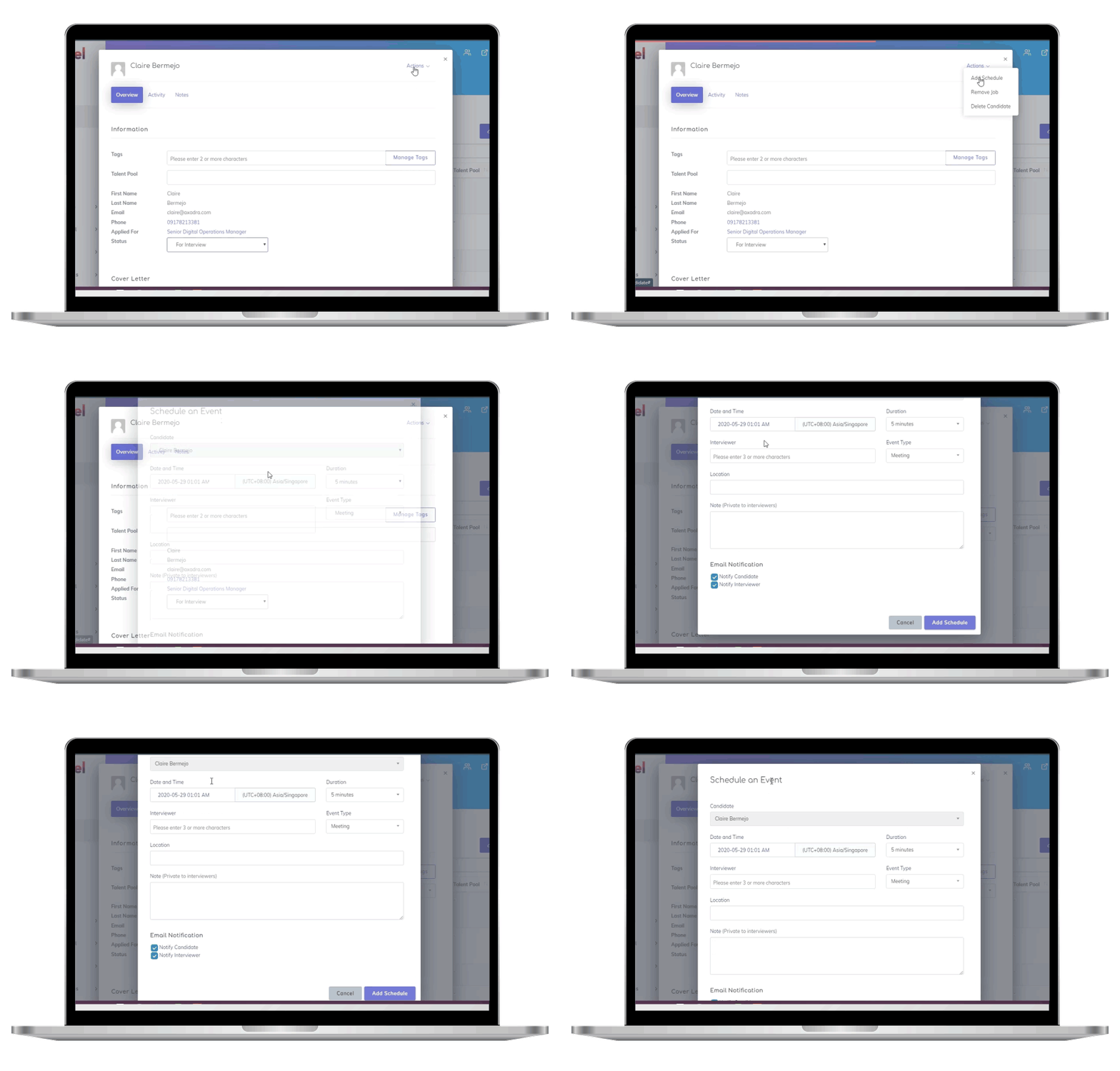
The centralized dashboard makes tracking disposition codes and referral sources straightforward, ensuring you’re always prepared for audits. With all features working together, Skillfuel helps contractors maintain compliance without added stress.
As compliance expert Sonia Chapin notes:
"These records are a required part of the contractor’s AAP. OFCCP would like for contractors to use the data proactively, to drill down into the data to see what titles or steps in the process are driving adverse results, even if they are not under audit."
– Sonia Chapin, Expert on OFCCP Audit Support
Customizable Career Pages & Interview Tools
Skillfuel allows contractors to create career pages that prominently feature Equal Employment Opportunity (EEO) and affirmative action policies. These pages also meet Section 503 accessibility standards. Meanwhile, real-time calendar syncing simplifies interview scheduling, and robust data security ensures sensitive demographic information remains confidential and separate from hiring files.
Case Study: Improving Hiring Processes with Skillfuel
The automation Skillfuel offers not only ensures compliance but also enhances hiring efficiency. Real-world challenges underline the importance of these features.
George Fironov, CEO of Talmatic, shared a key lesson from an internal audit:
"Early on, we underestimated the importance of including precise Equal Employment Opportunity (EEO) statements in job descriptions. This omission flagged us during an internal audit."
– George Fironov, CEO, Talmatic
This highlights how automated systems that standardize EEO statements across job postings can prevent common compliance missteps. Jon Morgan, CEO of Smarter Ventures, also shed light on the complexities of OFCCP posting requirements:
"It’s easy to assume that posting a job on the right platforms will automatically meet the requirements, but OFCCP regulations are very specific about where, how, and for how long you post openings."
– Jon Morgan, CEO, Smarter Ventures
Skillfuel’s automated ESDS job distribution eliminates the uncertainty around these regulations, ensuring compliance with the $150,000 contract threshold for mandatory state workforce agency listings.
Conclusion
OFCCP compliance goes far beyond simply checking boxes – it demands hiring processes rooted in fairness and transparency. Federal contractors face intricate requirements under VEVRAA and Section 503, such as tracking veteran and disability self-identification data and maintaining comprehensive applicant records. Relying on manual methods, like spreadsheets, often falls short when it comes to ensuring the data accuracy and integrity needed during compliance reviews.
An applicant tracking system (ATS) simplifies this complexity by automating and streamlining compliance workflows. Features like standardized disposition codes, automated self-identification surveys, and audit-ready reporting allow HR teams to focus on recruiting top talent instead of scrambling to gather documentation.
However, technology alone doesn’t guarantee compliance – it’s crucial to use these tools effectively. This includes training staff to customize disposition reasons, keeping demographic data separate from hiring decisions, and conducting regular internal audits well before an OFCCP review. The benefits extend beyond compliance: 86% of recruiting professionals report faster hiring, and 78% see better candidate quality after implementing an ATS. These tools not only simplify compliance but also enhance overall hiring efficiency.
Skillfuel’s ATS takes compliance management to the next level by automating self-identification data collection, standardizing disposition codes, and centralizing reporting through an intuitive dashboard. For federal contractors navigating strict regulatory demands while competing for top talent, the right recruitment technology is key to building efficient and legally sound hiring practices.
FAQs
How does an Applicant Tracking System ensure accurate OFCCP compliance reporting?
An Applicant Tracking System (ATS) plays a key role in ensuring accurate OFCCP compliance reporting by automating essential processes like data collection and record-keeping. By electronically storing applicant information – such as demographic details and application statuses – it helps maintain complete and precise records while significantly reducing the risk of human error. Features like timestamps and audit trails create a clear, verifiable history of the hiring process, which becomes invaluable during OFCCP reviews.
Modern ATS platforms take it a step further by automatically generating detailed compliance metrics, including applicant demographics and adverse impact analyses. This automation not only saves time but also ensures organizations meet OFCCP requirements consistently. With streamlined data management and audit-ready documentation, an ATS simplifies compliance reporting, making it both more efficient and more reliable.
What features should an ATS include to ensure VEVRAA and Section 503 compliance?
To meet the requirements of VEVRAA (Vietnam Era Veterans’ Readjustment Assistance Act) and Section 503 of the Rehabilitation Act, an Applicant Tracking System (ATS) should include features that make compliance and reporting straightforward. These tools should enable the collection and secure storage of demographic data, such as veteran and disability status, ensuring proper documentation for audits and reporting purposes.
Automated compliance reporting is essential for creating mandatory reports like EEO and OFCCP analyses. The system should also provide an accessible application process to ensure individuals with disabilities can apply without facing obstacles. Key functionalities like role-based access controls, detailed audit trails, and data retention options help meet record-keeping standards. Additionally, tracking accommodation requests and documenting equal opportunity initiatives underline a commitment to equitable hiring practices.
How do Applicant Tracking Systems help ensure OFCCP compliance during audits?
Applicant Tracking Systems (ATS) play a key role in helping companies meet OFCCP regulations, especially during audits. They enable HR teams to keep precise, well-organized records of the hiring process. This includes details like application timestamps, applicant flow, and hiring decisions, ensuring all required documentation is easily accessible to meet federal standards.
These systems also take the complexity out of compliance reporting. They can automatically generate important reports on applicant demographics, pay equity, and hiring practices. On top of that, ATS platforms securely store essential data, such as adverse impact analyses and accommodation requests – key areas often examined during audits.
By consolidating all this information in one place, ATS platforms make it easier for organizations to maintain transparency, stay prepared for audits, and reduce the risk of compliance issues.