
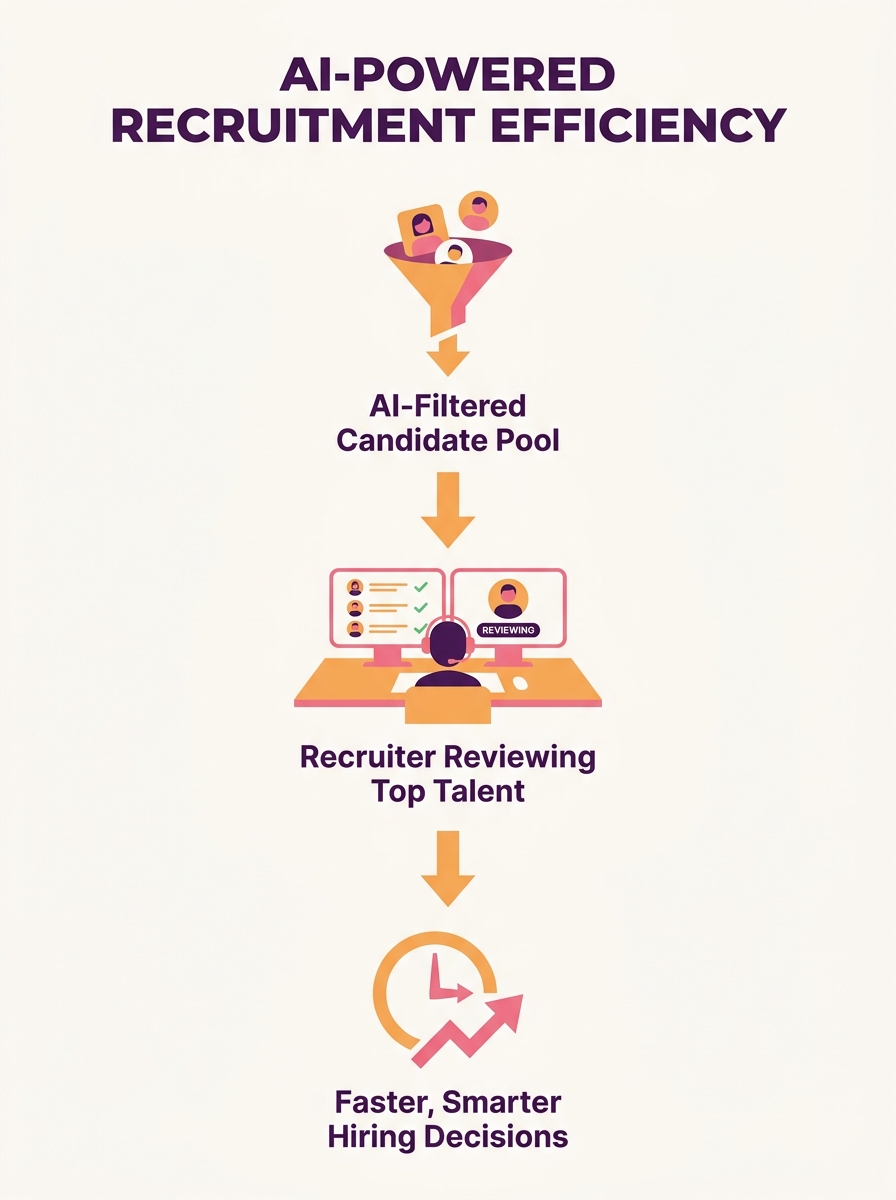
An audit of 200 automatically rejected CVs at a 40-person Manchester recruitment agency found 14 candidates—7 percent—should have advanced to human review despite being filtered out by AI screening software, according to a case study published September 12 by digital marketing consultant Lilach Bullock. The agency had implemented parsing and ranking automation that cut average shortlist time from 11 days to under 2 days for warehouse and logistics placements across the North West of England.
TL;DR: A Manchester logistics recruitment agency cut shortlist time from 11 days to 2 using AI screening, but a manual audit of 200 auto-rejected CVs revealed 14 qualified candidates—7%—were incorrectly filtered out before any human saw their applications.
The agency processes roughly 1,200 placements annually and faced 300 applications on busy Mondays before automation. Consultants manually reading CVs could process 15 to 20 applications per hour, creating two-day backlogs for initial triage. The AI system extracted forklift licenses, shift-pattern experience, and distance from site, then scored candidates against live job specifications. Applications scoring above 70 percent went directly to consultant queues; those between 40 and 70 percent triggered a three-question automated chat covering right-to-work status, license expiry, and notice period; scores below 40 percent generated auto-rejection emails.
False Rejections Traced to Job-Title Mapping and Experience Scoring
The eight-week audit identified two failure patterns. A candidate with “materials handler” experience scored low despite holding the required forklift certification because the parser failed to map the job title to “warehouse operative.” Another candidate with a two-year parental-leave gap scored lower not from direct penalization of the gap but because the scoring window measured recent relevant experience, reducing the weighting of older work history.
The agency had not conducted the audit internally. The case study notes the system’s speed came specifically from removing human judgment from the initial filter—the same mechanism that allowed qualified candidates to disappear without detection. Building an effective recruitment process for high-volume hiring now requires balancing automation speed against periodic manual sampling of rejected applicants.
Agency Screening Stacks Now Combine Multiple Platforms
Most UK and US recruitment agencies deploy combinations of dedicated tools rather than single-vendor solutions. Bullhorn and Manatal handle core applicant tracking and parsing. Textkernel powers CV parsing as a white-label engine embedded in multiple ATS platforms. Paradox’s Olivia chatbot conducts conversational screening. HireVue analyzes video interviews. Eightfold and Beamery manage enterprise talent matching for larger agencies.
Smaller agencies increasingly layer custom GPT-based screening on existing ATS infrastructure. The case study notes building a basic screening chatbot now takes two weeks rather than six months, lowering the barrier for mid-market agencies to automate first-contact filtering without replacing their applicant tracking system.
Six-Step Pipeline Routes Candidates Through Automated Tiers
The standard screening workflow starts with ingestion of CVs from job boards, website forms, and referrals in PDF, Word, or LinkedIn-export formats. Parsing extracts job titles, dates, skills, qualifications, and location, normalizing them against the agency’s taxonomy. Scoring assigns each candidate a match percentage against the job specification, weighted for mandatory requirements like security clearance or driving licenses versus preferred qualifications.
Tiering splits candidates into bands: top tier for immediate recruiter review, mid tier for automated screening, bottom tier for rejection or talent-pool holding. Mid-tier candidates receive chatbot or SMS-based questions—typically three to six, completed in under five minutes. Human review of the shortlist follows, with consultants listening to recorded video answers before selecting candidates to present to clients. The system closes with a feedback loop where recruiter decisions train the scoring model, though the case study notes most agencies skip manual audits of auto-rejected applications.
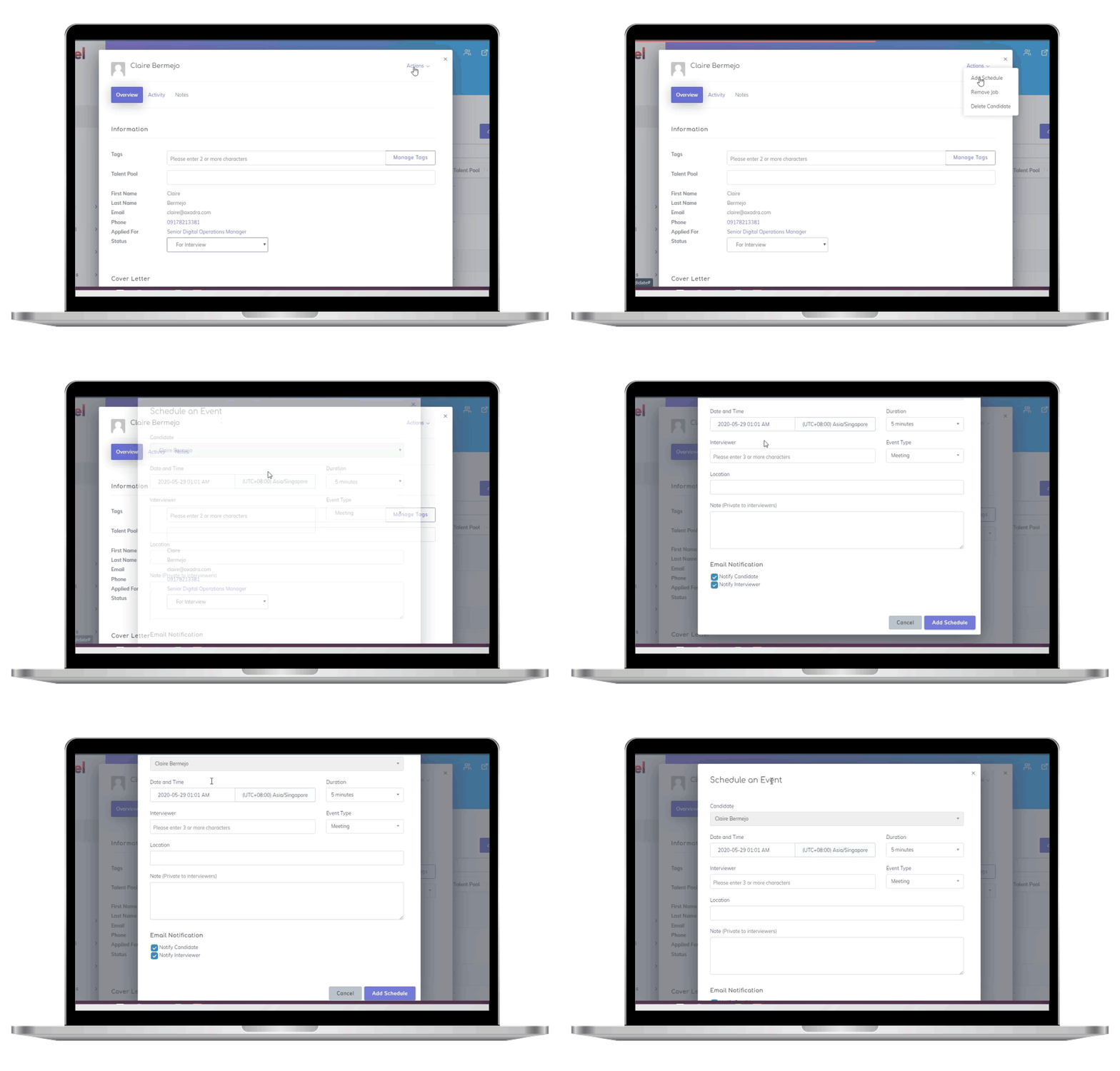
Agencies adopting automated interview scheduling typically integrate it at the human-review stage, letting consultants book finalist candidates without back-and-forth email threads.
Why This Matters Now
Recruitment agencies selling AI screening emphasize 80-90 percent time reductions in case studies while rarely publishing false-rejection rates or audit protocols. The 7 percent error rate in the Manchester sample suggests automation delivers measurable speed gains alongside untracked quality losses. For hiring managers working with agencies, the Manchester finding creates a negotiation point: ask whether the agency audits auto-rejections and whether you can review a sample of filtered-out candidates before finalist submission.
For in-house teams considering similar automation, the case study’s two failure modes—job-title synonym misses and experience-recency scoring—point to testable risks. Parsing engines trained on corporate job taxonomies may not recognize blue-collar role variations. Scoring algorithms that weight recent experience higher than total experience penalize candidates with parental leave, caregiving gaps, or career transitions without explicitly flagging those demographics. AI recruitment screening automation delivers the promised efficiency, but the quality control now sits with whoever designs the audit cadence, not with the software vendor’s benchmark.
Agencies that automate without sampling rejected CVs monthly aren’t running efficient operations—they’re running unmonitored filters that quietly reshape their candidate pools in ways clients never requested and recruiters never see.