
Global workforce intelligence firm TalentNeuron released research September 1 showing enterprises investing in AI are redesigning workforces through task reallocation rather than executing uniform headcount reduction, based on analysis of Salesforce, Klarna, Wells Fargo, Google, Microsoft, Citi, and BT Group, according to the announcement. The report, titled “The Great Reallocation: Understanding the Impact of AI on Talent Strategy,” found combined demand for HR, strategic workforce planning, and people analytics roles at the seven companies increased 16% over two years.
TL;DR: TalentNeuron analyzed seven global enterprises and found AI adoption is driving workforce redesign decisions around structure, skills, and hiring rather than a single reduction strategy, with HR and workforce planning demand rising 16%.
The research counters prevailing narratives positioning AI primarily as a job-elimination force. Organizations studied are making divergent workforce decisions based on individual business priorities as AI shifts from experimental projects to large-scale deployment, the report shows.
AI Skills Demand Spreads Beyond Traditional Tech Roles
TalentNeuron data identified 114,419 global job postings requiring core AI skills spanning 103 occupations, demonstrating demand expansion into roles historically unrelated to software development. Organizations seeking to automate tasks and processes are building AI capability across broader workforce segments.
“AI is accelerating the pace of workforce decisions, compressing planning cycles from years to quarters, and sometimes even weeks,” said David Green, co-founder and managing partner at Insight222, in the report. The shift reflects enterprises moving from contained AI pilots to organization-wide automation initiatives requiring distributed technical skills.
The finding aligns with emerging workforce patterns where AI eliminates specific screening tasks rather than entire recruiter roles, positioning AI as a task-level augmentation tool. Organizations building AI literacy across job families are targeting process automation rather than wholesale position replacement.
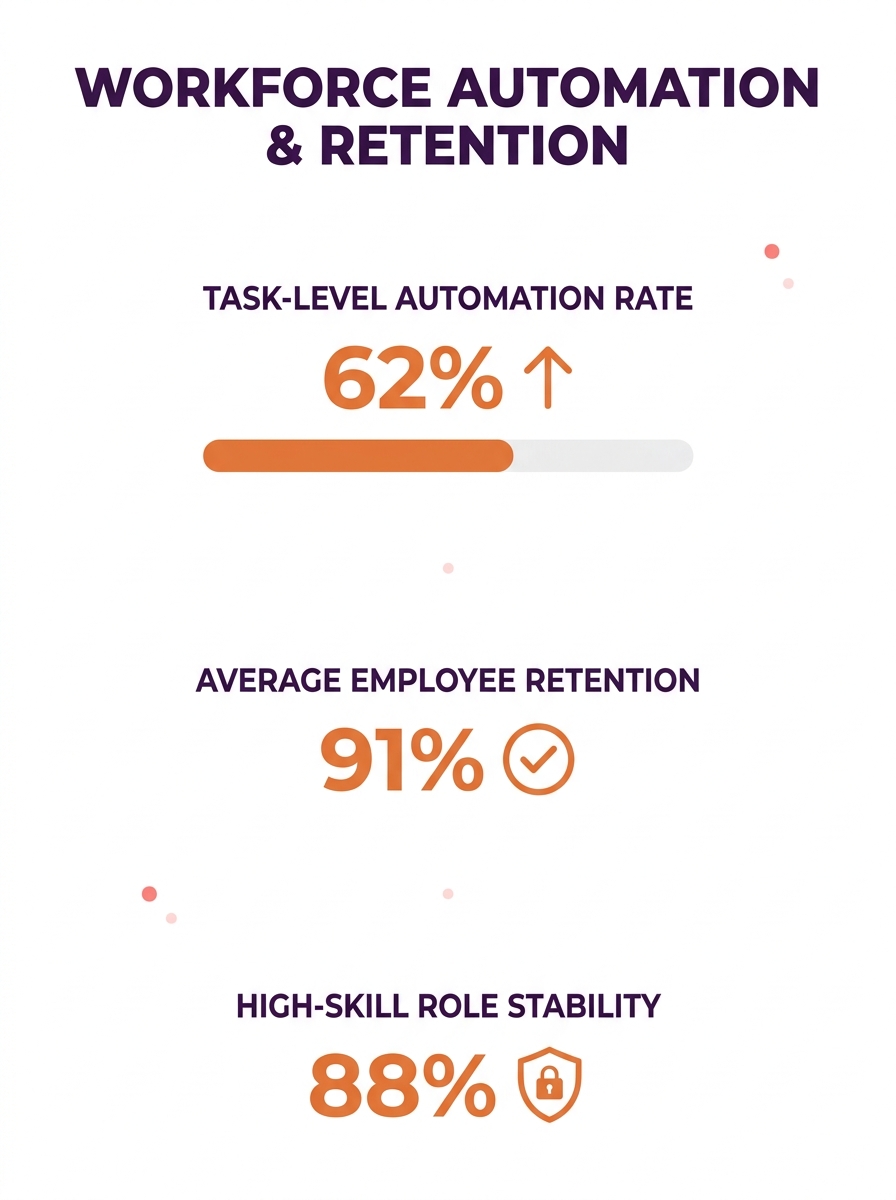
Task-Level Analysis Reveals 34% of Elimination Targets Contain Critical Human Judgment
TalentNeuron worked with a Fortune 100 manufacturer in 2026 to analyze job architecture at the task level, finding 34% of roles initially flagged for elimination contained tasks requiring human judgment central to the company’s transformation strategy. Proceeding with role-level analysis alone would have removed capabilities needed for strategy execution.
“No employee can be 100% replaced by AI, and no job is fully automatable,” the report states. Tasks composing a job automate at different rates, making task-level analysis critical for understanding actual AI workforce impact.
Erzsébet Malzenicky, Global Head of Workforce Strategy and Transformation at Experian, explained the design requirement: “You can’t design a workforce that blends human and automated capability without knowing, at a granular level, what your people actually do.” The Fortune 100 case demonstrates risk in automation decisions made without granular task mapping.
Organizations using applicant tracking systems for hiring face parallel task-analysis requirements when determining which recruitment workflow components to automate versus retain under human oversight. The same task-level scrutiny applied to manufacturing roles extends to recruitment operations.
Strategic Workforce Planning and L&D Demand Rises Alongside AI Investment
Across the seven companies analyzed, demand for strategic workforce planning skills increased 33%, people analytics demand rose 26%, and learning and development specialist demand climbed 42%, according to TalentNeuron data. L&D hiring nearly doubled at Microsoft, Google, and Citi.
The growth pattern indicates enterprises investing heavily in AI are retaining and expanding HR, strategic workforce planning, and people analytics functions to guide AI-enabled workforce development. Organizations are staffing planning capacity rather than reducing it.
“AI is changing what work looks like, but the question for enterprises is not simply how many jobs can be automated,” said David Wilkins, Chief Executive Officer of TalentNeuron. Organizations benefiting most understand work performance at the task level to make informed decisions about where to automate, where to reskill, and where human judgment remains critical.
The workforce planning expansion mirrors broader patterns where HR technology adoption drives culture and data foundation requirements rather than immediate headcount impact. AI deployment creates demand for professionals capable of mapping automation boundaries and redesigning workflows.
Enterprise AI Value Depends on Connecting Technology to Work Architecture
Organizations best positioned to benefit from AI connect technology investment to detailed understanding of how work gets done, the research concludes. AI transformation cannot be treated as standalone technology initiative separate from workforce strategy.
“Enterprises need to understand the workforce they have today, the workforce they will need in the future, and the skills and tasks that connect the two,” Wilkins said. That understanding enables smarter decisions about where AI creates value, where people remain essential, and how to build readiness for future changes.
The report positions workforce planning and people analytics as elevated functions rather than administrative overhead in AI-adopting organizations. More than 60% of the Fortune 100 use TalentNeuron for strategic workforce decisions including demand forecasting, automation impact analysis, scenario modeling, and talent optimization, according to the company.
TalentNeuron’s platform combines internal talent intelligence with external market data powered by AI and machine learning, delivering workforce intelligence across markets representing over 96% of global GDP. The research report is available from TalentNeuron’s website.
Reading Between the Lines
The 16% demand increase for workforce planning roles at companies aggressively deploying AI suggests enterprises are staffing the redesign work itself, not just absorbing headcount reductions elsewhere. That creates a planning-capacity market for practitioners who can perform task-level workforce analysis and map automation boundaries—skills most HR teams don’t currently hold at scale.
For talent acquisition leaders, the task-versus-role distinction matters immediately. Recruitment workflows contain automatable screening and scheduling tasks alongside judgment-dependent candidate evaluation and stakeholder consultation that resist full automation. Teams that map their own task architecture can make surgical automation decisions rather than wholesale vendor-platform adoption that misaligns with actual workflow needs.
The Fortune 100 manufacturer case—where 34% of elimination targets contained critical human tasks—serves as a caution flag for any organization making AI staffing decisions without granular work analysis. The same risk exists in TA: eliminating roles without task mapping can remove capabilities the hiring function actually needs to execute on quality-of-hire and time-to-fill targets simultaneously.