
Full SEO Online published an analysis August 18 positioning artificial intelligence as the solution to manual screening bottlenecks in candidate sourcing, according to the digital marketing consultancy’s recruitment optimization framework. The framework identifies five transformation areas where AI shifts talent acquisition from volume-based manual review to quality-based predictive discovery: automated resume screening, predictive performance analytics, expanded talent pool discovery through multi-platform scanning, personalized candidate engagement, and bias reduction in initial screening stages.
TL;DR: Full SEO Online’s August 18 framework argues AI transforms candidate sourcing by automating manual screening tasks and using predictive analytics to identify candidates likely to succeed, addressing volume overload and unconscious bias in traditional recruitment methods.
The framework arrives as organizations face mounting pressure to reduce time-to-hire while improving candidate quality, challenges that manual screening processes struggle to address at scale. Traditional sourcing methods require recruiters to manually review hundreds of applications per role, often missing qualified passive candidates who aren’t actively job-hunting and introducing unconscious bias into screening decisions, the analysis notes.
Automated Screening and Predictive Analytics Replace Manual Resume Review
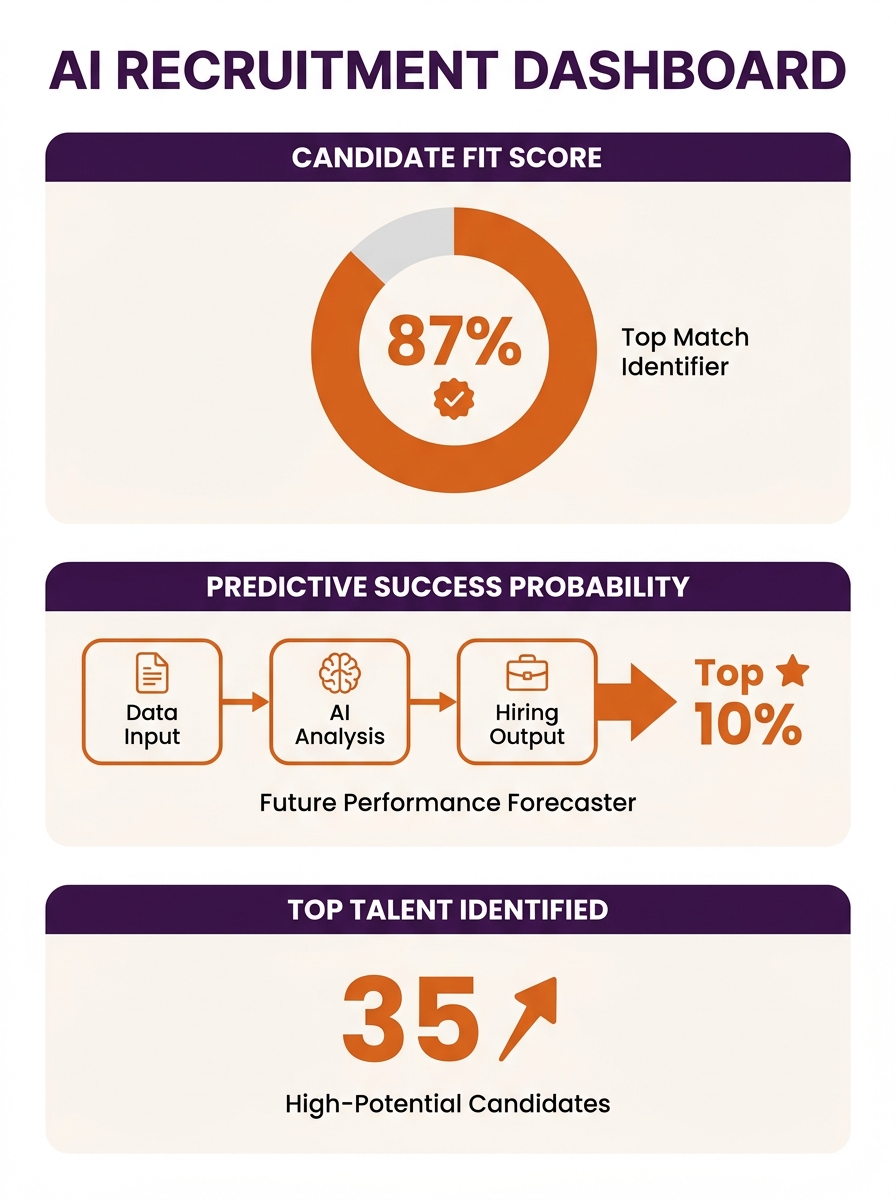
AI-powered systems can scan and analyze thousands of resumes in the time human recruiters spend reviewing dozens, identifying keywords, technical proficiencies, and experience patterns relevant to job requirements, according to the framework. The technology ranks candidates based on alignment with role specifications and presents recruiters with qualified shortlists rather than unfiltered application volumes.
Advanced implementations move beyond keyword matching to predictive analytics, the analysis states. By examining data patterns from successful employees—including career trajectories, skill combinations, and tenure records—AI algorithms can predict which candidates are likely to thrive in specific organizational environments and remain with the company long-term.
This predictive layer addresses not just whether candidates possess required skills but whether they’ll succeed in the company’s particular culture and role context, a distinction the framework positions as critical for reducing turnover costs.
Multi-Platform Talent Discovery Expands Beyond Active Job Seekers
Traditional recruitment reaches candidates on job boards and professional networks, but AI tools can scan social media platforms, academic publications, open-source project repositories, and industry forums simultaneously, the framework explains. This expanded search capacity uncovers passive candidates whose online presence demonstrates desired expertise even when they aren’t actively applying for positions.
Natural language processing enables AI systems to identify individuals based on demonstrated skills and contributions across digital platforms, not just explicitly stated job-search status. Organizations using these approaches access talent pools that manual sourcing methods miss entirely, according to the analysis.
The capability proves particularly valuable for specialized technical roles where qualified candidates may be scarce on traditional job boards but active in niche online communities and project spaces.
Personalized Outreach and Bias Reduction
Once AI identifies potential candidates, the technology can analyze profiles to generate tailored outreach messages highlighting role aspects most relevant to each individual’s career interests and expertise, the framework states. This personalization significantly improves engagement rates compared to generic mass recruitment emails.
For a software engineer with machine learning experience, AI-drafted outreach might reference specific AI projects the hiring company is pursuing and how the candidate’s skills would contribute directly to those initiatives, creating targeted rather than template-based communication.
The framework positions bias reduction as one of AI’s most significant sourcing benefits. Algorithms trained to focus on skills, experience, and performance indicators can screen candidates more objectively than human recruiters influenced by unconscious preferences around names, educational institutions, or career gaps. When properly implemented, AI sourcing tools evaluate candidates against consistent criteria across all applications.
However, the analysis acknowledges AI systems require careful design and monitoring to avoid perpetuating biases present in historical hiring data used for training. Organizations must audit AI tools regularly to ensure they expand rather than restrict candidate diversity, a challenge that human review gates at screening stages help address.
Data Integration Across Recruitment Platforms
AI candidate sourcing depends on integrating data from multiple platforms into centralized systems that track candidate interactions, application status, and communication history, according to the framework. This consolidation prevents the data fragmentation that occurs when recruiters manage candidate information across disconnected tools.
The analysis notes that enterprise recruitment software typically offers stronger integration capabilities than standalone sourcing tools, a consideration for organizations scaling their AI adoption. Smaller teams may find recruitment software for growing teams provides sufficient integration without enterprise-level complexity.
Organizations implementing AI sourcing strategies should ensure their ATS and recruitment tech stack can actually surface the candidates AI tools identify, the framework states. Discovery tools lose value when qualified candidates disappear into poorly integrated systems that hiring managers never access.
Reading Between the Lines
Full SEO Online’s framework describes AI capabilities that many recruitment teams already use in 2026, positioning the analysis more as a consolidation of existing practice than novel strategy. The value lies in connecting AI sourcing specifically to the volume-versus-quality challenge that defines modern recruiting friction: too many applications, not enough qualified candidates who actually fit.
The framework’s emphasis on predictive analytics and expanded talent pool discovery addresses the central automation question for recruiting teams—whether AI finds better candidates or simply processes more candidates faster. Organizations testing AI sourcing tools should measure both speed gains and quality improvements through metrics like interview-to-offer ratios and 90-day retention rates, not just time-to-shortlist reductions.
The bias reduction claims require scrutiny. AI sourcing can reduce unconscious bias in initial screening, but only when organizations actively design fairness criteria into their algorithms and audit results for demographic skew. The framework correctly notes this requires ongoing monitoring, a resource commitment that teams treating AI as “set-and-forget” automation frequently underestimate.