
Seventy percent of organizations have shifted to skills-based hiring practices in 2026, removing traditional degree requirements and expanding their candidate pools by 15.9 times in the United States and 6.1 times globally, according to workforce education analysis published August 16 by College Simplified.
TL;DR: Employers are prioritizing demonstrated competencies over academic credentials, with 86% now accepting non-degree certifications as proof of job readiness and skills-first organizations reporting 98% higher retention of top performers.
The adoption rate represents a five-percentage-point increase from 65% in 2024, reflecting accelerated movement away from the four-year-degree hiring pipeline that dominated professional recruiting for decades. The report identifies rapid digital transformation and shrinking technical-knowledge shelf life as primary drivers behind the shift, with traditional university curricula unable to keep pace with evolving industry requirements.
Retention and Pool Expansion Drive Corporate Adoption
Organizations implementing skills-first hiring report 98% higher retention of high-performing employees compared to those maintaining degree requirements, the analysis found. The retention advantage stems from better role-to-competency matching and reduced reliance on academic pedigree as a proxy for capability.
Removing degree barriers expands available talent pools dramatically. U.S. employers gain access to 15.9 times more candidates when they eliminate bachelor’s-degree requirements from job postings, while global organizations see 6.1-times expansion. The mathematics reflect millions of workers who acquired expertise through bootcamps, apprenticeships, industry certifications, or self-directed learning but lack traditional four-year credentials.
Eighty-six percent of employers now view non-degree certifications and micro-credentials as strong indicators of job readiness, up from previous years when such credentials carried minimal weight in applicant tracking system screening. The acceptance threshold has shifted as hiring teams encounter persistent talent shortages in technical roles where university graduation rates lag behind demand.
Modern ATS Configurations Prioritize Competency Verification
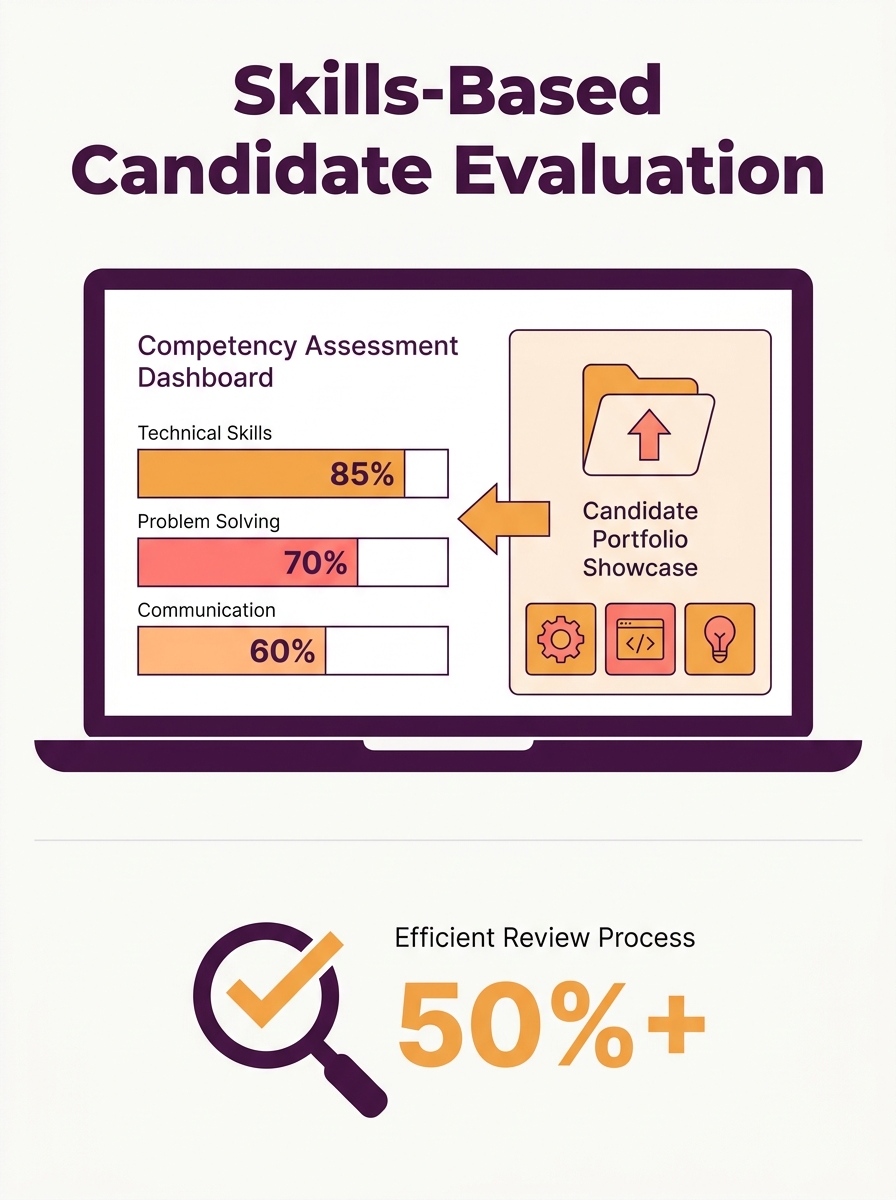
Recruitment technology has evolved to accommodate skills-first evaluation. AI-powered assessments and digital portfolio platforms allow hiring teams to measure candidate performance through structured simulations rather than resume keyword scanning, creating what the report describes as “more transparent, data-driven, and equitable hiring processes.”
The shift requires recalibration of ATS intake filters that historically screened out applicants lacking specific degree credentials. Teams now configure systems to recognize stackable credentials—micro-degrees and digital badges certifying specific technical abilities—alongside or instead of traditional diplomas.
Modern skills-based education models emphasize experiential learning through live projects and internships, industry-aligned curricula developed through corporate partnerships, and continuous professional development rather than terminal degree completion. The report identifies focus areas beyond technical hard skills, including emotional intelligence, critical thinking, creativity, and communication abilities that automation cannot replicate.
Skills Gap Widens as Application Volumes Surge
The workforce faces a documented paradox: job application volumes have surged while employers report unprecedented difficulty filling open roles. The report attributes the disconnect to a widening skills gap—the distance between what degree programs teach in theory and what businesses require in practice.
Traditional degrees emphasize rote memorization and academic theory that may become outdated between enrollment and workforce entry, the analysis notes. By contrast, competency-based models focus on real-world application, problem-solving, and adaptability—capabilities hiring teams can verify through portfolio reviews and practical assessments before extending offers.
Corporate recruiters already rank communication and problem-solving above AI skills in 2026 talent searches, reflecting the premium placed on transferable capabilities over static credentials. The prioritization allows companies to identify existing-workforce talent and map those employees to emerging roles rather than relying exclusively on external hiring.
What This Means for In-House Recruiters
In-house recruiting teams must audit their current applicant tracking system configurations to ensure degree requirements aren’t automatically disqualifying qualified candidates. Many ATS platforms still default to filtering out applicants who lack bachelor’s degrees in their profile data, creating an invisible barrier that contradicts stated skills-first policies.
Recruiters should work with hiring managers to rewrite job descriptions around demonstrated competencies rather than educational pedigree. Replace “Bachelor’s degree required” with specific skill validations: “Proficiency in Python demonstrated through GitHub portfolio” or “Project management certification from recognized industry body.” The language shift signals to candidates that non-traditional pathways are genuinely acceptable and improves application quality by attracting self-taught talent.
The 15.9-times pool expansion figure means teams willing to eliminate degree filters gain access to substantially larger candidate markets—a critical advantage in competitive technical hiring. However, expanded pools require stronger screening frameworks on the back end. Skills-first hiring trades credential shortcuts for competency verification, demanding investment in assessment infrastructure that traditional degree-based screening avoided.