
Building a diverse team isn’t just ethical – it’s smart business. Diverse teams outperform competitors by 36% in profitability, and companies with inclusive hiring practices are 2.6 times more likely to meet financial goals. But many organizations unintentionally limit their talent pool with biased job descriptions, narrow sourcing channels, or subjective hiring criteria.
Here’s how to fix that:
- Audit Your Hiring Process: Analyze each stage of your recruitment funnel to identify where underrepresented candidates drop off.
- Use Data-Driven Insights: Monitor weekly diversity metrics to adjust strategies in real time.
- Write Bias-Free Job Descriptions: Avoid gendered or exclusionary language and focus on essential skills.
- Diversify Sourcing Channels: Collaborate with niche job boards, professional associations, and community organizations.
- Track Metrics Continuously: Use real-time dashboards to measure outreach rates, passthrough rates, and time-to-hire by demographic.
A data-driven approach ensures every candidate gets a fair shot while boosting your company’s performance.
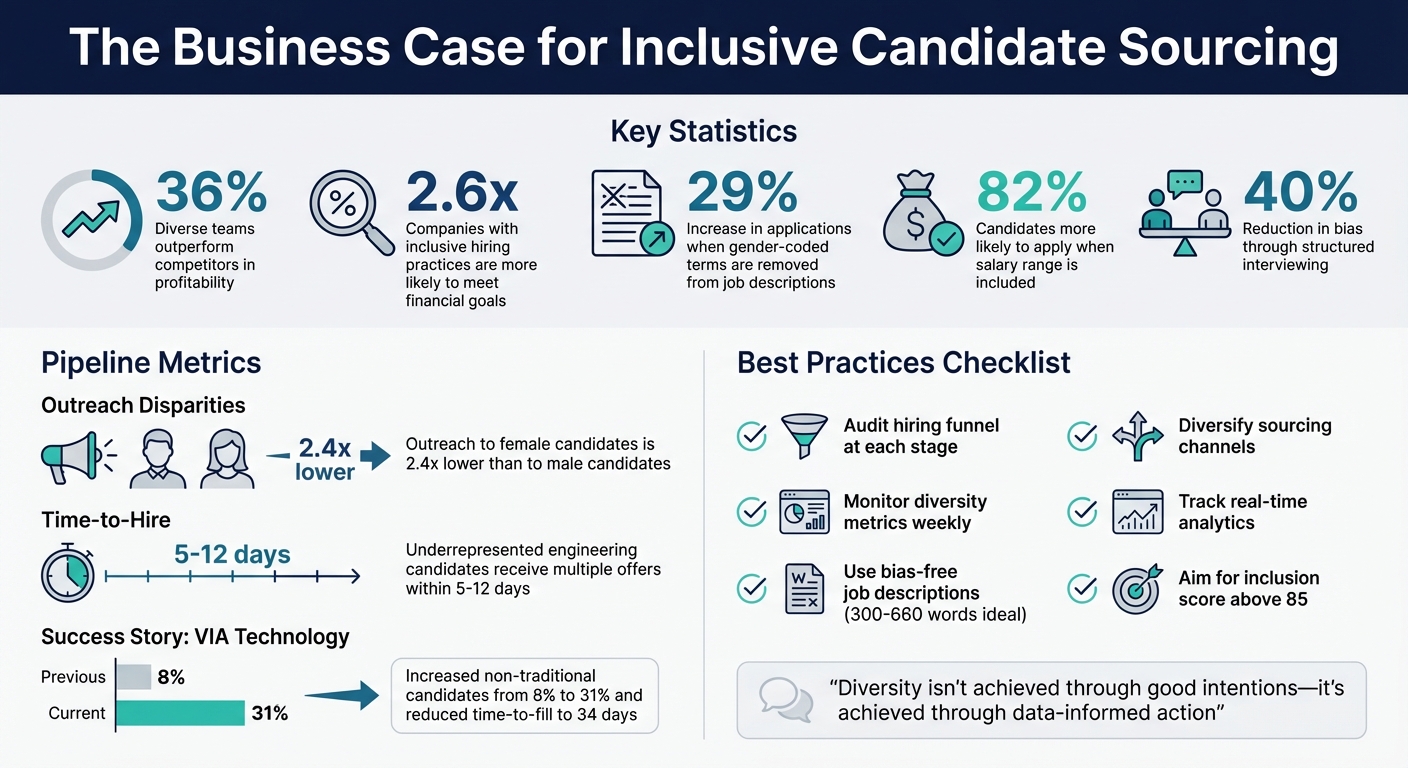
The Business Impact of Inclusive Hiring: Key Statistics and Metrics
How to Build Inclusive Sourcing and Hiring Strategies | The Millionaire Recruiter
Review Your Current Sourcing Process
Take a close look at your recruitment funnel to uncover where diversity gaps might be hiding. Map out every step – from the initial application to recruiter screenings, hiring manager interviews, team evaluations, and final decision-making rounds. Then, calculate the percentages of candidates from underrepresented groups at each stage to see where their representation starts to decline.
If you notice a sharp drop in the proportion of underrepresented candidates as they move from the application stage to the final round, you’ve likely pinpointed a problem area. As diversity consultant Tara Robertson explains:
"To make progress on diversity, Talent Acquisition teams must start using the data from their hiring pipelines in a more effective way".
Instead of grouping candidates into broad categories like "BIPOC" or "URM", break the data down further. Look at specific demographics such as race, ethnicity, gender, and even seniority levels. This detailed approach can reveal trends or biases that might otherwise stay hidden.
Don’t overlook your employee referral program, either. While referrals can be a great resource, they often reinforce existing patterns of homogeneity because people tend to recommend individuals from similar backgrounds. Dive into the data for your referrals and outreach efforts to identify where your pipeline might be losing diversity. For example, research shows that outreach to female candidates is often 2.4 times lower than outreach to male candidates. If this is happening in your process, it’s a clear signal that your sourcing strategy needs adjustment. By collecting accurate data at every stage, you’ll be better equipped to create a more inclusive hiring process.
These steps lay the groundwork for using analytics to address disparities quickly and effectively.
Use Real-Time Analytics for Data Insights
Once you’ve mapped your sourcing process, analytics can help you spot and fix disparities. Instead of relying on annual reports, consider monitoring your data weekly. This approach gives you timely insights, allowing you to address issues before they grow. Tools like Skillfuel’s centralized dashboards make this easier by pulling data directly from your applicant tracking system. These dashboards display diversity metrics for every step of your hiring funnel, offering a clear view of what’s working and what needs improvement.
Set up your dashboard to track key metrics like outreach rates, passthrough rates, and how your numbers compare to local demographic benchmarks. If you notice, for example, that women are advancing from phone screens to onsite interviews at a much lower rate than men, it’s time to dig deeper. Collaborate with hiring managers to explore possible reasons. Are the interview questions favoring certain communication styles? Is the scheduling process unintentionally creating barriers? Surveys can also help, providing both quantitative data and personal feedback from candidates. Combining these insights can help you uncover biases that might otherwise remain hidden, giving you the tools to create a more equitable hiring process.
Create Bias-Free Job Descriptions
Job descriptions are often a candidate’s first interaction with your company, and the language you use can make or break that connection. Research shows that removing gender-coded terms can increase applications by 29%. Words like "dominant", "competitive", or "ambitious" may unintentionally signal a preference for male candidates, while terms like "collaborative" or "empathetic" might lean toward female applicants. The goal isn’t to eliminate these terms altogether but to strike a balance that keeps the language neutral.
Bias isn’t limited to gender. Certain phrases can unintentionally exclude other groups. For example, requiring a "native English speaker" might discourage highly qualified candidates who are fluent in English but not native speakers. A better alternative would be "fluent in English". Similarly, terms like "digital native" or "perfect for new grads" can imply age bias, potentially deterring older, experienced professionals. Even physical requirements can be rephrased to be more inclusive. For instance, instead of "must be able to lift 50 lbs", consider "able to move equipment up to 50 lbs".
Keeping your language simple and direct is also key. Avoid buzzwords like "rockstar", "ninja", or "low-hanging fruit", which can confuse candidates and alienate those unfamiliar with such jargon. Women, in particular, tend to apply only when they meet all listed requirements, so focus on essential skills and highlight opportunities for growth. This approach not only promotes inclusivity but also aligns with data-driven sourcing strategies by ensuring your job postings appeal to a broader audience.
The ideal length for a job description is between 300 and 660 words. This range provides enough detail to clarify expectations without overwhelming potential applicants. Including a salary range is another best practice. Transparency in pay encourages 82% of candidates to apply, addressing wage gaps and attracting talent from a variety of socioeconomic backgrounds.
Once your draft is ready, take a moment to review the language for hidden biases.
Check Language for Bias
Identifying biased language on your own can be tricky, as unconscious habits often influence how we write. Augmented writing tools can help by scanning your job descriptions in real time, flagging problematic phrases, and suggesting inclusive alternatives. These tools analyze bias across multiple dimensions – such as gender, race, age, and disability – and provide an inclusion score to guide your revisions.
Here’s a quick reference table with examples of biased terms and their inclusive replacements:
| Instead of (Biased/Jargon) | Use (Inclusive/Clear) | Category |
|---|---|---|
| Chairman | Chair or Chairperson | Gender-Neutral |
| Native English Speaker | Fluent in English | Racial/Cultural |
| Rockstar / Ninja | Skilled or [Specific Qualities] | Jargon |
| Must be able to walk | Must be able to move/traverse | Disability |
| Grandfathered | Legacy | Racial Connotation |
As Jessica Khoshnood, Senior Customer Marketing Manager at Textio, puts it:
"A job description is never going to be just a single word. It’s how you’re balancing some of that biased language throughout… to make sure that you’re getting to, in the end, a neutral tone".
Job descriptions with an inclusion score above 85 often see higher application rates and lower costs per applicant. To maintain consistency, consider creating an internal diversity style guide that lists biased words to avoid and inclusive alternatives. This ensures all hiring managers can craft equitable job postings from the start.
Skillfuel’s tools, like real-time analytics and customizable diversity guides, make it easier to create bias-free job descriptions. These features integrate seamlessly into a broader strategy for inclusive recruitment, helping you attract and retain diverse talent pools.
sbb-itb-e5b9d13
Use Multiple Sourcing Channels
Sticking to just one recruitment channel can restrict your reach and result in a less diverse candidate pool. To create a more inclusive hiring process, it’s important to branch out and use various sourcing methods. Social media platforms like Facebook and LinkedIn not only allow you to share your company’s mission and values but also help attract a broader range of candidates while simplifying candidate tracking.
Employee referrals and collaborations with organizations focused on diversity are also excellent ways to widen your talent pool. Referred candidates often bring added benefits: they tend to be more qualified, accept offers more readily, and stay longer with the company. At the same time, working with niche job boards, professional associations, Historically Black Colleges and Universities (HBCUs), and community groups connects you directly with underrepresented candidates who might not frequent traditional job boards.
Expanding your sourcing channels also creates opportunities to improve internal programs like employee referrals.
Use Employee Referral Programs
When designed thoughtfully, employee referral programs can significantly enhance diversity in hiring. Traditional referral systems sometimes lead to homogeneity since employees often recommend people from similar backgrounds. To counter this, make diversity a clear priority in your referral program materials and ensure leadership visibly supports these goals. As HR expert Dr. John Sullivan explains:
"Literally, every real or imagined reason why, historically, employee referral programs might have had a negative impact on diversity can now be identified and neutralized".
Instead of focusing solely on monetary rewards, consider positioning referrals as a way to build stronger, more skilled teams. This shift in perspective can encourage employees to recommend candidates who bring new strengths to the table. Expanding eligibility to include former employees, contractors, vendors, and even relatives can also help diversify the referral pool, especially if your current workforce lacks diversity. Offering guidance on where to find diverse talent – like industry events, certification programs, or community groups – can further improve outcomes.
Another effective strategy is implementing a "name-only" referral system, where employees provide just the name and LinkedIn profile of a candidate. Pinterest successfully used this approach to minimize unconscious bias and improve diversity hiring. Companies like Intel and Accenture have also seen positive results by offering higher bonuses for diverse referrals. To keep employees engaged, use digital tools to provide real-time updates on referral progress. For example, Skillfuel’s referral tracking feature automates communication, manages incentives, and offers transparency – all in one place.
While employee referrals strengthen internal diversity, partnerships with external organizations can broaden your reach even further.
Work with Diversity Organizations
Teaming up with organizations that support underrepresented groups is a direct way to access a wider talent pool. Niche job boards designed for specific demographics can help you connect with candidates who may not frequent general job platforms. Similarly, professional associations that focus on marginalized groups can provide valuable networking opportunities.
Building relationships with HBCUs and local colleges can help diversify your pipeline for entry-level roles. Engaging with historically Black sororities and fraternities also opens doors to established professional networks. Local community organizations, schools, and media outlets catering to specific demographic groups are another way to reach emerging talent. When reaching out through these specialized channels, personalizing your communication – by referencing at least two specific details about the candidate’s skills or experience – can boost response rates and show genuine interest. Tools like Skillfuel’s applicant tracking system make it easier to manage candidates from multiple sources while ensuring consistent, personalized engagement.
Monitor and Improve Diversity Metrics
Using real-time data insights is just the beginning – continuously tracking diversity metrics is how you truly refine your recruiting strategy. This isn’t a one-and-done task. It’s an ongoing process of evaluating what’s working and identifying areas for improvement. Real-time analytics make it possible to turn diversity into measurable, actionable data. And the payoff is clear: companies with inclusive hiring practices are 2.6 times more likely to meet financial goals, and diverse organizations outperform their competitors by 36% in profitability. But these outcomes depend on tracking the right metrics and acting on the data.
Take a close look at funnel passthrough rates to understand where underrepresented candidates might be dropping out. For instance, if your interview-to-offer ratio shows that diverse candidates don’t advance as often, it could point to inconsistent standards being applied by interview panels. Similarly, tracking offer acceptance rates by demographic can shine a light on issues like pay inequities or concerns about company culture that may cause candidates to decline. As HR experts Joan C. Williams and Jamie Dolkas remind us:
"We measure what we treasure".
Another key metric is time-to-hire by demographic. In competitive fields like engineering, underrepresented candidates often receive multiple offers within 5 to 12 days. If your hiring process is slower, you risk losing top talent. Analyzing outreach response rates can also help you determine if your messaging resonates with all groups or if certain language unintentionally alienates underrepresented candidates. Real-time dashboards can take these metrics to the next level, giving you a clearer picture of where adjustments are needed.
Set Up Real-Time Diversity Tracking
Real-time dashboards are a game-changer for monitoring diversity efforts, offering instant visibility and enabling quick course corrections. Tools like Skillfuel’s dashboards integrate ATS data to visualize trends in diversity. Use these dashboards to track metrics like diversity sourcing ratios, ensuring your pipeline is truly inclusive.
Break down representation at each stage – application, screening, interview, and offer – to pinpoint where biases might creep in. For example, if diverse candidates pass initial screenings but drop off during hiring manager interviews, implementing structured interviews could help. Research shows that structured interviewing can reduce bias in hiring outcomes by up to 40%. To make this process effective, assign clear ownership for each metric. Recruiting operations teams might oversee data quality, while hiring managers ensure interview panels are diverse. When everyone understands their role and the metrics they’re responsible for, tracking diversity becomes part of your team’s routine, not just an occasional focus.
Conclusion
Creating a sourcing strategy that truly includes everyone starts with using data to make meaningful changes. By auditing your process, removing biased language, broadening your outreach channels, and monitoring metrics in real-time, you can build a system that ensures every candidate gets a fair shot.
Skillfuel’s platform brings all these elements together. Its applicant tracking system (ATS) provides a centralized view of your hiring pipeline, helping you identify where diverse candidates might be falling off. With real-time analytics dashboards, you can track diversity sourcing ratios, conversion rates between stages, and time-to-hire by demographic – giving you the tools to address issues quickly. Plus, employee referral tracking helps you tap into new networks and underrepresented talent pools.
Industry leaders echo this data-driven approach. Miriam Groom, CEO of Mindful Career Coaching, highlights the importance of taking action based on insights:
"Diversity isn’t achieved through good intentions – it’s achieved through data-informed action".
This approach works. VIA Technology in San Antonio used ATS data to revamp their screening criteria, boosting their slate of non-traditional candidates from 8% to 31% and reducing their time-to-fill to just 34 days.
The numbers speak for themselves. Companies with inclusive hiring practices are 2.6 times more likely to meet financial goals, and diverse teams outperform their competitors by 36% in profitability. But these outcomes depend on measuring the right metrics and acting on the results.
Start small: pick one metric, track it weekly, and adjust your approach based on what you learn. By committing to this process, you can turn diversity from a goal into a measurable reality while driving growth for your organization.
FAQs
How can I remove bias from my job descriptions to attract diverse candidates?
To craft job descriptions that welcome a diverse range of applicants, start by using neutral and inclusive language. Steer clear of gendered terms or expressions that might unintentionally discourage some candidates. For instance, swap out "he/she" for "they" or "their." It’s also a good idea to review job requirements carefully – make sure they are truly necessary and not overly restrictive. For example, avoid listing physical or educational qualifications unless they are critical for the role, as these can unnecessarily narrow your candidate pool.
Using tools that flag biased or coded language can be a game-changer. These tools can help you spot words or phrases that might unintentionally favor certain groups over others. Including a statement in your job descriptions about your organization’s commitment to diversity, equity, and inclusion (DEI) can also send a strong message that your workplace values inclusivity. Lastly, ensure your hiring managers are trained to recognize and address unconscious bias so the focus stays squarely on candidates’ skills and qualifications.
How can I effectively expand and diversify my candidate sourcing channels?
To widen your candidate sourcing efforts, consider branching out from conventional job boards and tapping into platforms that connect with a wider variety of talent. Look into niche job sites, social media channels, and professional networks that cater to underrepresented communities. Make sure to create inclusive job postings and set clear diversity objectives to appeal to a broader audience.
Collaborating with organizations and groups that advocate for underrepresented talent is another effective way to engage directly with diverse candidates. Additionally, tools like real-time analytics and applicant tracking systems can help pinpoint gaps in your sourcing strategy, allowing you to refine your approach to promote inclusivity. These methods not only expand your talent pool but also contribute to a fairer and more balanced hiring process.
How does real-time analytics support inclusive hiring practices?
Real-time analytics can make a big difference in creating a fairer and more inclusive hiring process. These tools provide instant insights into every step of your recruitment funnel, helping you track diversity metrics and spot where underrepresented candidates might be facing obstacles or dropping out. With this information, you can quickly tweak job descriptions, outreach efforts, or screening methods to make the process more inclusive.
These analytics also shine a light on unconscious biases that may exist in sourcing, screening, or selection, helping ensure that every candidate is treated fairly. Plus, they allow you to measure how effective your diversity initiatives are, so you can see if your efforts are driving real change. By using real-time data, you can build a hiring process that’s not only more transparent but also better aligned with your goals for diversity and inclusion.