Hiring foreign workers in Peru involves navigating strict labor and immigration requirements. Employers must comply with local workforce composition rules, secure contract approvals, and handle visa applications. Here’s a quick breakdown of the process:
- Workforce Limits: Foreign employees cannot exceed 20% of the workforce or 30% of the payroll (exceptions apply for specialized roles).
- Eligibility: Employers must justify hiring foreign workers by proving the role requires skills unavailable locally.
- Hiring Options: Choose between direct employment (if you have a local entity) or using an Employer of Record (EOR) for administrative support.
- Contracts: Draft contracts in Spanish, meeting Peruvian labor laws, and get them approved by the Ministry of Labor.
- Visa Process: Collect all required documents (e.g., passports, criminal records, employment contracts), ensure translations and apostilles, and submit applications either in Peru or via consulates.
- Post-Arrival: Register with Migraciones, provide biometric data, and obtain the Carnet de Extranjería (foreign ID card).
- Compliance: Track visa expirations, report employment changes, and register workers with tax and social security systems.
Proper planning and attention to detail are key to avoiding delays or penalties.
Pre-Hiring Requirements and Eligibility Checks
Before posting job openings in Peru, employers need to comply with specific workforce composition rules and decide on a hiring approach. Using recruitment tools like Skillfuel (https://skillfuel.com) can simplify the process by centralizing compliance tracking and ensuring no steps are overlooked. Here’s a breakdown of the key compliance and eligibility checks for hiring in Peru.
Workforce Composition Rules
Peruvian labor laws require that at least 80% of your workforce consists of Peruvian nationals. Additionally, foreign employees cannot exceed 20% of the total workforce, and their combined salaries must account for less than 30% of the total payroll. For example, if your company has 50 employees, you can hire up to 10 foreign workers, provided their salaries stay within the allowed percentage of the payroll. Exceptions to these limits may apply for highly skilled professionals or executives, but such cases require approval from the Ministry of Labour.
Verify Role Eligibility for Foreign Workers
Not all job roles are open to foreign worker sponsorship. Employers must demonstrate that the position requires specialized skills or expertise that cannot be sourced locally. This involves documenting the specific qualifications and expertise needed for the role and explaining why domestic talent cannot fulfill the requirement. These justifications are critical when submitting your application to the Ministry of Labour for approval.
Decide on a Hiring Approach: Direct Employment or Employer of Record
When hiring foreign talent in Peru, you have two main options:
- Direct Employment: If your business has a local entity, you can manage the entire process yourself. This includes overseeing compliance, securing contract approvals, and handling visa applications. This method gives you full control over the employment relationship.
- Employer of Record (EOR): If managing the hiring process locally isn’t feasible, an EOR can act as the official employer in Peru. While the EOR handles compliance and administrative tasks, you maintain control over the worker’s day-to-day responsibilities.
Choose the approach that aligns best with your company’s local resources, HR capabilities, and growth objectives.
Employment Contracts and Ministry Approval
After completing pre-hiring checks, the next step is to formalize employment terms and secure the necessary government approvals. Following local laws is crucial to avoid delays in the onboarding process. Below, we’ll cover how to draft compliant contracts and navigate the Ministry of Labor’s approval process.
Drafting Contracts in Line with Peruvian Labor Laws
Employment contracts in Peru need to be drafted in Spanish and include all legally required clauses. These contracts should clearly define the employee’s job title, responsibilities, salary, benefits, working hours, and the duration of the agreement. Employers must ensure that the terms meet Peru’s minimum wage requirements and include essential benefits such as vacation time, health insurance, and social security contributions.
To prevent issues during the approval process, contracts must strictly align with local labor regulations. Be sure to include termination procedures, confidentiality clauses (if applicable), and any specific terms related to the employee’s role. For part-time employees, remember that these contracts also need to be registered with the Labor Ministry.
Once the contract meets all legal requirements, it can be submitted for official approval.
Submitting Contracts to the Ministry of Labor
Employers are required to submit employment contracts to the Ministry of Labor (Ministerio de Trabajo y Promoción del Empleo – MTPE) for approval or registration, particularly for foreign workers. This step is a critical part of the work permit application process for non-Peruvian employees.
The submission package must include the employment contract, a declaration confirming compliance with foreign personnel limits (or proof of any granted exemptions), and a sworn statement verifying the employee’s qualifications.
Since processing times can vary, it’s essential to ensure that all documentation is accurate and complete to avoid unnecessary delays. Even a minor error or a missing document could extend the approval timeline by weeks.
To stay on track, monitor the submission status regularly, respond quickly to any additional requests from the Ministry, and keep a detailed record of all documents, submission dates, reference numbers, and related communications. This level of organization can make the process smoother and help avoid setbacks.
Required Employee Documentation
Once the employment contract is approved, gathering all necessary documents from both the employee and the employer is essential. Missing paperwork can cause delays, so attention to detail is key. Below is a breakdown of the required documents for a complete work visa application.
Personal Documents from the Employee
Foreign employees must provide a valid passport with at least six months of validity beyond their arrival date, along with a copy of the personal data page .
A criminal record certificate is also required. For resident work visas, this should cover the past five years from all countries where the individual has legally resided. For temporary work visas, a sworn statement is typically sufficient. Migraciones usually requests this certificate from the applicant’s home country.
Additional documents include educational certificates, licenses, and academic credentials that are relevant to the job position. These should directly align with the role described in the approved employment contract.
Applicants must also submit passport-sized photographs, a medical certificate, and completed visa application forms . In some cases, a birth certificate may also be requested.
Before applying for the visa, employees need to obtain the "Ficha de Canje Internacional" from Interpol in Peru. Temporary work visa applicants should ensure their "Permit to sign contracts" is valid when submitting the sworn statement regarding criminal records.
Supporting Documents from the Employer
Employers are required to provide documents that confirm the employment arrangement. This includes the approved Ministry employment contract. For independent resident work visas, the employer must submit a legally signed service contract with a duration of at least 12 months.
Translation and Apostille Requirements
To ensure the process runs smoothly, all foreign documents must be translated into Spanish by a certified translator. They must also be authenticated through apostille or legalization, following the Hague Convention guidelines. Typically, only documents issued within the last six months are accepted. For online submissions, ensure each PDF file is under 3MB.
Timing is critical during this phase. Obtaining criminal record certificates from home countries can take weeks, and apostille services may vary depending on the issuing country. Starting early and keeping track of document expiration dates can help avoid unnecessary delays. Staying organized is crucial for a seamless application process.
Work Visa Application Process
Once all the required documents are ready, the next step is figuring out where and how to submit the work visa application. The submission process depends on whether the applicant can enter Peru without a visa.
Choose the Right Filing Location
For citizens of visa-free countries, the process begins after entering Peru as tourists. Once in the country, they can apply for a change of immigration status directly through Migraciones, also known as DIGEMIN. This process, called "Cambio de calidad migratoria," allows tourists to transition to work visa status without leaving Peru.
On the other hand, nationals from countries requiring a tourist visa must take a different route. They need to apply for a residence visa at a Peruvian consulate in their home country before traveling to Peru. This external process tends to be more involved and time-consuming.
Since August 2021, Peruvian consulates have shifted their focus primarily to tourist and business visa applications. For temporary or residence visas, including work visas, applicants are now generally directed to Migraciones within Peru.
Submit Your Visa Application
Once the filing location is determined, applicants must follow the specific submission process based on their situation. For those applying within Peru, the Migraciones Agencia Digital platform is used. Here, all required documents must be uploaded electronically in PDF format.
The application package should include the Ministry-approved employment contract, all personal documents with apostille certifications, and the completed visa application form. After successful submission, the system generates a confirmation document called the "Registro de Solicitud de Cambio de Calidad Migratoria." This document contains important tracking details.
For those applying through a consulate, the process follows traditional diplomatic channels. However, consulate applications can take significantly longer, ranging from weeks to several months.
Monitor Your Application and Respond to Requests
After submitting the application, it’s crucial to stay on top of updates. For applications submitted via Migraciones Agencia Digital, applicants receive a "Numero de expediente" (file number) and access to a "Buzón electrónico" (electronic mailbox). The confirmation document includes key tracking information such as the file number, application date, verification code, and login credentials for the electronic mailbox.
The electronic mailbox serves as the primary communication hub, where applicants receive updates, requests for additional documents, and status notifications. Employers should remind their foreign workers to check this mailbox regularly and respond quickly to any messages.
For consulate applications, the tracking process may differ. Employers should confirm the specific procedures with the consulate managing the application to ensure nothing is missed.
sbb-itb-e5b9d13
Post-Arrival Registration Requirements
Once your work visa is approved, there are a few final steps to complete after arriving in Peru to ensure you’re fully authorized to work.
Register with Migraciones and Submit Biometric Data
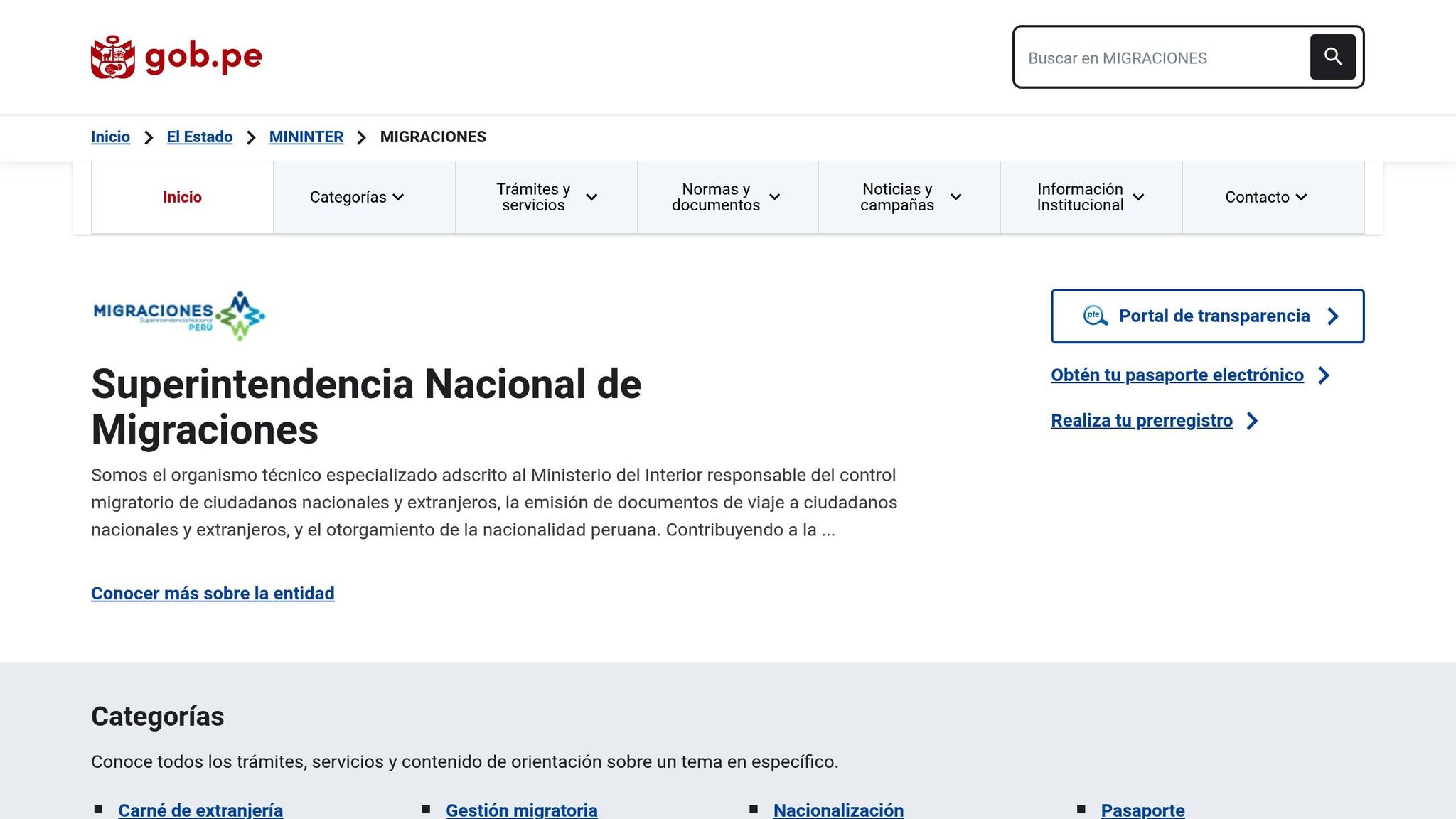
After landing in Peru with your approved work visa, your first stop is the National Superintendency of Migration (Migraciones). Here, you’ll need to register to finalize your immigration process. As part of this registration, you’ll provide biometric data, including fingerprints and photographs, which will be added to your immigration record.
It’s crucial to schedule this appointment as soon as you arrive. Any delays could affect your legal work status and make the rest of the process more complicated.
Obtain the Carnet de Extranjería
Once your biometric registration is complete, the next step is to secure your Carnet de Extranjería, Peru’s official foreign identification card. This card not only confirms your immigration status but also serves as proof of your work authorization in the country.
The Carnet de Extranjería includes key details like your immigration status, work authorization, and expiration dates. It’s important to note that the card itself usually expires after four years (three years for minors, five years for permanent residents), while your residence visa generally needs to be renewed annually. Keep track of both dates to avoid any legal issues.
If any of your personal information changes – such as your passport details, name, marital status, address, or employer – you’re required to update your Carnet de Extranjería within 30 days by filing an "Actualización de datos" with Migraciones. Missing this deadline will result in a fine of $15 USD (PEN 53.50) for each month your information remains outdated.
Additionally, failing to renew your residence visa on time carries a fine of $15 USD (PEN 53.50) per day of delay. To avoid these penalties, make sure to update your information promptly and renew your visa at least a month before it expires. Employers can help by setting up tracking systems to remind foreign employees of these deadlines well in advance.
Employer Compliance Responsibilities
When hiring foreign workers in Peru, employers take on a range of ongoing responsibilities that extend well beyond securing a visa. Staying compliant with Peruvian labor and immigration laws requires consistent attention to several key areas.
Monitor Visa Expiration and Renewal Deadlines
Keeping track of visa expiration dates is critical to avoid fines or disruptions. In Peru, work permits are typically tied to specific locations. Missing a renewal deadline can lead to penalties for both the employer and the employee, so careful monitoring is a must.
Notify Authorities of Employment Status Changes
Significant changes in a foreign worker’s employment – like promotions, terminations, transfers, or changes in work location – must be reported promptly to the relevant authorities. To ensure accuracy and compliance, always document these changes in writing and update work authorizations as needed.
Maintain Up-to-Date Documentation
Employers are required to keep detailed and current records of each foreign employee’s immigration status. Key documents include the approved employment contract (or the version submitted to the Ministry of Labor for exemptions), the worker’s visa, and their Foreigner Immigration Card (Carné de Extranjería). These record-keeping duties often overlap with other obligations, such as tax filings and payroll management.
Tax Registration and Payroll Setup
Once all immigration documents are finalized, the next step is setting up tax registration and payroll to ensure compliance with Peru’s employment laws. After obtaining visa approval, employers must register foreign workers with Peru’s tax and social security systems.
Register Foreign Workers with SUNAT
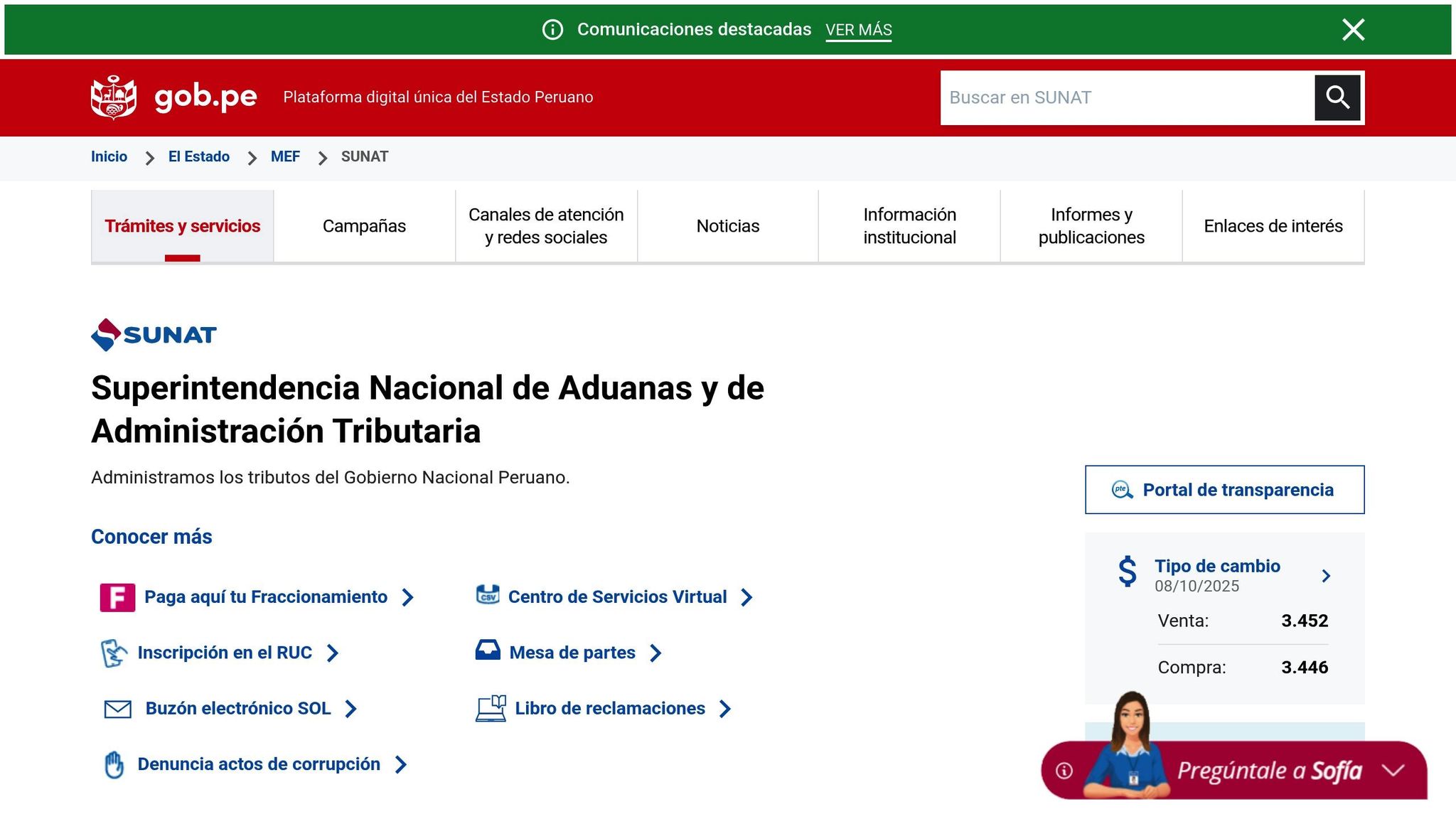
In Peru, foreign workers need to be registered with SUNAT, the national tax authority, to secure a tax identification number (RUC) and ensure proper income tax withholding. This process typically involves submitting the worker’s Carnet de Extranjería, passport details, and employment contract. Employers are required to start withholding income tax from the worker’s very first paycheck and must file monthly tax reports. Keeping accurate records of withholdings, payments, and reconciliations is crucial in case of future audits.
Enroll Employees in Pension and Social Security
Under Peruvian labor laws, all employees – both local and foreign – must be enrolled in the pension and social security systems. Employees have the option to choose between the state pension system (ONP) and private pension fund administrators (AFP), with enrollment required within the first month of employment. Additionally, employers must register employees with EsSalud, Peru’s public healthcare system, to guarantee access to healthcare services. Employers are also responsible for arranging workers’ compensation insurance and ensuring all policies remain up to date.
Skillfuel simplifies the onboarding process by streamlining documentation and tracking for foreign hires, making the transition smoother for both employers and employees.
Conclusion: Key Steps for Hiring Foreign Workers in Peru
Hiring foreign workers in Peru involves navigating a detailed process that demands careful compliance and accurate documentation at every stage. It starts with pre-hiring evaluations, securing contract approvals, and initiating visa applications. Each step, from initial screening to post-arrival procedures, plays a crucial role in ensuring a smooth transition.
To begin, make sure all employee documents are complete, properly translated, and certified with an apostille. The visa application process requires choosing the correct filing location and maintaining consistent communication with immigration authorities during the review period.
Once the visa is approved, employers must handle post-arrival tasks such as registering with Migraciones, capturing biometric data, and obtaining the Carnet de Extranjería. It’s also essential to monitor visa expiration dates, report any changes in employment status, and keep documentation up to date.
Additionally, new hires must be registered with SUNAT and enrolled in Peru’s social security and pension systems within their first month of employment. These final steps are critical to ensuring full compliance with Peruvian labor laws.
FAQs
What are the exceptions to Peru’s workforce composition rules for hiring foreign employees?
Peru places restrictions on the employment of foreign workers, generally capping them at 20% of the total workforce or 20% of the payroll. That said, there are exceptions to this rule. For instance, managerial or technical roles that demand specialized skills or higher salaries often fall outside these limits. Additional exemptions may also apply in industries or positions where local expertise is scarce.
Employers need to thoroughly understand these exceptions and adhere to Peruvian labor regulations when bringing foreign employees on board.
How can employers prove that a job requires skills not available locally when hiring foreign workers in Peru?
Employers can show that a job demands specialized skills unavailable locally by proving there are no qualified candidates within the region. This typically involves labor market testing, such as posting the job locally and keeping records of the lack of suitable applicants.
To strengthen their case, employers should emphasize the foreign worker’s distinct qualifications. These might include rare certifications, extensive experience, or expertise in a specific industry that’s hard to find among local candidates. Clear documentation of these qualifications can help satisfy legal requirements and justify the decision to hire from abroad.
How can citizens of visa-free countries switch from a tourist visa to a work visa in Peru?
If you’re from a visa-free country and looking to switch from a tourist visa to a work visa in Peru, the first step is landing a job offer from a Peruvian employer. Your prospective employer will handle the sponsorship for your work visa by submitting the necessary documents – like your signed employment contract – to Migraciones, Peru’s immigration authority.
Once the sponsorship is approved, your next move is applying for the work visa at either a Peruvian consulate or a local immigration office. The entire process usually takes about 1 to 2 months, though this can vary depending on your specific case and the completeness of your paperwork. Double-check that all your documents are accurate and properly prepared to avoid any unnecessary delays.