
For a long time, the standard way to hire was simple: post a job, require a specific degree, and look for big-name companies on a resume.
That might appear safe and predictable, but it’s a deeply flawed way of building a team. Just because someone studied at a prestigious university or worked at a famous company doesn’t mean they have the skills needed for your current challenges. This method filters out millions of capable, high-performing workers.
Most companies are now realizing this. Not surprisingly, nearly two-thirds of respondents in a survey confirm using skills-based hiring.
Wondering how skills-based hiring can help you find the talent you need? We’ll break that down here. But before that, let’s dive into the issues with traditional credential-based hiring.
What is the Issue With Traditional Credential-Based Hiring?
Traditional hiring practices have long relied on educational credentials as a shorthand for intelligence, discipline, and workplace readiness.
However, this reliance has led to a phenomenon known as degree inflation or upcredentialing. Employers demand degrees for roles that historically did not require them and whose daily tasks do not necessitate four years of higher education.
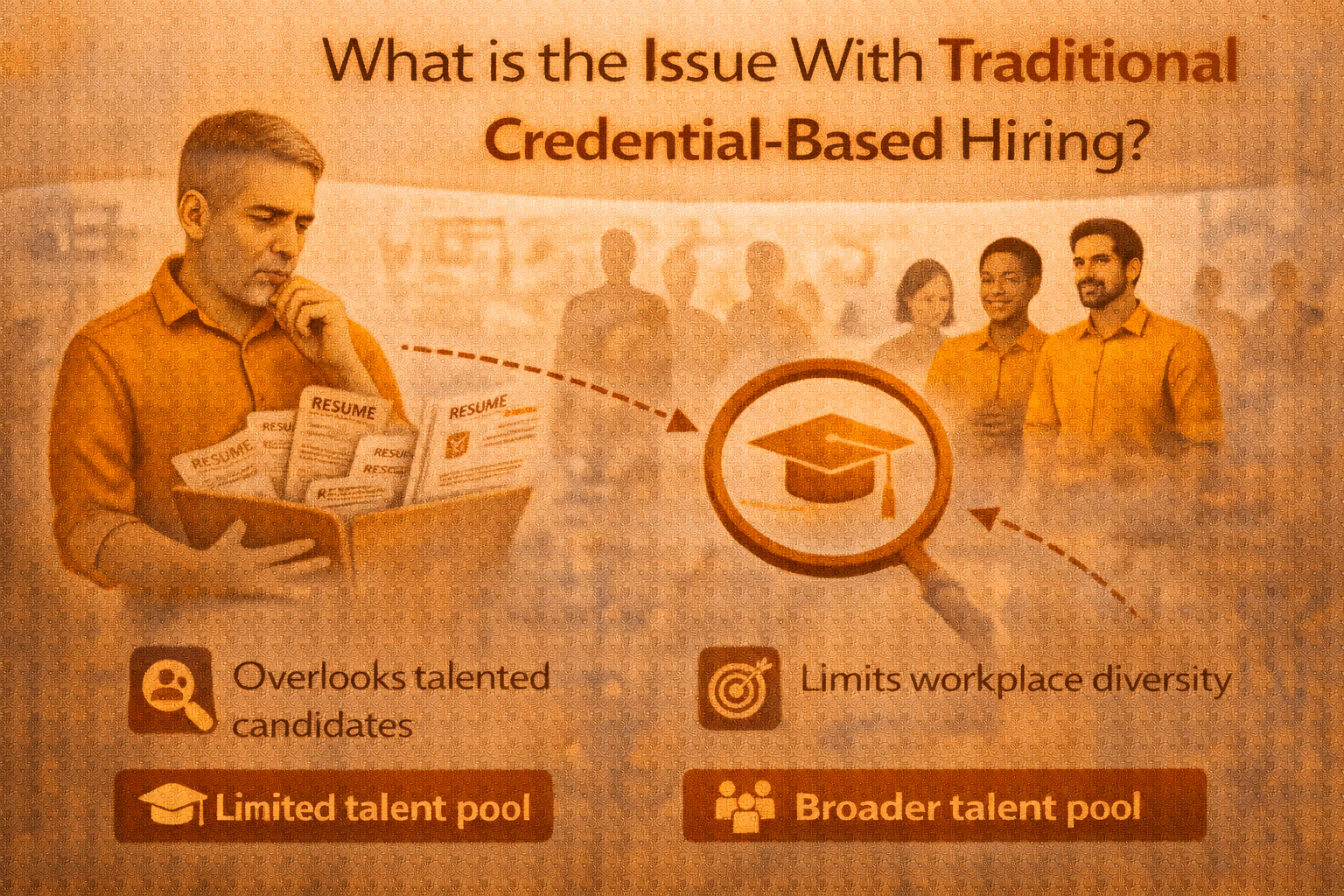
This devalues degrees and creates unnecessary market friction. It also causes an artificial labor shortage by locking out talented workers who lack specific paperwork.
Traditional hiring also relies too much on resumes and fancy college names, which often gives an unfair advantage to people from wealthy backgrounds.
In elite fields like banking and consulting, talent is often judged by status rather than actual skill.
When companies only hire from top-tier universities, they ignore great candidates who couldn’t afford those schools or didn’t have the right connections. This creates an invisible escalator for the privileged, leading to a workforce that lacks the diverse ideas needed to solve modern, global problems.
How Skills-Based Hiring Helps You Find the Right Talent?
Here’s how skills-based hiring helps you find the talent you need:
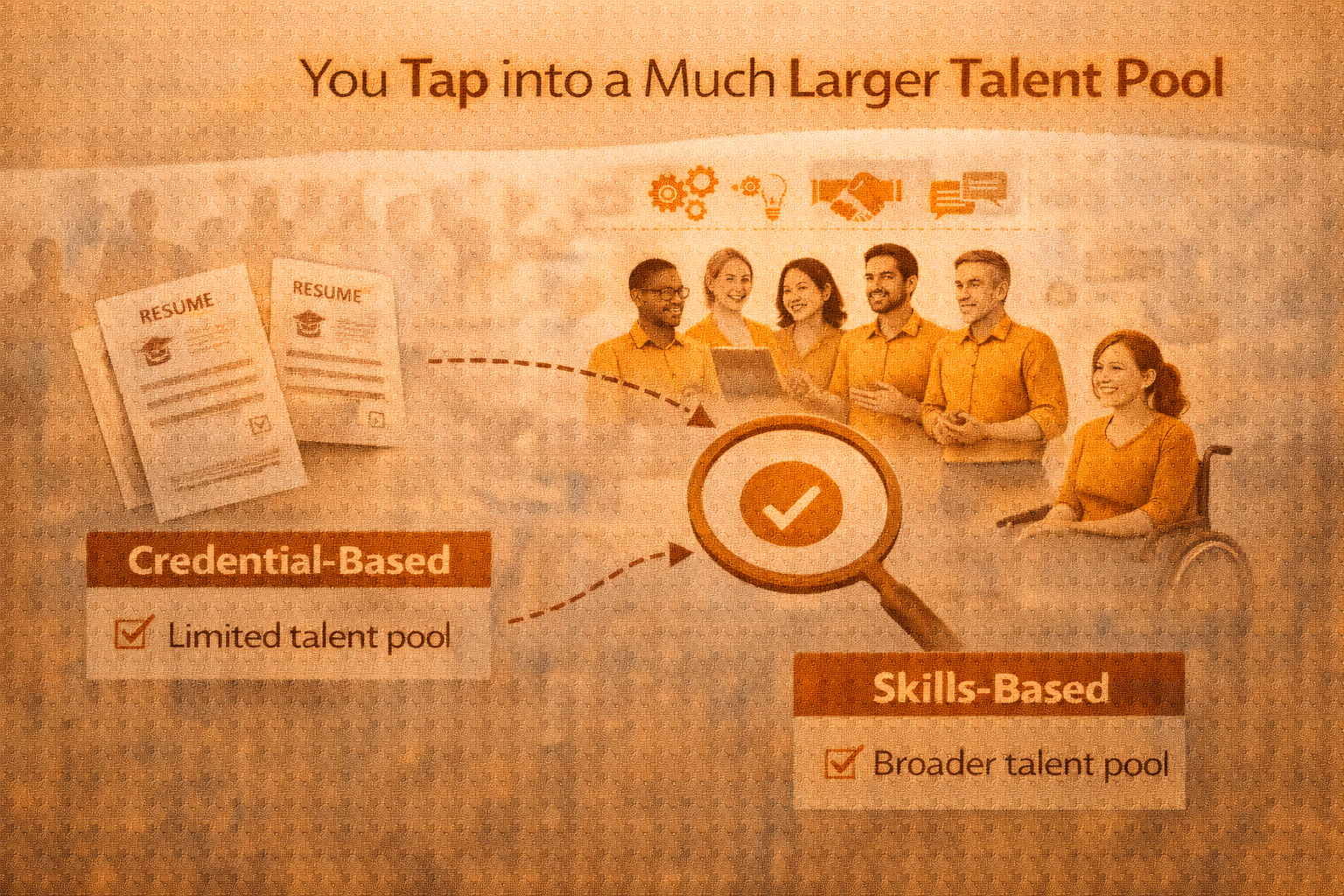
1. You Tap into a Much Larger Talent Pool
The biggest win for skills-based hiring is simple: it opens the door to millions of talented workers. You get to tap into the 70 million American workers classified as Skilled Through Alternative Routes (STARs).
These individuals have acquired their expertise through military service, community college, on-the-job experience, or intensive training programs like boot camps. In the current economic climate, where 71% of U.S. employers report that they cannot find the talent they need, this matters.
Research shows that it currently takes a STAR worker 30 years to reach the same wage that a college graduate earns on the first day of their career. This gap is not a reflection of a lack of skill but a lack of recognition.
Relying on degrees as a hiring filter has a major impact on fairness and equity. When employers make a degree mandatory, they automatically block more than half the population from even applying.
This barrier hits minority communities the hardest. Due to historical and economic factors, many talented Black and Hispanic workers are more likely to have gained their skills through alternative routes rather than a traditional university.
The government is leading the way in showing how skills-based hiring can work. In 2022, for instance, Maryland removed degree requirements for thousands of state jobs. This was so successful that other states also decided to do the same thing.
2. You Hire for Potential, Not Just History
Technology moves so fast today that what a student learns in their first year of college might be outdated by the time they are ten years into their career.
Skills-based hiring solves this problem. Instead of looking at what someone studied years ago, companies focus on what that person can actually do right now. It prioritizes a candidate’s current talent and their ability to learn new things quickly, rather than just their old academic history.
When you test a candidate by asking them to solve a real-world problem or complete a work sample, you are measuring their ability to perform right now. Traditional hiring, which looks mostly at degrees, only measures their starting line, where they were years ago when they began their career.
Even in highly specialized fields, how candidates acquire skills is changing. Someone looking to lead a corporate training department or influence educational policy might pursue a Doctorate of Education online while working full-time.
A Doctor of Education (Ed.D) is a terminal degree that combines academic study with practical experience. Marymount University explains that Ed.D. courses prepare professionals to drive change in a variety of situations by deepening their understanding of teaching and learning.
At the surface, it might look like they have just gained a title. But in reality, their degree, which they chose because of flexibility, demonstrates excellent time management and digital literacy skills.
When you value the skills gained through that online doctorate, not just the format of the degree, you find candidates who are both academically rigorous and deeply practical.
3. You Reduce Bias and Build Fairer Hiring Processes
Traditional hiring is often affected by unconscious bias. Recruiters often favor people who have similar backgrounds to their own or who graduated from prestigious universities. Unfortunately, these cultural fits often lead to culture clones, which stifles innovation and creates a lack of diversity.
Skills-based hiring makes the process more objective. It focuses on what a person can actually do. That way, every applicant is judged on their talent rather than their connections.
Traditional unstructured interviews are often no more effective at predicting job success than a coin toss.
Skills-based hiring replaces gut instinct with standardized, objective data. Structured interviews, where every candidate is asked the same set of behavior-based questions and rated on a common scale, predict future performance more accurately.
Pre-employment assessments, such as cognitive ability tests and personality profiles, provide further objective data points. When these tools are used, organizations are more likely to achieve their diversity and inclusion goals.
In short, the companies winning the talent game aren’t necessarily offering the highest salaries or the fanciest perks. They are the ones prioritizing skills over credentials.
When you stop looking at a candidate’s degree and start looking at their skills, you get better results. It turns the search for talent from a narrow filter into a wide-open door, ensuring your team is built on what people can actually achieve.
And perhaps most importantly, you send a powerful message to candidates: If you have the skills, you belong here. That’s not just good hiring; it’s good business.
Author Bio: Gaurav Gupta is a passionate writer with a knack for exploring complex topics. When he’s not crafting engaging content, he enjoys exploring nature trails, experimenting in the kitchen, and strumming his guitar. His diverse interests fuel his creativity, resulting in insightful and relatable articles.