Gut feelings are not enough. Real-time analytics transforms hiring by providing instant data insights, helping you make faster, better decisions. Here’s why it matters:
- 83% of HR leaders believe in data-driven decisions, but only 37% use data actively.
- Real-time analytics reduces time-to-fill by 30% and improves quality-of-hire by 20%.
- It identifies bottlenecks (e.g., slow interview scheduling) and tracks key metrics like application completion rate and source effectiveness.
- AI tools process applications 3x faster with 87% accuracy, cutting time-to-hire significantly.
- It reduces bias by standardizing evaluations and spotting inconsistencies in real-time.
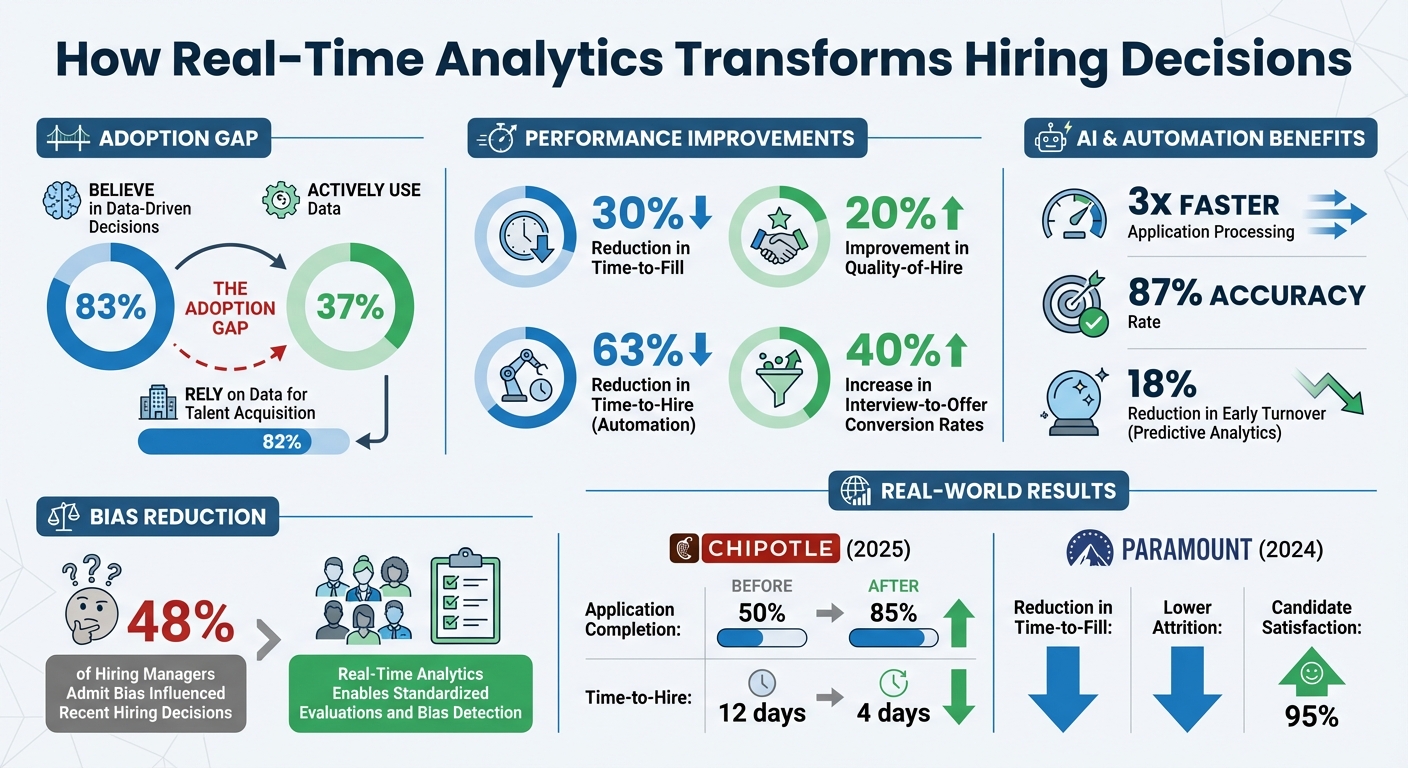
Real-Time Analytics Impact on Hiring: Key Statistics and Benefits
What Real-Time Analytics Means for Recruitment
Defining Real-Time Analytics
Real-time analytics is all about continuously gathering and analyzing data from every step of the recruitment process. From sourcing candidates to conducting interviews and extending offers, this data is instantly available through centralized dashboards, making it easy to monitor progress at any moment.
For example, when a candidate finishes an assessment, their results are available right away. If a job posting isn’t attracting applicants or scheduling interviews is delayed, the issue can be identified and resolved within hours, not weeks. This approach shifts recruitment from being a reactive process to one that’s actively managed as it happens.
This marks a clear departure from traditional recruitment methods, which rely heavily on reviewing outcomes after the fact. Let’s take a closer look at how these two approaches differ.
Real-Time vs. Traditional Recruitment Analytics
Traditional recruitment analytics focuses on analyzing past performance, but real-time analytics takes it a step further by offering insights into what’s happening right now.
With real-time analytics, decisions are guided by live metrics rather than gut feelings. For instance, if a highly qualified candidate starts disengaging, you’ll know right away and can intervene before they accept another offer.
AI-powered tools make this process even faster and more efficient. Automation can cut time-to-hire by up to 63%, while real-time screening tools process applications three times faster than manual methods, all while maintaining an impressive 87% accuracy rate. This proactive approach helps recruiters tackle issues like slow pipelines, ineffective job ads, or delays in scheduling interviews before they become major problems.
sbb-itb-e5b9d13
Hiring Excellence Series: Modern Recruiting Metrics
Which Metrics to Track with Real-Time Analytics
Data plays a central role in hiring strategies, with 82% of companies relying on it to guide talent acquisition decisions. By tracking the right metrics in real time, HR teams can address issues early, focus on the best candidates, and shift from reactive hiring to more strategic approaches.
Metrics for Managing Your Candidate Pipeline
Application completion rate measures how many applicants finish the process. If fewer than half complete the application, it could mean the process is too lengthy or not mobile-friendly. This metric helps pinpoint hurdles that might deter qualified candidates before it’s too late.
Source effectiveness identifies which recruitment channels – like LinkedIn, job boards, or employee referrals – bring in the best hires. For example, leading companies often see over 40% of their hires come from employee referrals. Real-time tracking allows you to quickly reallocate resources to the most effective channels instead of waiting for post-cycle reviews.
Candidate pipeline conversion rates, or pass rates, measure how many candidates move from one stage to the next. Both excessively high and low pass rates can be problematic. For instance, if 92% of candidates pass a technical test, it might not be rigorous enough. On the flip side, a pass rate of just 10% could be too stringent, creating bottlenecks in your pipeline.
In addition to monitoring flow, focusing on time-based metrics can further streamline hiring processes.
Metrics for Reducing Time-to-Hire
Time-to-hire (from entering the pipeline to accepting an offer) and time-to-fill (from job requisition approval to offer acceptance) are critical for maintaining momentum and avoiding candidate drop-off.
Average number of days in stage highlights where candidates are getting stuck. For example, if candidates spend two weeks in the "awaiting interview" stage, that stage may be a bottleneck. As Melissa Suzuno from Greenhouse points out:
"Speed and timely communication are vital to getting offers signed in a candidate’s market, so it’s important to monitor coordinator speed through the pipeline in real time".
Interview feedback turnaround time measures how quickly interviewers provide evaluations. Delayed feedback can slow down the process, but automated reminders prompting responses within 24 hours can keep things moving efficiently.
Once flow and speed are optimized, real-time data can also help identify top candidates.
Using Live Data to Find Top Candidates
Interviewer calibration compares how different interviewers rate candidates. This can uncover inconsistencies, flag potential biases, or provide unique insights into the evaluation process.
Interview-to-offer ratio tracks how many interviews are needed to extend one offer. A high ratio might indicate unclear role requirements or inconsistent evaluation standards. For instance, if it takes 30 phone screens to make one hire, hiring five candidates could require 150 screens, equating to roughly 75 hours of interviewing.
Quality of hire measures the success of new hires based on their performance and retention. This metric helps identify which recruitment sources or candidate traits predict long-term success.
Skillfuel’s real-time analytics dashboard consolidates these metrics, enabling HR teams to make immediate, informed adjustments and maintain a proactive approach throughout the hiring process.
Finding and Fixing Hiring Bottlenecks in Real-Time
Identifying hiring slowdowns is just the beginning. With real-time analytics, HR teams can tackle issues as they arise, keeping the hiring process on track and avoiding costly delays.
Spotting Problems in the Candidate Journey
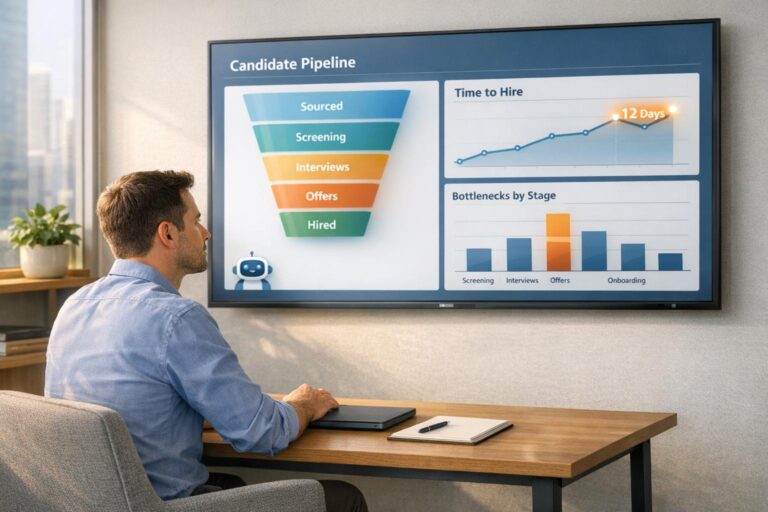
Pipeline reports offer a clear view of your recruiting funnel, showing where candidates move along smoothly and where they hit roadblocks. A key metric to watch is the average days in stage. If candidates are stuck in the "awaiting interview" phase for two weeks while other stages move faster, you’ve likely uncovered a bottleneck.
Take the example of Greenhouse Senior Recruiter Ariana Moon in February 2026. She used real-time data to discover that a take-home test stage had a pass rate of just 10%. This low rate caused a sharp drop in onsite interviews, raising red flags for the hiring manager. By reviewing the test parameters immediately, they determined it was overly strict and adjusted it to better align with their hiring goals.
Assessment tracking can reveal even more detailed issues. If candidates accept an assessment invite but don’t start the test, there could be broken links or unclear instructions. If they stall midway through, confusing wording or tight time limits might be to blame. These insights allow you to step in quickly, but spotting these issues is only useful if you act fast to resolve them.
Taking Immediate Action to Fix Issues
Once a bottleneck is identified, real-time data enables swift adjustments. For instance, if a screening stage has a 92% pass rate, it may not be filtering out enough unqualified candidates – tighten the criteria immediately to avoid overloading your interview team. On the flip side, if an assessment stage has an unusually low pass rate, you might need to simplify the test or clarify instructions to retain strong candidates.
In early 2025, Chipotle faced the challenge of hiring 20,000 workers. By using an AI assistant and analyzing real-time interaction data, they identified drop-off points in the application process. With quick adjustments to candidate communication and process steps, they boosted application completion rates from 50% to 85% and cut their average time-to-hire from 12 days to just 4 days. Their ability to adapt in real-time made all the difference.
Tools like Skillfuel’s centralized dashboard make it easier to monitor progress and act quickly. If candidates are stalling at a specific stage, you can send automated reminders, adjust scheduling workflows, or reallocate resources – without waiting for end-of-cycle reports. These real-time tweaks keep your hiring process efficient and candidates moving forward.
Reducing Bias with Real-Time Analytics
Unconscious bias can disrupt fair hiring practices. Consider this: 48% of hiring managers admit that biases influenced at least one of their recent hiring decisions. Real-time analytics offers a way to combat this issue by replacing subjective judgments with objective, data-driven insights.
Spotting Bias Through Data Patterns
Real-time dashboards are invaluable for identifying patterns that might indicate bias. For instance, tracking selection-rate ratios across different candidate groups can quickly reveal disparities. If candidates with strong technical scores consistently receive low interview ratings, it might suggest that subjective factors like "culture fit" are being prioritized over measurable qualifications.
Another common issue is interviewer calibration drift – when some evaluators consistently rate candidates much higher or lower than their peers. Analytics tools can flag these discrepancies. As Talview explains, "When different interviewers use different criteria to assess candidates, you’re not comparing candidates at all – you’re comparing interviewer preferences". By identifying such outliers early, you can provide targeted coaching to correct these biases before they influence more hiring decisions.
Real-time tracking also sheds light on where qualified candidates may get stuck or drop out. For example, if certain groups take longer to progress from screening to interviews or face higher rejection rates at specific stages, you can pinpoint exactly where bias might be creeping in. This level of detail allows you to address the root causes rather than relying on guesswork.
However, identifying bias is just the first step. Ensuring consistent and fair evaluations is equally important.
Maintaining Consistent Candidate Evaluations
Standardized scorecards are a powerful tool for eliminating inconsistencies in candidate evaluations. Real-time analytics can support structured interview frameworks, where every candidate answers the same set of questions and is rated against clear, competency-based criteria. For example, instead of vague feedback like "good communicator", evaluators rate specific behaviors on a defined 1-to-5 scale.
AI-powered tools can further streamline this process. Resume parsing software categorizes candidates into "Strong Fit", "Partial Fit", or "Low Fit" based solely on their skills and experience. This objective screening removes the influence of subjective factors like gut instincts or keyword searches. Some platforms even enable blind hiring by automatically removing identifying details such as names, photos, and locations from resumes, ensuring that evaluations focus purely on qualifications.
Platforms like Skillfuel offer centralized dashboards that help maintain these standards across your hiring team. With live monitoring, you can identify when interviewers deviate from scoring rubrics and ensure that every candidate is treated equitably. Combining structured scorecards with real-time oversight not only reduces bias but also creates a transparent audit trail – critical if hiring decisions are ever called into question.
Measuring Hiring Success with Real-Time Analytics
Measuring hiring success goes beyond simply filling positions – it’s about understanding whether new hires contribute lasting value to the organization. Real-time analytics shifts the focus from short-term wins to long-term impact, offering businesses a chance to connect recruitment data with tangible outcomes.
Tracking Hire Quality Metrics
Quality of Hire (QoH) is one of the clearest indicators of hiring success, but it requires more than intuition. Instead, measurable factors like 6–12 month retention rates, time-to-productivity, and standardized manager assessments can help create a reliable composite hiring score. For instance, while a sales role might emphasize ramp time, a specialized engineering position might focus more on retention.
Many organizations use a composite hiring score to combine multiple data points into one actionable metric. A common formula might look like this:
(0.30 × ATS Score) + (0.25 × Interview Sentiment) + (0.20 × Skills Gap) + (0.15 × Cultural Fit Rating) + (0.10 × Candidate Experience Score).
This method reduces bias and creates a consistent benchmark for evaluating hires.
Consider this example: In October 2024, Paramount used real-time analytics and objective assessments to achieve remarkable results – cutting time-to-fill by 30%, lowering attrition by 56%, and reaching a 95% candidate satisfaction rate. These metrics highlight how tracking the right data can revolutionize hiring outcomes.
Real-time dashboards also play a key role in maintaining interviewer calibration, ensuring that interviewers apply consistent standards when evaluating candidates. Monitoring this in real time helps organizations maintain fairness and objectivity throughout the hiring process.
When these quality metrics are tied to long-term performance data, the benefits of real-time analytics become even more apparent.
Connecting Real-Time Data to Employee Performance
Taking things further, linking hiring data to post-hire performance creates a feedback loop that strengthens future decisions. Real-time analytics becomes especially valuable when candidate data – like interview scores and assessment results – is tied directly to metrics like productivity and tenure. This connection helps pinpoint the traits that predict success within your organization.
Predictive analytics adds another layer of insight by forecasting outcomes before making a hire. For example, companies using AI-powered tools report a 40% increase in interview-to-offer conversion rates. Similarly, predictive models for attrition have been shown to reduce early turnover by up to 18%. Ameya Deshmukh of EverWorker highlights the impact:
"Predictive analytics changes this by quantifying what drives success in your context… and by bringing those signals into the moment of decision."
Tracking the ROI of recruitment channels is another crucial aspect. Real-time data can reveal which sources – like job boards, referrals, or social media – consistently deliver high-performing employees. This allows businesses to focus their budgets on channels that provide quality rather than just volume. In fact, companies that use recruitment analytics report a 20% improvement in quality-of-hire.
Integrated platforms, such as Skillfuel, simplify this process by combining applicant tracking, real-time dashboards, and data-driven insights into one seamless solution. This kind of integration turns recruitment into a strategic, data-informed process that drives continuous improvement.
How to Implement Real-Time Analytics in Your Hiring Process
Shifting to real-time analytics requires the right tools, proper training, and consistent feedback loops. These steps build on the metrics and insights already discussed, ensuring your recruitment process becomes both adaptable and data-driven. Although many HR professionals see the potential of data-informed decisions, the real hurdle lies in implementation.
Selecting Real-Time Analytics Tools
The first step is choosing a platform that meets your needs. Prioritize tools with centralized dashboards to unify all recruiting workflows – from sourcing to offer acceptance. Automation is another key feature: AI-powered screening can process applications three times faster than manual reviews while maintaining 87% accuracy.
Your chosen tool should integrate seamlessly with your current systems. Smooth data flow between your applicant tracking system (ATS), HRIS, and other platforms is critical to avoid creating silos. Customization is also important – recruiters may focus on metrics like pipeline velocity, while executives often want insights into how hiring impacts overall business goals.
For example, Skillfuel (https://skillfuel.com) offers a web-based recruitment management platform that combines applicant tracking, centralized dashboards, and automated workflows. Features like customizable career pages and real-time calendar syncing ensure consistent, reliable data for analytics.
Training Your HR Team to Use Data
Transitioning to data-driven hiring requires comprehensive training, especially for teams accustomed to making decisions based on intuition. Start by ensuring your team is comfortable navigating dashboards and interpreting analytics. Training should also address change management to ease resistance to new processes.
Focus on practical, hands-on learning. Teach your team how to identify pipeline bottlenecks, interpret metrics that signal quality candidates, and adjust sourcing strategies based on live data. This kind of experience is crucial for turning raw insights into faster, smarter decisions.
Creating Feedback Loops for Ongoing Improvement
Real-time analytics thrive on continuous refinement. Use live data to identify high-performing sourcing channels and reallocate resources as needed. Monitor metrics like application completion rates and response times to fine-tune the candidate experience.
Set up regular review sessions where your team evaluates real-time metrics alongside hiring outcomes. These feedback loops allow you to refine your recruitment strategies based on insights like source ROI and retention trends. The ultimate goal is to shift from reactive hiring to a proactive approach – where each data point improves the next decision, making your talent acquisition process more effective over time.
Conclusion
Real-time analytics transforms hiring from a reactive process into one driven by data and foresight. With live insights into pipeline velocity, sourcing ROI, and candidate quality, HR teams can make quicker decisions without compromising accuracy. This shift is crucial because, while many HR leaders understand the importance of data-informed hiring, only a few actively use it to address management challenges. Bridging this gap leads to fewer missed opportunities and better hiring outcomes.
The advantages go beyond just speed. Real-time analytics helps standardize evaluations, reducing bias and ensuring decisions are grounded in objective data. It also enables teams to identify bottlenecks – whether it’s a sluggish interview phase or an underperforming sourcing channel – so they can adapt strategies before losing high-quality candidates. These tools bring both efficiency and precision to every stage of the hiring process.
To fully realize these benefits, you need a system that consolidates all your hiring data. Skillfuel (https://skillfuel.com) offers centralized dashboards, automated workflows, and real-time calendar syncing to ensure recruitment data stays accurate and actionable. With features like applicant tracking, customizable career pages, and GDPR compliance, Skillfuel provides the tools HR teams need to turn analytics into stronger hiring decisions.
The payoff is undeniable: companies leveraging analytics report shorter time-to-fill metrics and higher-quality hires. By identifying top talent quickly and backing decisions with data, your team can build a workforce that drives long-term success.
FAQs
What data do I need to start real-time hiring analytics?
To kick off real-time hiring analytics, start by collecting essential recruitment metrics. These include application rates, time-to-hire, cost-per-hire, candidate source performance, and pipeline status. Don’t forget to tap into your Applicant Tracking System (ATS) for data like resume reviews, interview scheduling, and offer approvals – these insights are crucial for understanding the full picture.
By consolidating this information into real-time dashboards, HR teams can quickly spot bottlenecks, make data-driven decisions, and streamline hiring processes with greater precision.
How do you detect bias in hiring with real-time analytics?
Real-time analytics plays a key role in identifying and addressing hiring bias by uncovering patterns of unfair practices through data analysis. By using tools like centralized dashboards and bias detection algorithms, companies can monitor critical metrics such as diversity ratios and conversion rates, helping to pinpoint disparities in the hiring process. Features such as blind resume screening and objective scoring systems ensure that evaluations are grounded in measurable, impartial criteria. Additionally, real-time feedback allows for immediate adjustments, helping to mitigate unconscious bias and create a fairer, more equitable hiring process.
How can Skillfuel’s dashboards reduce time-to-hire?
Skillfuel’s dashboards provide real-time, visual insights into recruitment metrics, making it easier for HR teams to improve their hiring process. These tools help identify bottlenecks, monitor candidate progress, and enable quicker, data-driven decisions. By simplifying the hiring workflow, HR teams can spend more time focusing on finding the best candidates.