
Employee referral programs save time, cut costs, and improve retention – but how do you measure their success? Calculating ROI is simple: compare the savings from referrals (like reduced hiring costs and faster time-to-fill) against the program’s expenses (bonuses, software, and admin time). Here’s why referrals work:
- 82% of employers rank referrals as their most cost-effective hiring method.
- Referred hires save up to $7,500 per candidate on recruitment costs.
- They are hired 55% faster and stay longer, with 46% retention after one year compared to 33% for career site hires.
ROI Formula
ROI = (Total Savings – Total Costs) / Total Costs × 100
For example, if referrals save $15,000 but cost $5,000, the ROI is 200% – you earn $2 for every $1 spent.
To maximize ROI:
- Offer staged or tiered bonuses to encourage quality referrals.
- Use software like Skillfuel to automate tracking and save admin time.
- Track metrics like retention, time-to-fill, and savings to refine your program.
Referrals account for just 6% of applications but deliver 37% of hires. With the right strategy, they’re a measurable hiring advantage.
The Power of an Employee Referral Program | AIHR Learning Bite
Costs of Employee Referral Programs
Before determining the ROI of an employee referral program, it’s crucial to break down the associated costs. These typically fall into three main categories: payouts for referrals, investments in technology, and administrative overhead. Each contributes to the overall budget in unique ways.
Referral Bonuses
Referral bonuses are often the most noticeable expense. On average, payouts range from $1,000 to $3,000 for each successful hire, but for specialized or executive roles, these bonuses can climb to $5,000 or even $10,000+. To encourage retention, many companies opt for staged payouts, which have been shown to reduce first-year attrition by up to 26%.
To ensure you’re incentivizing quality hires, it’s a good idea to release the full bonus only after the referred candidate has completed onboarding and passed their probationary period.
Next, let’s look at the tools that make referral tracking more efficient.
Software and Tracking Tools
Tracking referrals manually – using emails or spreadsheets – can lead to inefficiencies and missed opportunities. Digital platforms like Skillfuel streamline the process by automating resume collection, providing real-time updates, and notifying recruiters. This automation can reduce the time spent on administrative tasks by up to 50%.
"A manual referral tracking system usually involves HR emailing employees, collecting resumes, and then manually cross-referencing applicant data with current openings. This approach wastes valuable time." – Skillfuel
Skillfuel offers both free and paid versions, with scalable plans to suit different organizational needs. Industry-wide, software costs vary significantly. Entry-level platforms might start at $179 per month, while more advanced enterprise solutions can cost several thousand dollars each month.
However, technology is only part of the equation. Administrative tasks also carry hidden costs.
Administrative Time and Training
The administrative side of managing a referral program can be deceptively time-consuming. When handled manually, these tasks – like emailing employees about openings, managing inquiries, cross-referencing candidate data, and processing bonus payouts – can take up 30% of an HR employee’s time.
There’s also the cost of training employees on program rules and encouraging active participation. These promotional efforts add another layer to your total investment.
Benefits of Employee Referral Programs
Employee referral programs can deliver impressive savings, faster hiring processes, and better retention rates, making them a smart choice for businesses looking to optimize recruitment.
Reduced Cost-per-Hire
Referrals are a budget-friendly alternative to traditional hiring methods. On average, hiring through referrals can save up to $7,500 per candidate by avoiding hefty agency fees, which typically range from 15% to 25% of a new hire’s first-year salary. For a $60,000 position, this translates to savings of $9,000–$15,000 compared to agency fees. In contrast, offering a referral bonus of $2,000–$3,000 is far more economical.
The hiring process itself becomes more efficient as well. Referred candidates are 7 times more likely to be hired than those from traditional channels. This reduces the time spent screening unqualified applicants and eliminates the need for costly job board postings or external marketing efforts.
Here’s a quick comparison of key hiring metrics across different channels:
| Metric | Job Board | Recruitment Agency | Employee Referral |
|---|---|---|---|
| Avg. Cost-per-Hire | $8,000 | $12,000 | $5,000 |
| Avg. Time-to-Hire | 45–55 days | 38 days | 28–29 days |
| 1-Year Retention Rate | 22–70% | 65% | 46–85% |
| Hiring Likelihood | Baseline | High | 4x–7x Higher |
Referral programs offer an impressive return on investment, delivering around $28 for every $1 spent on bonuses. They also contribute to a 15% reduction in overall employee turnover, as employees feel more engaged in the hiring process.
Faster Time-to-Fill
Speed is critical in recruitment. Every day a role remains unfilled represents lost productivity and revenue. Referrals streamline the hiring process by eliminating some of the most time-consuming steps, like posting ads, waiting for applications, and sifting through countless resumes.
Referred candidates are hired 30% to 55% faster than those sourced through career sites. For example, filling a sales role 15 days earlier could save $7,500 in lost revenue if the position generates $500 per day.
Why are referrals so much quicker? Employees who refer candidates typically recommend people they know are a good match for the role and the company. These candidates are pre-vetted, which means fewer interviews and quicker decisions. Plus, they’re more likely to accept offers because they trust the recommendation of their referrer. This efficiency not only speeds up hiring but also lays the groundwork for better retention.
Improved Retention Rates
Retention is where employee referrals truly excel. Referred employees often stay longer, benefiting both individual teams and the broader organization.
A European grocery chain found that stores with referral programs reduced attrition by 15% between 2019 and 2022. Interestingly, even non-referred employees stayed longer, likely because they appreciated being part of the hiring process.
This retention advantage comes from a stronger cultural fit. Referrers offer candidates a realistic view of the job and work environment, while also giving hiring teams insights into the candidate’s work ethic. Additionally, referred hires often start with built-in social connections, which boosts engagement from day one.
The financial impact is notable too. Referred employees generate 25% more profit for their companies compared to those hired through other methods. For instance, a Swiss services company switched to a tiered referral bonus model – $1,000 at hire and another $1,000 after six months – and saw early attrition drop by one-third over a year.
How to Calculate ROI: Step-by-Step
How to Calculate Employee Referral ROI in 3 Steps
Measuring the ROI of your referral program is simpler than it might seem. With the right formula and accurate data, you can assess whether your program is delivering measurable returns.
The ROI Formula
The formula to calculate ROI is straightforward:
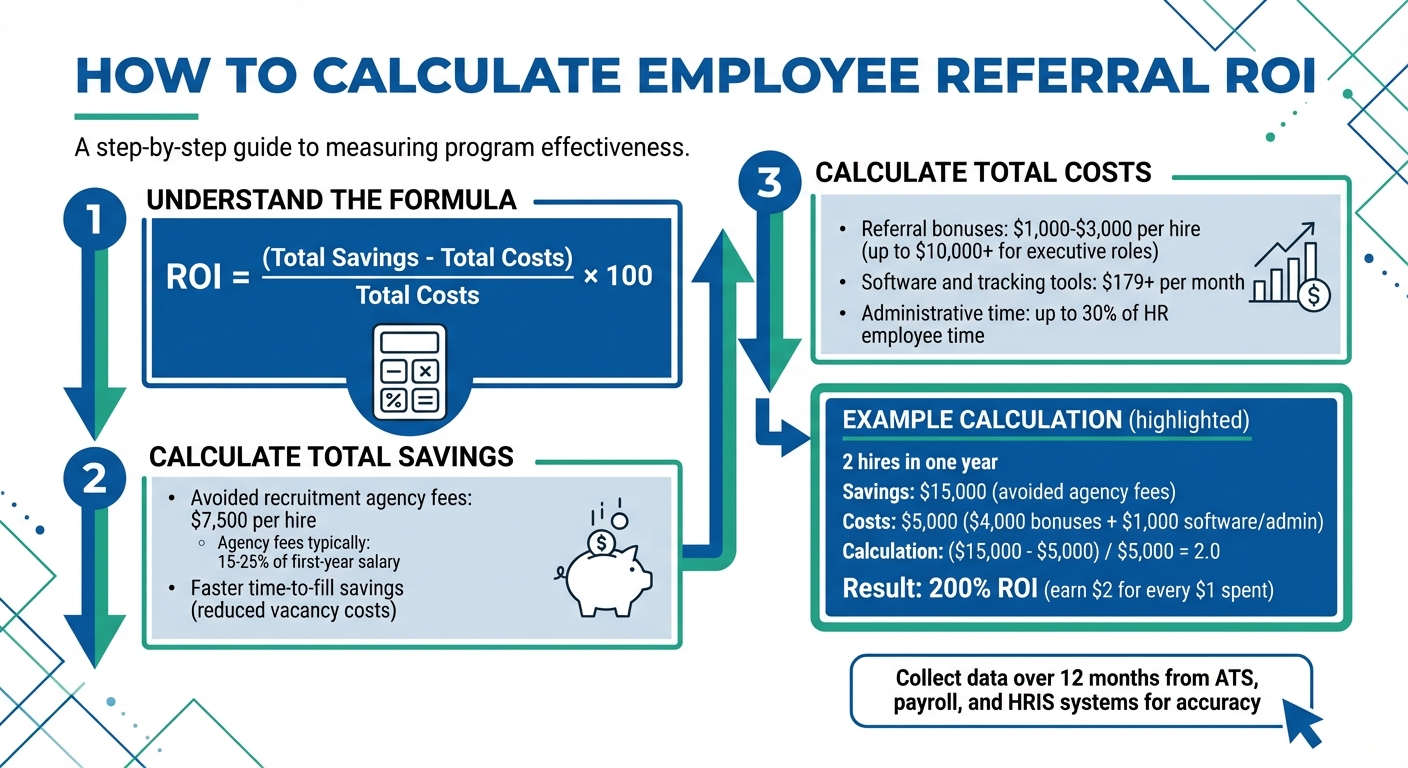
ROI = (Total Referral Savings – Total Referral Costs) / Total Referral Costs × 100
- Total Referral Savings: This includes the costs avoided by not using agencies or job boards – typically 15% to 25% of a new hire’s first-year salary. It also factors in savings from faster hiring, which reduces vacancy costs.
- Total Referral Costs: This covers all expenses, such as referral bonuses, software subscriptions, administrative time, and promotional efforts.
Collecting Data for Accurate Calculations
To ensure accuracy, gather data over a 12-month period. Pull information from systems like your ATS, payroll software, and HRIS. Establish baseline metrics for non-referral hires to compare against. Be thorough in tracking both direct costs, such as bonuses, and fixed costs, like software fees. Every relevant expense should be included.
Once you’ve collected your data, you can plug it into the formula to calculate ROI.
Example Calculation in USD
Let’s say your referral program resulted in two hires over the course of a year. By avoiding recruitment agency fees – estimated at $7,500 per hire – you saved $15,000 in total. If your program expenses included $4,000 in referral bonuses and $1,000 for software and administrative time, your total costs would be $5,000.
Here’s how the formula works:
($15,000 – $5,000) / $5,000 = 2.0, or 200% ROI.
This means that for every dollar spent on your referral program, you earned two dollars in return. A Swiss services company in 2024 saw similar results by adopting a staged bonus model, offering $1,000 at hire and another $1,000 after six months.
sbb-itb-e5b9d13
Additional Metrics to Measure Referral ROI
While the basic ROI formula offers a starting point, digging deeper into additional metrics helps uncover the broader impact of your referral program. These metrics go beyond profitability to highlight long-term value and operational efficiency. Let’s explore key areas like retention rates, break-even analysis, and tracking automation.
First-Year Retention Rate Analysis
Retention rates reveal whether referred employees are truly a good fit and staying with your company. Research shows that referred hires have an 85% retention rate after 12 months, compared to 70% for job board hires and 65% for agency hires. To evaluate this, track how many referred employees remain after six months and one year, then compare those figures against non-referral hires for the same timeframe.
If retention rates for referrals are no better than other hires, it might suggest issues with the quality of referrals or mismatches in fit. As Dr. John Sullivan, a well-known HR expert, explains:
"The primary reason for using referrals is because they produce better performers (quality of hire)".
To calculate retention, use this formula:
(Referred employees retained after 12 months / Total referred hires) × 100.
Higher retention rates indicate that your referral program isn’t just about quick hires – it’s building a stronger, more stable workforce.
Break-Even Point for Program Costs
Understanding when your referral program starts to pay off is crucial. The break-even point shows how many hires it takes to recover your program’s costs. Use this formula:
Program Cost / (Baseline Cost-per-Hire – Referral Bonus – Admin Cost per Hire) = Number of hires needed to break even.
For instance, if your program costs $10,000 annually (including software, bonuses, and admin expenses), and your typical agency hire costs $12,000 while a referral hire costs $5,000, the break-even point would be:
$10,000 / ($12,000 – $5,000) = 1.4 hires.
This means your program starts saving money after just two referral hires.
Additionally, referrals can reduce vacancy costs since they fill roles 30%–55% faster. For example, if a vacant sales position costs $500 per day in lost revenue and referrals fill the role 15 days faster, that’s an extra $7,500 saved. These savings, combined with faster hiring times, highlight the efficiency of a well-run referral program.
Using Skillfuel for Tracking and Automation
Manually tracking referral data can consume as much as 30% of a recruiter’s time. That’s where platforms like Skillfuel come in. Skillfuel automates referral tracking, offering real-time performance insights and eliminating the errors often tied to spreadsheets.
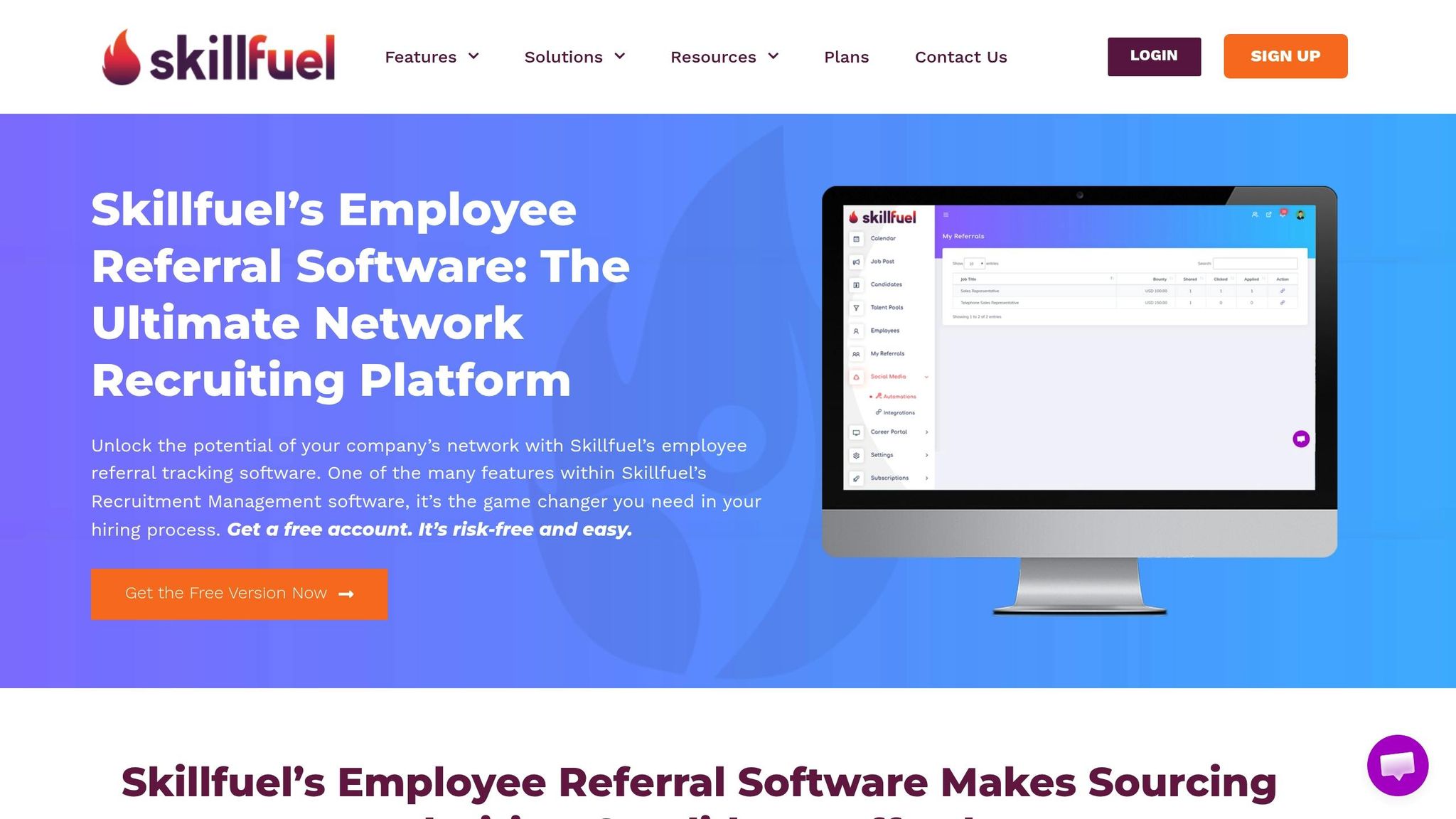
The platform provides a centralized dashboard that calculates key metrics like referral-to-hire rates, time-to-fill comparisons, and retention rates. It also tracks which employees are submitting referrals, monitors candidate progress, and measures participation rates across departments. This automation ensures accurate, up-to-date data for decision-making.
Skillfuel integrates seamlessly with ATS and HRIS systems, automating ROI calculations. Features like real-time calendar syncing and automated candidate communication speed up hiring, further boosting your program’s efficiency by reducing time-to-fill.
With tools like Skillfuel, you can streamline processes, save time, and maximize the long-term impact of your referral program.
How to Improve Employee Referral ROI
Maximizing the return on investment (ROI) from employee referral programs involves more than just implementing a system – it requires fine-tuning to encourage participation, streamline processes, and improve hiring outcomes. Even well-established programs can benefit from some thoughtful adjustments.
Incentivize Participation
Incentives are a key driver of engagement. While most companies (69%) offer cash bonuses between $1,000 and $5,000, you can diversify your approach by incorporating options like public recognition, additional paid time off, or unique experiences.
Another effective strategy is to align incentives with retention. For example, staged payouts – splitting the bonus into two parts, such as 50% at hire and 50% after the probation period – can reduce first-year turnover by up to 26%. Alternatively, tiered bonuses that increase with the number of successful referrals can motivate employees to stay actively involved.
Simplicity is equally important. As Kara Yarnot, President of Meritage Talent Solutions, explains:
"It allows you to turn your entire workforce into recruiters. When you only have so many recruiters and so many resources… it helps to have a great referral program to empower all of your employees."
Make the process as easy as possible – for instance, allow employees to submit referrals in under two minutes by only requiring basic details like a name and contact information. The easier it is, the more likely employees are to participate. Pairing these streamlined incentives with modern tools can further enhance efficiency.
Use Technology for Efficiency
Managing referrals manually can quickly become overwhelming. Automating the process not only saves time but also improves communication. With the right tools, administrative tasks can be cut down significantly – freeing up to 50% of the hours typically spent on spreadsheets and reporting.
Platforms like Skillfuel, for example, use unique referral links to track candidates automatically from submission to hire. Real-time updates keep employees engaged. Automated notifications – such as "interview scheduled" or "offer extended" – help maintain enthusiasm and encourage future participation. As Kara Yarnot warns:
"Failing to promptly contact referred candidates undermines the program’s success."
Mobile-friendly submission options and tools like calendar syncing make the referral process seamless, transforming what could be a time-consuming task into an efficient hiring engine.
Set Clear Expectations
Even with strong incentives and efficient tools, a lack of clarity can hinder participation. In fact, 63% of employees say they need clear rules to feel comfortable participating, and 59% would refer more candidates if the process was simpler and more transparent.
Start by clearly defining what makes an ideal candidate. Go beyond the job description to outline the values, skills, and work ethic your company prioritizes.
Additionally, set clear rules about eligibility. For instance, you might prohibit managers from referring their direct reports to avoid conflicts of interest. Establish guidelines for how long referrals remain valid – such as six months – and be upfront about payout timelines and tax implications (referral bonuses in the U.S. are typically taxed as regular income).
Consistent communication is also critical. Use multiple channels like email, Slack, WhatsApp, or even physical posters for non-desk workers. Weekly updates highlighting priority roles can keep the program top of mind and ensure employees know which positions are incentivized. When everyone understands the rules and knows where to focus, the program runs more smoothly and delivers better results.
| Payout Model | Timing | Best For |
|---|---|---|
| Flat Bonus | Paid in full upon hire | Simple, high-volume roles |
| Tiered Bonus | Increases with referral volume | Motivating top referrers |
| Staged Payout | Split (e.g., hire + 6 months) | Maximizing long-term retention |
Conclusion
Measuring the ROI of your employee referral program turns referrals into a powerful driver of growth. With 82% of employers identifying referrals as their most effective ROI source, tracking the right metrics ensures leadership support and strengthens your hiring strategy.
Referred candidates often outperform others when it comes to hiring speed, retention, and overall profitability. These advantages depend on monitoring key metrics like cost-per-hire, time-to-fill, retention rates, and break-even points accurately.
To maximize these benefits, consider automating your referral tracking process. Relying on spreadsheets can lead to errors, hidden costs, and missed opportunities. Tools like Skillfuel simplify referral tracking by offering real-time analytics and seamless system integration. This can free up as much as 50% of administrative time, ensuring every hire is properly tracked and every dollar spent is accounted for.
FAQs
How can we improve the quality of referrals to boost ROI?
To get the most out of employee referrals, it’s crucial to emphasize quality over quantity when it comes to candidates. Start by defining what makes a referral strong – think about factors like relevant skills, experience, and alignment with your company’s values. Make sure employees understand these criteria so they know exactly what you’re looking for.
Motivate employees to make thoughtful recommendations by offering incentives for referrals they truly believe are a great match. Tools like Skillfuel’s employee referral software can make this process easier by automating tracking, simplifying engagement, and offering clear visibility into the program. This kind of transparency often encourages employees to focus on referring top-notch candidates.
Keep an eye on metrics like the performance and retention rates of referred hires to measure how well the program is working. Use this data to tweak your approach and fine-tune incentives, ensuring your strategy evolves to consistently deliver better-quality referrals and a stronger return on investment.
What are the hidden costs of an employee referral program?
Employee referral programs might seem straightforward, but they come with several hidden costs that can impact their overall return on investment (ROI). For starters, there’s the cost of developing and maintaining the program. This includes setting up the necessary infrastructure and ensuring everything runs smoothly over time.
Then there are marketing efforts. Promoting the program internally to get employees engaged often requires resources, whether that’s through emails, events, or other internal campaigns. And don’t forget the referral bonuses – those rewards paid to employees when their referrals are successfully hired can add up quickly.
On top of that, you’ll likely need to invest in recruitment software or platforms to manage and track referrals effectively. Administrative tasks, like ensuring compliance, preventing system misuse, and continuously improving the program through testing, also contribute to the overall expense.
Understanding these less obvious costs is crucial. It allows you to assess the true ROI of your referral program and make sure it continues to be a valuable part of your hiring strategy.
How can Skillfuel make employee referral programs more efficient?
Skillfuel makes employee referral programs run smoother by automating essential processes and bringing everything into one place. It takes care of referral tracking, cuts down on manual work, and minimizes errors or outdated information. This frees up recruiters to spend more time connecting with great candidates instead of getting bogged down in admin tasks.
The platform also boosts employee involvement by including features like incentive management and clear updates about rewards. With real-time data insights and a centralized dashboard, tracking performance, adjusting strategies, and showing ROI becomes straightforward. Skillfuel helps referral programs work faster, scale easily, and deliver better hiring results.